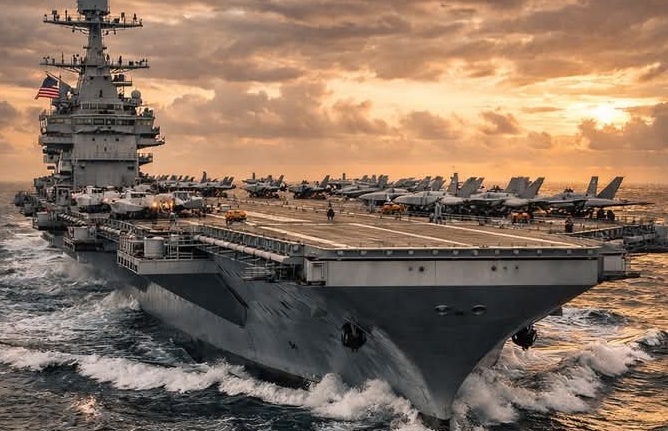
Iran Warns U.S.: “Strike Us If You Dare” — Tehran Signals Regional War If Attacked

Tensions between the Iran and the United States have sharply escalated, with Tehran issuing one of its bluntest warnings yet: any American strike would ignite a conflict far beyond Iran’s borders.

Iranian officials say a U.S. military attack would not remain limited or surgical, but would instead trigger a chain reaction across West Asia, threatening American bases, regional allies, and global energy markets.

Ebrahim Rezaei, spokesperson for Iran’s parliamentary National Security and Foreign Policy Committee, described anticipated talks with Washington as a “test” for former U.S. President Donald Trump. In a post on X, he warned the outcome would determine “whether American soldiers go to hell or return to America,” underscoring Tehran’s increasingly confrontational tone.
A Calculated War of Words
Iran’s leadership appears to be raising the perceived cost of any military move before it happens.
Supreme Leader Ali Khamenei warned that a new conflict would not be contained. “If they start a war this time, it would be a regional war,” he said — a signal that retaliation would extend to U.S. interests and allied infrastructure across the Middle East.
Tehran has reinforced that posture institutionally by forming a new Defense Council reportedly led by veteran security figure Ali Shamkhani, a move analysts interpret as preparation for potential high-intensity confrontation rather than routine political crisis management.
The Strait of Hormuz Factor
One of Iran’s most potent leverage points remains the Strait of Hormuz — a narrow maritime corridor through which roughly one-fifth of global oil supply passes.
During recent military exercises, Iranian forces reportedly showcased capabilities aimed at disrupting traffic through the strait. Even temporary interference could cause immediate spikes in oil prices and destabilize global supply chains.
The implicit message: war with Iran would carry worldwide economic consequences.
U.S. Installations in the Crosshairs
Iranian-linked media have issued indirect warnings to regional states hosting American military infrastructure. Potential flashpoints include:
Al-Udeid Air Base in Qatar
United States Fifth Fleet headquarters in Bahrain
U.S. facilities in Iraq and Syria
Tehran has also warned that any strikes coordinated with Israel would expand the scope of retaliation.
Is War Trump’s Strategy?
While Trump is known for hardline rhetoric, analysts note a pattern in his foreign policy approach: escalate verbally, project unpredictability, then calculate costs carefully.
Past U.S. engagements — from Venezuela to Yemen — reflected a preference for indirect pressure and economic leverage rather than prolonged direct military entanglement. In Iran’s case, the risks would be significantly higher:
Retaliation against U.S. forces
Threats to Israel
Energy market shock
Domestic political fallout from casualties
Potential open-ended regional war
The strategic debate in Washington is not about capability — the U.S. retains overwhelming strike capacity — but whether military action would deliver durable results without triggering uncontrollable escalation.
A Duel Over Risk
At its core, the standoff is about cost and deterrence.
Washington seeks to pressure Tehran without crossing into full-scale war. Tehran aims to convince Washington that once conflict begins, escalation cannot be contained.
The United States projects power through regional bases, fleets, and alliances. Iran sits at the geographic center of that network — with proximity to shipping lanes, energy corridors, and U.S. installations.
The upcoming diplomatic engagement may determine whether brinkmanship gives way to restraint — or whether a miscalculation could ignite what both sides publicly claim they want to avoid.
Because if the first strike happens, the consequences may not be limited — they may reshape the entire region.