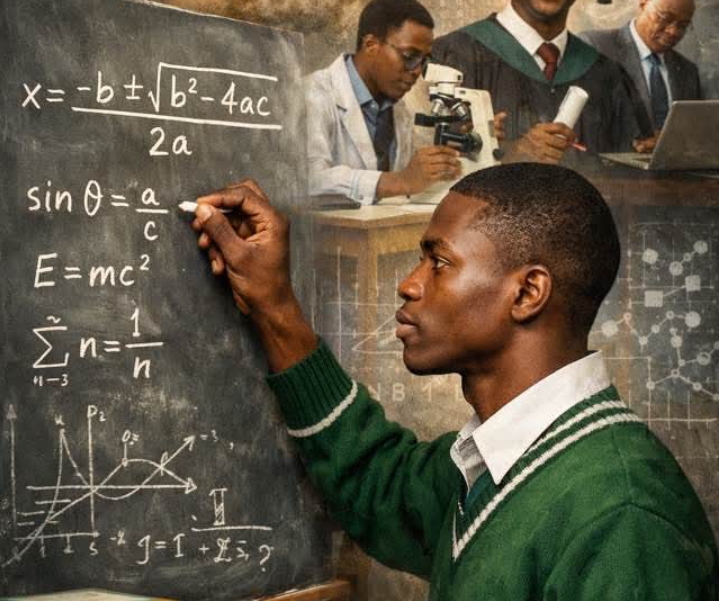
Nigerians Aren’t Just “Good at Mathematics” — Here’s What’s Really Happening

For years, I have heard the same question posed in various ways: What are Nigerians truly skilled at academically? My answer has always been instinctive—mathematics, not because of statistics or reports, but because of lived experience, observation, and the undeniable presence of Nigerians in some of the most intellectually demanding fields in the world.

But instinct alone is not enough. Let’s examine this properly.

A Nation Trained to Think in Numbers
In Nigeria, mathematics is not optional. It is compulsory, central, and unforgiving.
From an early age, students are drilled in:
• Arithmetic
• Algebra
• Logical problem-solving
You cannot progress academically without passing mathematics. You cannot enter university without it. You cannot avoid it. That pressure—constant and relentless—creates something powerful: mental discipline.
This is not a system that allows intellectual laziness. It forces engagement with numbers whether you like it or not.
Excellence at the Top, Not Always Across the Board
Here is where the reality becomes more complex.
Nigeria does not produce universal excellence in mathematics across its entire population. The system is uneven. Infrastructure is inconsistent. Teaching quality varies widely.
And yet—
At the top end, Nigerians consistently rise:
• Engineers in the United States and the United Kingdom
• Doctors and surgeons across Europe and North America
• Financial analysts, coders, and quantitative experts globally
This is not accidental. It is the result of a system that, despite its flaws, sharpens those who survive it.
Beyond Mathematics: A Broader Intellectual Strength
To say Nigerians excel only in mathematics is too narrow.
What we actually see is strength across STEM disciplines:
• Physics
• Chemistry
• Medicine
• Engineering
• Technology
Mathematics is simply the foundation—the language through which these fields operate.
And increasingly, Nigerians are dominating in:
• Software development
• Artificial intelligence
• Data science
This is where the world is heading—and Nigerians are already there.
The Cultural Engine Behind the Success
This is not about genetics or mythology. It is about culture.
Nigeria places a unique weight on education:
• It is seen as a pathway out of hardship
• It is tied to family honour and expectation
• It is treated as a non-negotiable priority
Failure is not easily accepted. Effort is expected. Results are demanded.
That environment produces individuals who are:
• Resilient
• Competitive
• Numerically sharp
The Uncomfortable Truth
There is, however, a contradiction that cannot be ignored.
While Nigerians produce exceptional individuals, the broader education system struggles:
• Underfunded schools
• Overcrowded classrooms
• Limited resources
This creates a divide:
• Brilliance at the top
• Inconsistency at the base
It is a system that does not maximise its full potential—but still manages to produce world-class minds.
Conclusion
So yes—my instinct was not wrong.
Nigerians do excel in mathematics, but not in the simplistic way people imagine.
It is not uniform. It is not guaranteed. It is not systemic perfection.
It is something more interesting:
A high-pressure intellectual environment that produces individuals capable of competing—and often outperforming—on the global stage.
And when that potential is fully supported, the results are undeniable.
Kio Amachree