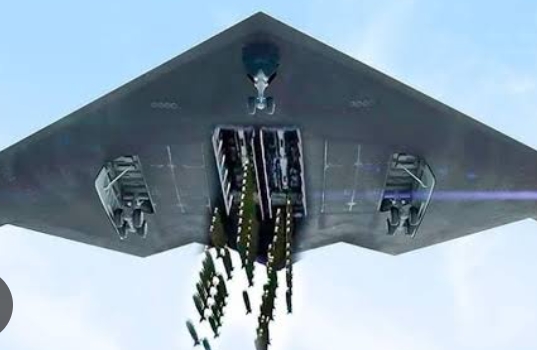
“How the B-2 Spirit Stealth Bomber Operated in Iran.”

Two people. That’s the crew of a B2 Spirit stealth bomber. One pilot, one mission commander, sitting side by side in a cockpit, narrower than most sedans, responsible for 172 ft of aircraft, 40,000 lbs of precision munitions, and a mission that will keep them airborne for more than 30 hours straight.

They will cross the Atlantic Ocean in the dark. They will refuel from a tanker without landing. They will enter airspace defended by surface-to-air missile systems designed to kill exactly what they’re flying. They will open their bomb bay doors for a fraction of a second, release weapons onto targets buried deep underground, close the doors, and turn for home.

Nobody on the ground will know they were there. Uh on the night of February 28th, 2026, that’s what happened. The United States launched Operation Epic Fury, one of the largest American air campaigns in over two decades. US Central Command confirmed that over a thousand targets were struck in the first 24 hours. Target categories included command and control centres, integrated air defence systems, ballistic missile sites, and military communications infrastructure.
Among the assets employed, B2 Spirit stealth bombers armed with 2,000lb bombs struck Iran’s hardened ballistic missile facilities. Here’s the thing about the B2 that almost nobody talks about. This aircraft was not designed for Iran. It wasn’t designed for Iraq or Afghanistan or Kosovo or Libya. All places it has flown combat missions.
It was designed in the early 1980s for a single purpose, to deliver nuclear weapons into the Soviet Union through the most dense integrated air defence network ever constructed. The Soviet Union collapsed in 1991. The threat, the B2 was defeated and ceased to exist before most of the fleet was even delivered.
The original plan called for 132 aircraft. Congress cut the buy to 21. At roughly $2 billion per airframe, research, development, and production combined, the B2 became the most expensive military aircraft ever built, and one of the smallest combat fleets in American history. Two have since been removed from service, one destroyed in a crash, one retired after fire damage.
19 remain, every single one based at Whiteitman Air Force Base in central Missouri. And here’s the irony that defines this aircraft’s entire story. 37 years after it was designed for a war that never happened, the B2 remains the only manned aircraft in the United States inventory that can penetrate modern air defences and deliver heavy penetrating munitions onto hardened underground targets.
When Operation Epic Fury required strikes on Iran’s buried ballistic missile facilities, there was no alternative. No other platform could do it. The machine they almost didn’t build enough of turned out to be the one thing that nothing else could replace. That’s not just an engineering story. That’s the thesis of this entire video.
To understand why the B2 was irreplaceable over Iran, you have to understand what makes it invisible. And invisible isn’t a figure of speech. It’s physics. Radar works by sending electromagnetic pulses and measuring what bounces back. A conventional fighter or bomber, vertical tail fins, an angular fuselage, and external weapons pylons is a collection of surfaces that reflect that energy straight back to the transmitter.
The B2 eliminates virtually every one of those reflective features. No vertical tail, no angular fuselage, no external weapons. The entire aircraft is one continuous curved wing shaped so that incoming radar energy deflects away rather than returning to the source. The US Air Force publicly states that low observability comes from composite materials special coatings and the flying wing design reducing radar infrared acoustic electromagnetic and visual signatures simultaneously.
Many specifics remain classified. What’s publicly known? The skin uses radar-absorbing materials that convert electromagnetic energy into negligible heat rather than reflecting it. These coatings are so precisely engineered that they must be applied by robotic systems during depot maintenance and so fragile that the aircraft requires climate-controlled hangars just to keep the surface intact between missions.
The engines are buried deep inside the wing. Exhaust routes over the top surface, mixing with ambient air before ground-based infrared sensors can detect the heat signature. The intake ducts are serpentine-shaped curves that prevent radar from reaching the spinning compressor blades. And every pound of the 40,000lb weapons payload rides inside two internal bays, sealed behind doors that expose the aircraft’s profile for a fraction of a second during release.
The aircraft carries a passive sensor suite, no transmission, just listening, that detects hostile radar emissions from hundreds of miles away and maps the gaps in enemy coverage in real time. The B2 doesn’t jam enemy radar. It routes around it. It flies through the seams in the defence network that the defenders don’t know exist.
To put this differently, a fifth-generation stealth fighter like the F-35 can also penetrate defended airspace, but it carries two 2,000lb bombs internally. One B2 carries 16, or two 30,000lb massive ordinance penetrators, the largest conventional bombs in the American inventory, designed to punch through 200 feet of earth and reinforced concrete.
No other operational platform can carry them. When the target is buried deep inside a mountain, the B2 isn’t the best option. It’s the only option. Much of the operational detail surrounding B2 missions in Epic Fury remains classified. What follows is reconstructed from confirmed sentcom statements, official Air Force doctrine, publicly documented precedent missions, and open source defence analysis.
Where specific details have not been officially confirmed, they are clearly noted. This is the part most coverage misses entirely. The stealth gets the headlines. But the human reality of putting this aircraft over a target 6,000 mi from home and bringing it back is the story that never gets told. The B2’s unrefueled range is approximately 6,000 nautical miles.