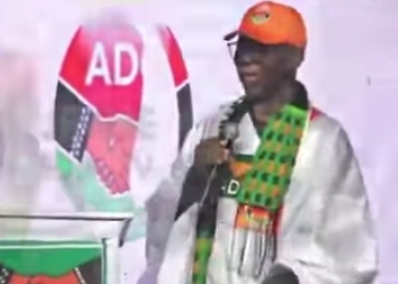
John Odigie-Oyegun mistakenly shouted APC instead of ADC at the ADC convention

At the convention of the African Democratic Congress (ADC), former Edo State governor John Odigie-Oyegun—who is historically associated with the All Progressives Congress (APC)—apparently slipped and mentioned “APC” instead of “ADC” while addressing the crowd.

Given his long-standing ties to APC (he was actually the party’s first national chairman), the mix-up wasn’t entirely surprising, but it still drew reactions.

Dino Melaye, known for his dramatic and outspoken style, seized the moment to mock the slip, jokingly telling Oyegun to “seek refuge from the devil.”
Moments like this tend to go viral because they highlight:
lingering political loyalties
the intensity of party switching in Nigerian politics
and, of course, the humor and theatrics figures like Dino Melaye bring to the scene.
Party switching in Nigeria is extremely common—and moments like John Odigie-Oyegun’s “APC instead of ADC” slip are almost a side-effect of that political culture rather than a rare blunder.
Why politicians switch parties so often
1) Weak party ideology
Most major parties—like the All Progressives Congress (APC) and the People’s Democratic Party (PDP)—don’t differ sharply on ideology. They’re broad coalitions rather than value-driven parties.
Result: politicians can move without having to “explain” a major shift in beliefs.
2) Power and access to resources
Politics in Nigeria is heavily tied to access to state power and patronage. Being in the ruling party often means:
better access to funding
influence over appointments
stronger electoral machinery
When power shifts, politicians follow. For example, after APC won the presidency in 2015, there was a wave of defections from PDP.
3) Ticket survival (internal party battles)
Primaries are often intense and sometimes controversial. If a politician loses a ticket—or fears losing—they may jump ship to another party where:
they can secure a nomination more easily
internal opposition is weaker
4) Godfatherism and political networks
Influential figures (so-called “godfathers”) can move entire blocs of politicians. When they switch parties, loyalists often follow.
5) Weak enforcement of anti-defection rules
Nigeria’s constitution discourages defections without “division” in a party—but in practice:
the rule is loosely enforced
courts often interpret “division” broadly
This makes switching relatively low-risk.
How common is party switching?
Very common—at all levels:
Governors, senators, and House members frequently defect mid-term
Entire factions sometimes move at once
Pre-election periods see the highest volume of defections
Some politicians have belonged to 3–5 parties over their careers.
Why slips like Oyegun’s happen
When someone like Oyegun—deeply tied to APC history—joins or appears at another party’s event, a few things are at play:
1) Habit and muscle memory
Years of repeating one party name in speeches makes it almost automatic.
2) Identity overlap
For many politicians, party identity is less personal than strategic—so the mental switch isn’t always immediate.
3) Recent or strategic alignment
If someone recently moved—or is politically aligned across camps—it increases the chance of confusion.
How common are these “slips”?
They’re not everyday occurrences, but they’re not rare either, especially in:
campaign seasons
coalition periods
events involving defectors or cross-party alliances
Most don’t go viral—but when they involve high-profile figures or outspoken reactions they quickly become political talking points.
Bottom line
Party switching in Nigeria is driven more by strategy than ideology, and verbal slips like this are a visible reminder of how fluid party loyalty can be. They’re less about “mistakes” and more about the reality of a system where political identity is constantly in motion.