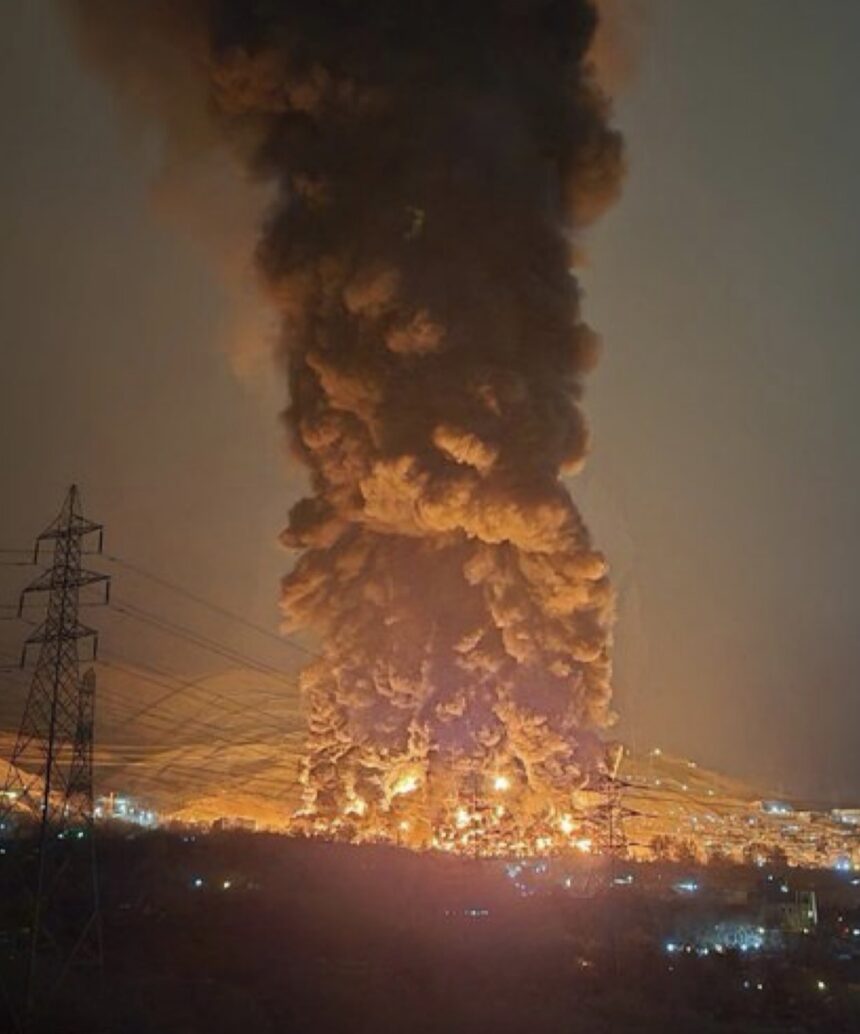
Israel–Iran War Escalates as 30 large oil storage tanks across Iran are bombed

President Trump has declared that the United States has successfully decimated the core of Iran’s military infrastructure in a series of overwhelming strikes. During his remarks, he specified that the Iranian Navy has been effectively neutralised, with all 44 of its primary ships reportedly at the bottom of the ocean.

The President also claimed that the Iranian Air Force has been entirely “wiped out,” asserting that every plane in their fleet has been eliminated. These military operations follow a week of intense conflict where the U.S. has targeted leadership, communications, and manufacturing areas.

Beyond the loss of hardware, the administration reports that two full sets of Iranian leadership have been neutralised, leaving the country down to its “third set” of commanders. U.S. officials state that missile manufacturing areas have also been hit “very hard,” reducing their current capacity to a fraction of its original strength.
Military analysts note that the U.S. and Israel now maintain “almost total control” over Iranian skies as the war enters its second week. The U.S. Treasury has signalled that further bombing campaigns will continue to target remaining missile launchers and factories.
President Trump has maintained an “unconditional surrender” stance, suggesting hostilities will only cease when Iran is no longer capable of resistance. He urged remaining military and police forces in Iran to lay down their arms to avoid certain death.
The conflict between Israel and Iran appears to have entered a dangerous new phase as reported strikes targeted parts of Iran’s oil infrastructure, raising fears of a wider economic and energy war across the Middle East.
The development signals a significant escalation, as the destruction of national energy infrastructure could have both military and economic consequences for the Islamic Republic.
Iran Accuses United States of Hitting Water Facility
Meanwhile, Iranian officials accused the United States of striking a desalination plant on Qeshm Island, a facility reportedly linked to the supply of potable water for local communities.
While the claim has not been independently verified, attacks on water and energy facilities would represent a dramatic widening of the war beyond conventional military targets.
Earlier in the conflict, smaller strikes were reported on refinery-related facilities, but analysts say attacks on large fuel reserves and critical civilian infrastructure would significantly raise the stakes.
Risk of Strait of Hormuz Crisis
Security experts warn that sustained attacks on Iran’s energy sector could provoke retaliation affecting global energy supply routes.
One potential flashpoint is the Strait of Hormuz, the narrow waterway through which a substantial portion of the world’s oil exports pass.
Iran has historically threatened to disrupt shipping in the Strait during periods of heightened confrontation. Any move to mine or block the channel would likely trigger a broader international crisis and send global oil prices surging.
Energy Infrastructure Now in the Crosshairs
Analysts say the latest developments suggest the conflict may be evolving into economic and energy warfare, with critical infrastructure increasingly becoming targets.
Possible retaliatory options discussed by security observers include attacks on energy shipments or infrastructure linked to Israel or its regional partners.
As the conflict enters its second week, the risk of a wider regional escalation continues to grow, with implications not only for the Middle East but also for global energy markets.