Former Head of State, Yakubu Gowon, has revealed that the military officer he personally entrusted with his protection, Joseph Garba, was among those who orchestrated the July 1975 coup that ended his administration.

The disclosure is contained in Gowon’s newly launched 859-page autobiography, My Life of Duty and Allegiance, where the former military leader offers an extensive personal account of the political developments and betrayals surrounding his removal from office.

According to Gowon, Garba, then Commander of the Federal Guards Unit, had denied involvement in any plot against the government and even swore before him that he knew nothing about plans to overthrow his administration.
The former Head of State described the development as the deepest personal betrayal of his public life, noting that those involved were individuals he had elevated and trusted deeply.
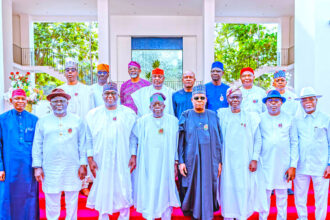
The book, unveiled at a ceremony in Abuja attended by President Bola Tinubu represented by Vice President Kashim Shettima, former President Goodluck Jonathan and other dignitaries, recounts how Gowon was warned ahead of the coup by his Chief Security Officer and Special Branch head, M.D. Yusuf.

According to Gowon, Yusuf informed him that some officers were planning a takeover ahead of the OAU summit in Kampala, Uganda, and specifically identified Garba and Anthony Ochefu as key figures.
The revelation placed him in what he described as an acute dilemma. As commander of the Federal Guards Unit, Garba occupied one of the most sensitive positions in the country’s security architecture and was responsible for the physical protection of the Head of State.
Gowon said his confidence in Garba was rooted not only in years of personal trust but also family and regional ties.
“As commander of the Federal Guards, which is the elite entrusted with the responsibility of protecting the person of the Head of State, Garba was supposed to have unquestionable loyalty,” he wrote.
“Not only did I intimately know both men, but I had also grown to like and trust them over the years.”
Rather than immediately acting on the intelligence report, Gowon said he confronted Garba directly. Looking back, he admitted the decision may have given the alleged conspirators enough time to move ahead with their plans.
He recalled that Garba strongly denied knowledge of any coup and “swore by heaven and earth” that he had no involvement.
As a precaution, Gowon said he instructed his Aide-de-Camp, Mr. Walbe, to return to Lagos to monitor the situation, but circumstances delayed his trip.
He further recounted that on July 29, 1975, while attending the OAU summit in Kampala, he was approached by Ugandan leader Idi Amin with a Reuters dispatch announcing that his government had been overthrown.
According to him, early reports mentioned a certain “Colonel Darwa,” a name he suspected was a mistaken reference to Garba, though he initially struggled to believe the man he trusted could be involved.
Despite later developments, Gowon wrote that he initially believed Garba might have been pressured or manipulated into participating in the coup.
The autobiography spans 36 chapters and chronicles Gowon’s journey from his roots in Plateau State through military service, the civil war years, post-war reconstruction efforts, exile in Britain and his eventual return to Nigeria.
The former military ruler governed Nigeria from July 1966 until his removal in July 1975.