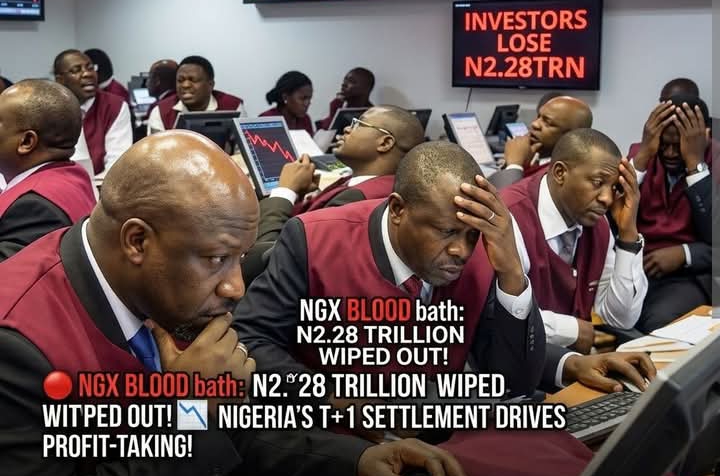
A one-day loss of N2.28 trillion in market capitalisation is substantial, yet the NGX All-Share Index declined by 1.44%, which is generally considered a market correction rather than a crash. Market crashes typically involve much steeper declines over a very short period, often accompanied by widespread panic selling.


Several factors appear to support the profit-taking narrative:

Investors are locking in gains after the strong rally recorded earlier in 2026.
The T+1 settlement cycle has increased market liquidity and transaction speed.
Institutional investors are actively rebalancing portfolios.
Some stocks had become significantly overvalued after months of sustained gains.
Perhaps the most important signal is that trading activity increased rather than collapsed. Higher volumes during a decline often indicate that buyers are stepping in to absorb shares being sold by profit-takers.
However, investors should be cautious about assuming every dip is a buying opportunity. Key questions include:
1. Are the affected companies still delivering strong earnings growth?
2. Are current valuations attractive relative to future prospects?
3. Is the broader economy supportive of continued corporate growth?
4. Are dividend yields sufficient to compensate for market volatility?
Stocks such as MTN Nigeria, GTCO, Zenith Bank and UBA remain among the market’s heavyweight counters, and many long-term investors will be watching closely to determine whether the pullback creates attractive entry points.
The old investment principle remains relevant: corrections can create opportunities, but only when supported by sound fundamentals. Investors who focus on earnings quality, cash flow, dividend sustainability, and valuation metrics are generally better positioned than those who react purely to market sentiment.
In short, Wednesday’s sell-off looks more like a broad-based profit-taking correction than a market crash. Whether it becomes a wealth-building opportunity will depend on the quality of the companies being bought and the investor’s time horizon.