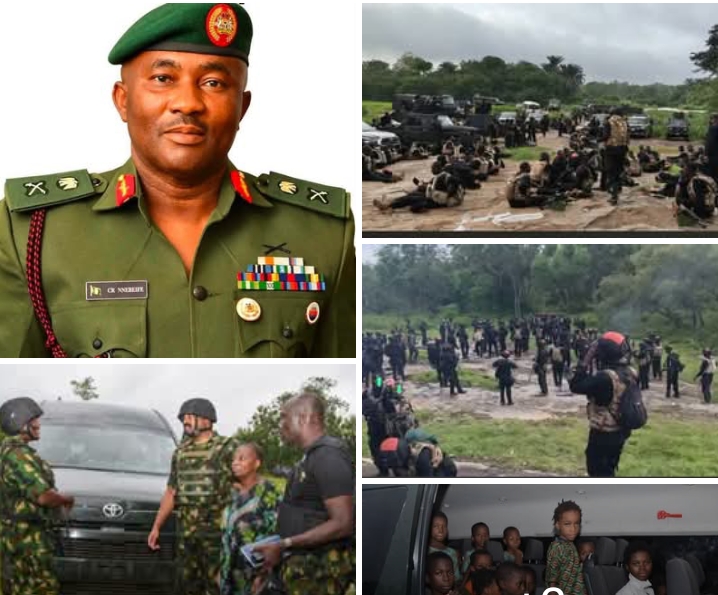
#OYORescue : The General Who Led the Operation

For 54 agonising days, the abduction of 44 pupils and teachers from Oriire Local Government Area of Oyo State remained one of Nigeria’s most closely monitored security operations.

While families pleaded for their loved ones’ return and public attention focused on the fate of the captives, a parallel battle was unfolding far from public view—an intelligence-driven, multi-agency operation involving Nigeria’s military, intelligence community and local security networks.

Multiple security sources familiar with the operation said the mission was deliberately kept out of public discourse to avoid compromising tactical plans or provoking the kidnappers into relocating or harming the hostages.
At the centre of the operation was Major General Chinedu Ralph Nnebeife, General Officer Commanding (GOC), 2 Division, Nigerian Army, Ibadan, who coordinated military operations across Oyo State while working with strategic national security institutions.
A Different Approach
Rather than relying on a large-scale military assault, commanders reportedly adopted a patient intelligence-led strategy.
According to security sources, surveillance teams spent weeks studying the terrorists’ movement patterns, supply routes, communications, possible escape corridors and changing hideouts within the forests surrounding the Old Oyo National Park.
The overriding objective, sources said, was to secure the release of every hostage alive while minimising casualties among both security personnel and civilians.
Building a Multi-Agency Intelligence Network
The operation brought together assets from the Office of the National Security Adviser (ONSA), particularly the National Counter Terrorism Centre (NCTC), Defence Headquarters, the Nigerian Army, Nigerian Navy, Nigerian Air Force, Nigeria Police Force, Department of State Services (DSS), National Intelligence Agency (NIA), Nigeria Security and Civil Defence Corps (NSCDC), Amotekun Corps, local vigilantes and experienced hunters familiar with the difficult terrain.
Security insiders said each organisation contributed specialised capabilities.
Military Special Forces reportedly carried out reconnaissance and operational planning; intelligence agencies analysed information gathered from multiple sources; police investigators supported intelligence development and coordination; while local hunters, vigilantes and Amotekun personnel provided invaluable knowledge of forest routes, abandoned settlements and likely movement corridors used by armed groups.
Air surveillance and aerial reconnaissance were also understood to have supported ground commanders in monitoring areas difficult to access by land, although operational details remain classified.
Why the Operation Took Weeks
Security officials said the kidnappers frequently changed locations, forcing commanders to adjust operational plans repeatedly.
Rather than rushing into an assault that could endanger the captives, security planners reportedly chose sustained surveillance, intelligence verification and carefully coordinated pressure designed to restrict the kidnappers’ freedom of movement.
The forests around the Old Oyo National Park have long posed operational challenges because of their vast size, thick vegetation and multiple access routes stretching across neighbouring communities.
According to security analysts, successful operations in such terrain require close coordination between conventional military units, intelligence services and locally based security volunteers.
The Final Phase
Sources indicated that after weeks of sustained intelligence gathering and coordinated pressure, security forces tightened their operational grip around the terrorists’ movement corridors.
The increasing difficulty faced by the abductors in relocating, obtaining supplies and maintaining safe hideouts is understood to have contributed to the eventual unconditional release of the victims.
Authorities have not publicly disclosed every tactical detail of the operation, citing ongoing security considerations.
Lessons from the Mission
Security experts say the operation underscores the growing emphasis on intelligence-led counter-terrorism rather than relying solely on conventional force.
It also demonstrates the increasing integration of military, intelligence and community-based security structures in responding to kidnapping and terrorism across Nigeria.
For many observers, the successful recovery of all 44 abducted pupils and teachers represents not only an operational achievement but also an illustration of the importance of inter-agency cooperation, disciplined intelligence gathering and sustained operational patience.
As commendations continue to pour in for the officers and personnel involved, tributes are also being paid to security operatives who have made the ultimate sacrifice in defending the nation.
Editor’s Note: Some operational details remain withheld for security reasons. Portions of this report are based on information attributed to security sources and have not been independently verified by NewsMediaNG. Official agencies have not released a comprehensive after-action account of the operation.