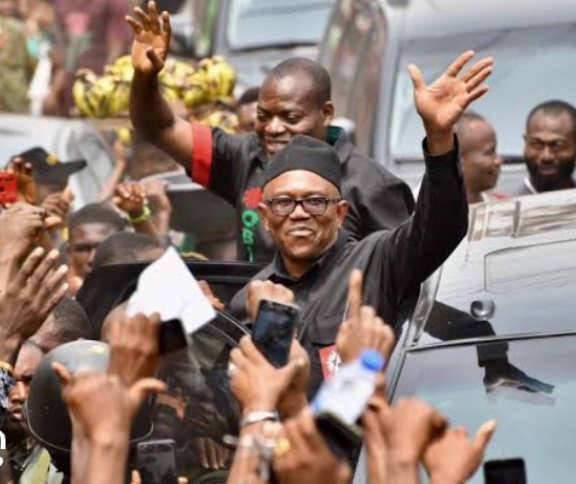
The presidential candidate of the Nigeria Democratic Congress (NDC), Peter Obi, has suggested that the 2027 general election could mark his final bid for Nigeria’s highest office, saying the country’s long-standing power rotation arrangement and his advancing age make a future presidential contest after 2027 increasingly unlikely.


Obi made the remarks during an interview with media personality Rufai Oseni while responding to questions about his political future beyond the next general election.

The former Anambra State governor said although politics remains dynamic, his decision to seek the presidency again after 2027 would largely depend on the outcome of the election and whether the presidency remains in the South or rotates to the North in line with Nigeria’s informal zoning arrangement.
“For me, it depends on what happens. I don’t want to say it because people might think that I’m saying it because of some people,” Obi said.
Recalling a conversation with a secondary school student who asked whether he would contest again if unsuccessful in 2027, Obi said he explained that his belief in the zoning principle makes another presidential bid in 2031 improbable.
“I said because if I don’t run now, by the next time it comes, believing in the zoning formula, it will go to the North.
“If it goes North in 2031, by the time it comes again to the South, I will be 78 years old, and I don’t think I would be doing this at that age,” he stated.
He, however, acknowledged that another presidential ambition could only be considered if the presidency remained in the South after 2027, but described such a scenario as unlikely.
“If it’s still in the South in the next election, maybe, but the probability is very slim. I don’t know until after the outcome of the 2027 election,” he added.
Political Implications
Obi’s comments come at a time when political alignments ahead of the 2027 general election are gathering momentum, with conversations around zoning, coalition-building and opposition unity dominating Nigeria’s political landscape.
Although zoning is not a constitutional requirement, the principle has, over the years, served as a political balancing mechanism among the country’s diverse ethnic and regional interests. Major political parties have often adopted the arrangement in selecting their presidential candidates to promote inclusiveness and national cohesion.
By publicly acknowledging the impact of zoning on his political calculations, Obi has reinforced the significance of the unwritten power-sharing convention in Nigeria’s electoral politics. His remarks are also likely to fuel fresh debate over whether competence or regional rotation should take precedence in choosing the country’s next leader.
Political observers say Obi’s statement may be interpreted as an attempt to reassure stakeholders that his ambition is not intended to disrupt the North-South balance, even as he remains focused on the 2027 presidential race.
Supporters have welcomed the remarks as evidence of his commitment to democratic conventions, while critics argue that electoral outcomes should be determined by the choice of voters rather than informal political arrangements.
With preparations for the 2027 elections expected to intensify in the coming months, Obi’s latest comments are likely to remain part of the broader national conversation on succession, zoning and the future direction of Nigeria’s democracy.