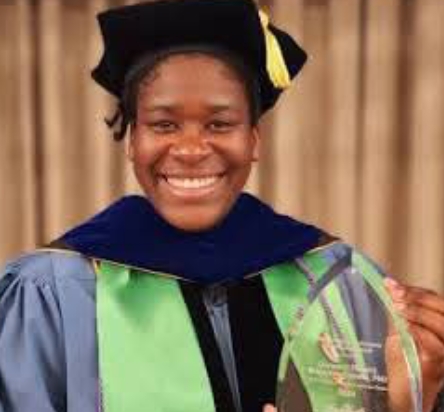

Nigerian-born engineer Oluwami “Wami” Dosunmu-Ogunbi has etched her name in history after becoming the first Black woman to earn a PhD in Robotics from the University of Michigan.

The historic achievement, announced by the university in May 2024, marked a significant milestone in engineering and robotics while highlighting a remarkable journey of resilience, mentorship and academic excellence.
Speaking at the Michigan Engineering Graduate Student Commencement Ceremony, Dosunmu-Ogunbi reflected on how her doctoral journey transformed her vision of engineering beyond scientific discovery.

“A Michigan Engineer is one who does not just provide scientific and technological leadership, but also is one who is intellectually curious, socially conscious, creates collaborative solutions to societal problems, and promotes an inclusive and innovative community of service for the common good,” she told fellow graduates.
The daughter of Nigerian immigrants, Dosunmu-Ogunbi began her doctoral studies with an impressive academic record, having earned several honours, including the Most Valuable Performer award from the University of Illinois chapter of Pi Tau Sigma, the mechanical engineering honour society.
However, her path to success was far from smooth.
She failed her qualifying examinations in the Mechanical Engineering PhD programme, a setback that nearly ended her academic journey during the COVID-19 pandemic, when economic uncertainty made leaving graduate school an even more difficult prospect.
At the critical moment, Professor Chad Jenkins stepped in to support her, connecting her with Professor Jessy Grizzle, one of the founding architects of Michigan’s Robotics programme.
Grizzle welcomed Dosunmu-Ogunbi into his laboratory as his final PhD student before retirement, giving her another opportunity to pursue her dream.
She retook the qualifying examinations and, despite early struggles, regained confidence with encouragement from Professors Kira Barton and Robert Gregg.
“When Wami came out of her shell, she exploded with creativity and resilience, the two key features of a successful PhD,” Grizzle said.
For her doctoral research, Dosunmu-Ogunbi developed an innovative stair-climbing control algorithm for bipedal walking robots.
Working with one of the university’s early Cassie robots presented additional challenges after manufacturer support for the machine ended during her studies.
When the robot eventually became unusable, Professor Ram Vasudevan provided another Cassie robot, enabling her to complete crucial testing.
Her work culminated in the first demonstration of a bipedal robot stepping onto, riding and stepping off a moving walkway—an achievement that advanced research in robotic mobility.
Reflecting on her journey, Dosunmu-Ogunbi emphasised that success is rarely achieved alone.
“I do not stand here on my own two feet alone. None of us got here by our individual merit alone,” she said.
“I share this story to emphasize the critical importance for us to be socially conscious and promoting diversity, equity and inclusion in our solutions.”
Beyond her academic accomplishments, Dosunmu-Ogunbi has been recognised for her commitment to mentorship, outreach and diversity in engineering.
She received the Martin Luther King Jr. Spirit Award from the College of Engineering for inspiring and mentoring students, served as a Robotics Outreach Ambassador for three consecutive years, and was named runner-up in the College of Engineering’s Three-Minute Thesis Competition.
She has also been inducted into the Bouchet Graduate Honor Society, which recognises outstanding scholarly achievement while promoting diversity in graduate education and academia.
Dosunmu-Ogunbi’s achievement stands as a landmark moment for Black women in robotics and serves as an inspiration for aspiring engineers across Nigeria, Africa and the global scientific community.