MTN Nigeria at 25: The Other Story — 25 Years of Connecting Nigeria, Transforming Lives

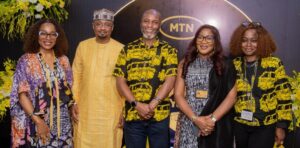
Beyond the calls, data and billions: the enduring legacy of a company that has become woven into the Nigerian story
By NewsMediaNG Editorial Desk

Some anniversaries celebrate the survival of a company.

And there are anniversaries that invite a country to pause and measure what changed because that company was here.
MTN Nigeria’s 25th anniversary belongs in the second category.
A quarter of a century ago, telecommunications in Nigeria was a different world. Connectivity was scarce, mobile phones were beyond the reach of many households, and the idea that a Nigerian could carry the internet, a bank, a classroom, a marketplace and an office in the palm of one hand belonged largely to the future.
Today, that future is here.
But the MTN story is bigger than network bars, subscriber numbers, data consumption and financial results.
Behind the familiar yellow brand is another story — one of scholarships awarded, laboratories renovated, healthcare taken to rural communities, entrepreneurs empowered, women supported, young people trained and communities given infrastructure they could not easily provide for themselves.
That is the story of impact.
And it deserves to be told.
The Numbers Tell One Story. The People Tell Another.
The MTN Foundation says it has invested more than ₦34.4 billion in projects across Nigeria’s 36 states and the Federal Capital Territory, reaching 32.28 million people, 3,610 communities and implementing projects at 1,093 sites. Its interventions include 229 upgraded primary healthcare centres, 219 boreholes in 154 communities, 174 public schools that received learning furniture, 103 ICT laboratories, 110 science laboratories and thousands of young Nigerians trained in ICT and business skills.
Those numbers are impressive.
But numbers alone cannot adequately describe impact.
Impact has a human face.
It has the face of Edith Onodugo, an entrepreneur in Enugu who began the MTN Rural Telephony Project with little more than a phone, an umbrella, a table and a chair.
Her business grew.
Then another outlet followed.
Then another.
Eventually, Edith was employing people and helping train other entrepreneurs.
The Rural Telephony Project eventually empowered more than 4,500 men and women across 28 states and the FCT.
That is what corporate social investment looks like when it moves beyond a cheque and becomes an opportunity.
From Enugu to Cross River: When CSR Becomes Personal
Then there is Maria Eyo Okon of Calabar, Cross River State.
Maria was struggling to raise her children after being abandoned and left with limited means to provide for them.
Through MTN Foundation’s Children at Risk Empowerment Scheme, she received support ranging from food and school materials to lesson fees and psychosocial assistance.
Then tragedy struck again.
One of her daughters developed a breast lump.
The Foundation provided support for the operation, which was successful.
Today, Maria’s children speak about becoming doctors and engineers.
That is more than corporate philanthropy.
That is a family given another chance.
The MTNF CARES programme has provided integrated educational, nutritional and psychosocial support to more than 600 orphans and vulnerable children across Lagos, Kogi, Sokoto, Gombe, Imo and Cross River States, with an institutional resource centre for street children in Jos, Plateau State.
From the South-South to the North-Central, the philosophy has remained the same: identify a need, intervene and create the possibility of a better tomorrow.
Across Six Geopolitical Zones
The scale of MTN Foundation’s interventions is perhaps best understood by looking at the geographical spread.
In the South-West, education and healthcare interventions have reached communities in Lagos and Oyo, among others. In Oyo State, more than 330 students of Yejide Girls’ Junior Grammar School, Ibadan, recently received learning materials under the Foundation’s Learning Support Materials Initiative. One of the beneficiaries, Rebecca Ayinde, said the support would motivate her to do better academically.
In Lagos, MTN Foundation has also renovated science laboratories, including six laboratories at Queens College, strengthening facilities for the study of chemistry, physics and biology.
In the South-East, the Foundation has intervened in healthcare and education.
Government Secondary School Owerri, Imo State, is among schools that received renovated science laboratories, while hospitals in Anambra, Ebonyi and Imo benefited from MTN Foundation’s Emergency Ward Intervention Project.
The beneficiaries included the Federal Teaching Hospital, Abakaliki; Chukwuemeka Odumegwu Ojukwu University Teaching Hospital, Anambra; and Imo State University Teaching Hospital, Owerri.
The Foundation had previously supported hospitals in Borno, Adamawa and Yobe under the same emergency healthcare initiative.
In the South-South, the story extends from Cross River to Rivers and Delta.
The Foundation’s Y’ello Doctor initiative has provided mobile healthcare services in Rivers, while science laboratories have been refurbished in Delta State. Its health intervention is designed to take primary healthcare closer to people in underserved communities.
In the South-West, the Foundation’s interventions also include its Y’ello Doctor programme in Lagos, where mobile clinics have been deployed to take basic healthcare services closer to communities and markets.
In the North-Central, MTN Foundation’s footprint includes Kwara and Nasarawa, while its interventions have also reached Abuja and Plateau State.
The organisation’s community projects have included healthcare, education, water and youth empowerment initiatives.
In the North-West, the Foundation has supported beneficiaries in states including Kaduna, Kano and Katsina.
One striking example is the Foundation’s intervention at the Demonstration School for Deaf Children in Kaduna. The school received an MTNF SchoolsConnect laboratory equipped with computers, VSAT equipment, a projector, printer and other facilities, alongside specialised software and training designed to support children with special needs.
And in Katsina, the Foundation has continued its education-focused interventions, including the distribution of learning materials to female students.
In the North-East, MTN Foundation’s interventions have included healthcare support in Borno, Adamawa and Yobe, while young people in Borno and other northern states have benefited from ICT and business-skills programmes.
The point is not that every Nigerian community has benefited equally.
It is that the footprint demonstrates an effort to make social investment a national, rather than metropolitan, responsibility.
Healthcare That Travels
One of the most compelling examples is the MTN Y’ello Doctor initiative.
Healthcare is often discussed in terms of hospitals, doctors and equipment.
But for millions of Nigerians, the first problem is simply access.
A hospital may exist, yet remain too far away.
A market woman may need medical attention but cannot afford to abandon her stall for an entire day.
A rural family may postpone treatment because transportation itself is a financial burden.
The Y’ello Doctor model attempts to address that gap by taking healthcare to communities.
In its third phase, MTN Foundation deployed six mobile clinics to Lagos, Anambra, Rivers, Kano, Gombe and Kwara, providing medical screening, consultation, treatment, drug prescriptions and referral services.
That geographical spread is significant.
One clinic in Lagos.
Another in Kano.
Another in Gombe.
Another in Kwara.
Different languages. Different cultures. Different healthcare challenges.
But the same fundamental need: access to care.
Building the Next Generation
If telecommunications connects people to the present, education connects young people to the future.
This explains why MTN Foundation’s investment in education and skills deserves particular attention.
The Foundation reports more than 15,000 young people trained in ICT and business skills, while its scholarship and music scholarship programmes have created additional pathways for young Nigerians.
Its ICT and Business Skills programme has trained thousands of young Nigerians across states including Kano, Nasarawa, Oyo, Imo, Rivers, Abia, Akwa Ibom, Kaduna, Katsina and Borno.
The training has involved partners such as Google, Oracle and Cisco, exposing participants to digital and entrepreneurial skills.
This is important because Nigeria’s biggest asset is not oil.
It is not telecommunications infrastructure.
It is not even technology.
It is people.
A country of more than 200 million people, predominantly young, cannot afford to leave its youth without the skills required to participate in the economy of the future.
Women Who Build Businesses
The story of impact is also increasingly female.
The MTN Y’ellopreneur initiative was created to support women entrepreneurs through training, mentorship and access to resources.
By March 2026, the Foundation said the first two phases had trained 5,754 women and facilitated ₦304 million in loans for 122 female entrepreneurs. A new partnership with the Bank of Industry established a ₦1 billion matching fund for women-led enterprises.
The ambition is even bigger: the Foundation says it plans to build the capacity of 30,000 women-led businesses by 2030 and unlock capital for 10,000 enterprises.
That is not merely a CSR statistic.
It is a statement about economic inclusion.
When a woman grows a business, the impact rarely stops with her.
It reaches employees.
Children.
Suppliers.
Customers.
And an entire household.
When Communities Decide What They Need
Perhaps one of MTN Foundation’s most interesting approaches has been its “What Can We Do Together” initiative.
The philosophy is straightforward: allow communities to identify their priorities and participate in determining the interventions.
Earlier phases reachedd hundreds of communities and included transformers, boreholes, medical equipment for primary healthcare centres, school furniture and support for orphanages. MTN later announced another phase involving investment in healthcare, education and alternative power projects.
There is wisdom in this approach.
Development works best when the people who live with the problem are allowed to help define the solution.
A community may need a borehole more urgently than another building.
Another may need electricity.
Another may need a healthcare centre.
Another may need school furniture.
The principle is simple:
Do not merely give communities what looks good. Listen to what they actually need.
Science, Technology and the Confidence to Dream
The renovation of science laboratories is another part of the story.
MTN Foundation says it has provided 110 science laboratories, with 29 laboratories recently completed across parts of the North-East and South-East.
This matters because laboratories are where abstract lessons become experiments.
They are where a student moves from reading about chemistry to conducting chemistry.
Where physics becomes something that can be tested.
Where biology becomes something that can be observed.
And perhaps where a future Nigerian scientist first discovers that a career in science is not an impossible dream.
The Foundation’s education intervention therefore carries a message larger than infrastructure:
Give children the tools to imagine themselves differently.
The Arts: Because Development Is Also About Culture
There is another dimension that is sometimes overlooked in discussions about corporate social responsibility: culture.
MTN Foundation has supported Nigerian arts and cultural platforms, including productions such as Saro the Musical, Wakaa, Fela and the Kalakuta Queens, Moremi, Isale Eko and the Life in My City Art Festival.
Its partnership with the Musical Society of Nigeria through the MTN MUSON Music Scholars Programme has also supported young musicians seeking professional training.
The story of a nation is not written only in its economic statistics.
It is also written in its music.
Its theatre.
Its literature.
Its visual arts.
Its stories.
And the young Nigerians who keep those stories alive.
The Bigger Question: What Does 25 Years Leave Behind?
This is where MTN Nigeria’s 25th anniversary becomes more than a corporate celebration.
It becomes an opportunity to ask a bigger question:
What does a company leave behind after 25 years?
Buildings can age.
Technology becomes obsolete.
Products change.
Markets shift.
But human capacity can endure.
A scholarship recipient can become a doctor.
A trained entrepreneur can employ ten people.
A renovated laboratory can inspire a scientist.
A borehole can transform the daily life of an entire community.
A healthcare intervention can save a mother.
A young musician can carry Nigerian culture to the world.
A digitally trained young person can build a company that did not exist before.
That is the real dividend of social investment.
MTN at 25: A Legacy Still Being Written
It would be naïve to suggest that MTN has solved Nigeria’s social and developmental challenges. It has not.
No corporation can.
Nor should CSR be used as a substitute for government’s responsibility to provide public infrastructure and essential services.
But responsible businesses have a role to play in building the society from which they derive value.
MTN’s 25-year journey offers an example of how that responsibility can be expressed — through connectivity, investment, innovation, community development and social intervention.
The Foundation’s own figures tell part of the story: more than ₦34.4 billion invested, 1,093 project sites, 3,610 communities reached and more than 32 million people touched by its interventions.
Yet perhaps the most important figures are the ones that cannot be easily calculated.
The number of children who now believe they can become scientists.
The number of women who discovered that their businesses could grow.
The number of patients who received treatment closer to home.
The number of young Nigerians who acquired a skill that changed their prospects.
The number of families whose burdens became slightly lighter.
Those are the invisible statistics of corporate citizenship.
And they may ultimately be the most important.
The Next 25 Years
Nigeria is entering another defining technological era.
Artificial intelligence is reshaping work.
Fintech is redefining financial services.
5G is expanding the possibilities of connectivity.
Digital skills are becoming as important as traditional qualifications.
And the conversation about 6G, smart cities, automation and the future of work has already begun.
MTN’s next challenge, therefore, is not simply to connect more Nigerians.
It is to help ensure that Nigerians can benefit from the possibilities created by that connection.
That means deeper digital inclusion.
More youth empowerment.
Greater support for women entrepreneurs.
Stronger healthcare interventions.
More investment in education and science.
More sustainable community development.
And a continued willingness to listen to communities.
Twenty-five years ago, MTN came into Nigeria to build a telecommunications business.
Twenty-five years later, its story has become intertwined with the story of a changing Nigeria.
From the entrepreneur in Enugu to the mother in Calabar.
From the deaf child in Kaduna to the student in Oyo.
From the healthcare beneficiary in Kano to the young entrepreneur in Borno.
From the science student in Lagos to the aspiring musician in Nigeria’s creative community.
Different people.
Different states.
Different dreams.
One country.
Nigeria.
And perhaps that is the most powerful way to understand MTN at 25.
Not merely as a telecommunications company that connected Nigerians to one another, but as a corporate citizen that, through its investments and social interventions, has sought to connect Nigerians to opportunity.
The next 25 years will determine how far that opportunity can travel.
But if the first quarter-century is any indication, the most compelling part of MTN Nigeria’s story may still be unwritten.
Twenty-five years connected.
Millions of lives touched.
And a bigger responsibility ahead.