NLNG CEO Adeleye Falade Urges Global Gas Industry to Prioritise Methane Reduction as Business Strategy

*Falade challenges global gas industry to prioritise methane reduction as business strategy, says emissions cuts can deliver financial returns
NewsMediaNG | Energy

The Nigerian Liquefied Natural Gas Limited (NLNG) has called on the global gas industry to reposition methane reduction from an environmental obligation to a business priority, stressing that every tonne of methane released into the atmosphere represents lost revenue, wasted energy and a missed commercial opportunity.
The company said investments in methane reduction could deliver measurable financial returns while improving operational efficiency, reducing emissions and strengthening the competitiveness of gas producers.

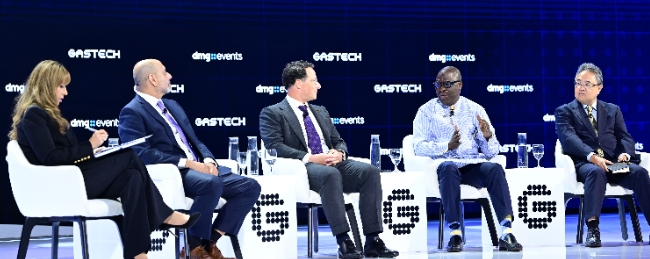
NLNG’s Managing Director and Chief Executive Officer, Adeleye Falade, made the call at the Gastech 2026 Exhibition and Conference in Bangkok, Thailand, during a panel session titled: “Capturing the Lost Opportunity: Driving Global Alignment on Methane Abatement Across Natural Gas Supply Chains.”
Falade said the gas industry must move beyond viewing methane reduction solely as a cost, arguing that preventing gas losses could create significant commercial and environmental value.
“Every tonne emitted is lost product, lost revenue and lost energy; gas we could have sold. Every molecule of methane avoided is both an emissions reduction and a recovered energy resource,” he said.
Methane Reduction Projects Can Pay for Themselves — NLNG
According to Falade, NLNG’s methane management strategy begins with accurately measuring gas losses, identifying the sources of emissions and directing investments towards leak prevention and gas recovery.
He cited the company’s new boil-off gas compressor and start-up gas recovery project as examples of initiatives designed to combine emissions reduction with financial performance.
Falade said each project targets methane reductions of approximately 10–15 per cent, with both projects recording positive projected net present values, indicating that their anticipated financial benefits exceed their costs over their operational lifespans.
“The most compelling business case is the simplest one: the projects that cut our methane also pay for themselves,” he said.
“The same discipline that reduces methane also improves asset reliability and plant efficiency. The returns show up in more places than the emissions ledger.”
The NLNG chief executive explained that reliable measurement was central to the company’s investment decisions, enabling it to identify methane losses, deploy resources effectively and evaluate the outcomes of interventions.
He added that gas producers in developing economies could establish internationally trusted emissions-reporting systems by investing in monitoring infrastructure, strengthening reporting capabilities and subjecting their data to independent verification.
NLNG Highlights Global Methane Reporting Recognition
Falade highlighted NLNG’s Gold Standard recognition under the Oil and Gas Methane Partnership (OGMP) 2.0, noting that the company was the first in Africa to achieve Level 5 methane emissions reporting.
He said NLNG’s measurement, reporting and verification (MRV) system is independently assured by DNV in accordance with ISO 14064.
The company’s methane management framework includes:
- Site-wide optical gas imaging.
- A structured Leak Detection and Repair (LDAR) programme.
- Phased deployment of continuous monitoring systems.
- Real-time emissions dashboards across its plant and vessels.
- Independent verification of emissions data.
Falade maintained that credible methane measurement was driven by organisational commitment rather than geographical location, noting that NLNG’s experience demonstrated that high reporting standards could be achieved in Africa.
“Credible measurement is a function of commitment and not a function of geography. NLNG has proved it can be done in Africa,” he said.
He argued that the industry should raise its standards globally rather than lower expectations for producers operating in emerging economies.
Train 7 to Incorporate Methane Reduction Measures
The NLNG managing director disclosed that methane reduction considerations were also being integrated into the design of the company’s Train 7 project, which is expected to increase Nigeria’s LNG production capacity from 22 million tonnes to 30 million tonnes per annum.
He said the company had not waited for perfect infrastructure before commencing methane reduction efforts, choosing instead to prioritise credible measurement, deploy appropriate technology and improve reporting through independent scrutiny.
According to him, methane management must become an integral part of gas infrastructure development and long-term operational planning.
NLNG Links Gas Monetisation to Nigeria’s Flaring Reduction
Addressing Nigeria’s gas-flaring challenge, Falade said NLNG’s longstanding role in monetising gas that might otherwise have been flared had contributed to a reduction in the country’s gas-flaring rate from over 65 per cent to under 20 per cent.
He described the conversion of wasted gas into marketable products as an early example of the commercial case for emissions reduction.
“The original commercial case for emissions abatement was converting wasted gas into a marketable product,” he said.
Falade also noted that the importance of emissions data extended beyond plant operations, as methane intensity increasingly influenced procurement decisions, financing arrangements and buyer confidence.
NLNG Extends Methane Accountability Across Supply Chain
The NLNG chief executive said the company was extending its emissions management efforts beyond its immediate operations through its formal Scope 3 Advocacy Plan.
The initiative involves engaging feed-gas suppliers and contractors to measure, disclose and reduce emissions across the supply chain.
He said NLNG sources verified upstream emissions data from its feed-gas producers and incorporates environmental, social and governance considerations, alongside emissions criteria, into supplier selection and evaluation.
Falade said the approach was necessary to ensure that methane reduction was not limited to LNG production facilities but extended across the wider natural gas value chain.
Falade Calls for Harmonised Methane Regulations
On regulation, Falade called for greater consistency in methane measurement and reporting requirements across jurisdictions.
He argued that differences in measurement methodologies and disclosure obligations could make enforcement uneven and complicate meaningful comparisons between industry operators.
“The industry does not need weaker standards; it needs stronger, shared ones backed by real measurement,” Falade said.
He stressed that globally aligned standards would help improve transparency, strengthen accountability and encourage investment in methane reduction technologies.
Energy Access and Climate Goals Must Progress Together
Addressing the balance between climate ambition, energy access and affordability, Falade said Nigeria’s emissions reduction efforts must be pursued alongside the country’s development and energy security objectives.
He said NLNG’s operations support Nigeria’s commitments to achieving net-zero emissions by 2060 and zero routine gas flaring by 2030.
However, he warned that developing economies should not be forced to choose between economic growth and emissions reduction.
“Developing economies cannot be asked to choose between economic development and emissions reduction. Both must progress together,” he said.
Falade said NLNG’s approach was built around three key principles: credible measurement of gas losses, investment in gas recovery and the application of consistent standards across the value chain.
The panel also featured Zubin Bamji of the World Bank, Niels Dijksman of Brunei LNG and Hiroyuki Mori of JOGMEC. The session was moderated by Dr Carole Nakhle, an energy economist with Crystol Energy.