Stop Boiling Rice and Eggs Together – Medical Experts Warn Nigerians
By NewsMediaNG
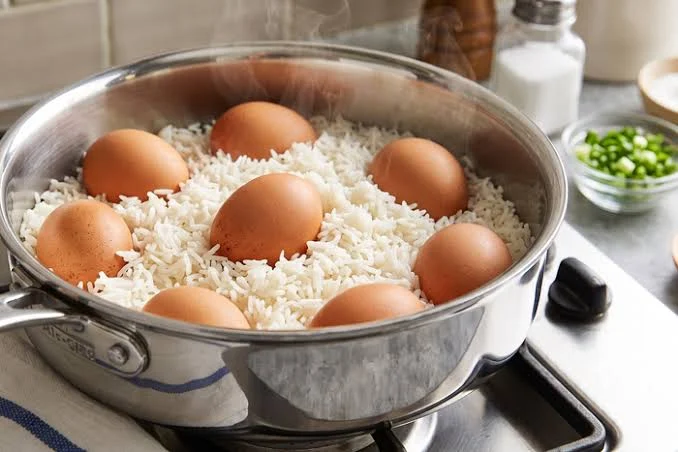
Registered dietitians and nutritionists have advised Nigerians to avoid boiling unpeeled eggs together with rice in the same pot, warning that the practice could increase the risk of cross-contamination and foodborne infections.

The experts said bacteria, including Salmonella, may be present on eggshells and could potentially contaminate rice during the cooking process, particularly if an eggshell cracks while the food is being prepared.

The warning follows renewed public discussion on social media after a viral post on X prompted Nigerians to share experiences involving the practice of cooking rice and eggs together.
Many Nigerians reportedly combine the two foods in the same pot as a way of saving cooking time, water, utensils and cooking fuel, particularly amid rising household energy costs.

However, nutrition experts said food safety should take precedence over the convenience or potential fuel savings associated with the practice.
A nutrition and public health practitioner, Registered Dietitian-Nutritionist James Oloyede, explained that Salmonella could be present on an eggshell even after washing.
According to him, the risk of cross-contamination arises because rice begins absorbing water from the pot as soon as cooking starts.
“Cooking egg and rice together in the same pot is a risk factor in cross-contamination of certain bacteria, especially Salmonella, that can be found on the shell of the egg even after washing with the rice that is being cooked.”
Oloyede, a former Director of Nutrition Services and Health Education at the Osun State Primary Health Care Development Board, said the absorption process begins while the water is still heating.
He explained that if contaminated water from an eggshell comes into contact with the rice during that stage, there is a potential pathway for contamination.
“The challenge with rice is that absorption begins to take place the moment you put your rice in the water. When the water begins to warm up, we see the rice grain begin to swell. What makes it swell is the absorption of the water,” he said.
Oloyede further warned that eggshells could crack during cooking, allowing portions of the egg to leak into the rice.
“Apart from that, in most cases, even when you boil an egg in water, you see that at times the shell can crack. You see some of the white parts of the egg coming out from the shell,” he said.
According to him, such leakage could affect the appearance, taste and odour of the rice.
The nutritionist acknowledged that some households have adopted different methods to prevent eggs from contaminating the rice, including placing eggs inside nylon before putting them into the cooking pot.
He, however, maintained that cooking the two foods separately remained the safest approach.
“But of course, the safest way of cooking egg and rice is to boil them separately. That’s the safest way,” Oloyede said.
He also cautioned that any illness resulting from food contamination could ultimately cost households more than the money saved on cooking fuel.
Oloyede said the financial consequences could include medical expenses, time spent seeking treatment and lost productivity, particularly for workers whose income depends on daily activities.
He urged Nigerians to prioritise food safety rather than the short-term savings associated with cooking rice and eggs together.
Another registered dietician-nutritionist, Charles Oguikpe, also warned against cooking eggs in the same pot with rice, noting that contaminants present on eggshells could potentially be transferred to the rice.
The experts’ concerns centre on the possibility of cross-contamination, particularly where eggs are not adequately handled and an eggshell cracks or comes into contact with food during preparation.
While thorough cooking can reduce or eliminate many foodborne pathogens, proper food handling and preventing contamination before and during cooking remain important components of food safety.
For households that choose to prepare rice and eggs as part of the same meal, the nutritionists’ recommendation is straightforward: cook them separately and maintain good food-handling practices.