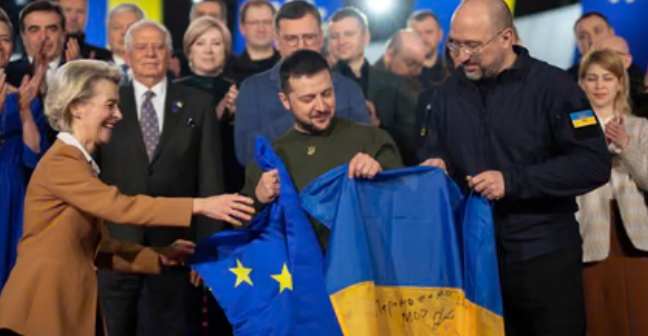
Ukraine War: EU Support Zelensky with €224.5bn, UK Commits £25bn as Peace Efforts fail
The European Union and the United Kingdom have committed substantial financial, military and humanitarian assistance to Ukraine since Russia launched its full-scale invasion in February 2022, as efforts to negotiate an end to the war continue to face difficulties.

According to the European Commission, the European Union and its member states have mobilised approximately €224.5 billion in overall support for Ukraine since the beginning of Russia’s full-scale invasion.

The support covers financial, military, humanitarian and other forms of assistance, including funding provided or guaranteed through the EU budget.
The European Commission’s breakdown includes €110.3 billion provided or guaranteed through the EU budget, €77.9 billion in military assistance measures, up to €17 billion to support member states hosting Ukrainians, €15.5 billion in member-state support and €3.8 billion from proceeds generated by immobilised Russian assets.

The figures reflect different categories of assistance and financial arrangements rather than a single cash transfer to the Ukrainian government.
UK commits £25 billion to Ukraine
The United Kingdom has also committed substantial resources to supporting Ukraine.
According to a UK government factsheet updated on October 13, 2026, Britain’s total commitments to Ukraine amount to £25 billion.
This includes £16 billion in military support, up to £5.6 billion in non-military assistance and a £3.5 billion export-finance cover limit for reconstruction and defence projects.
The British government has also pledged to sustain £3 billion annually in military assistance until the 2030–2031 financial year and for as long as necessary.
The UK’s support includes military equipment, economic assistance, humanitarian programmes, energy security and reconstruction initiatives.
However, these commitments should not automatically be added to the EU’s €224.5 billion total without accounting for differences in reporting periods, categories and possible overlap in jointly financed programmes.
€260 billion refers to frozen Russian assets
The €260 billion figure has a different meaning in the context of the war.
According to reporting by the Financial Times on October 14, 2026, Western countries froze approximately €260 billion in Russian state assets following Moscow’s full-scale invasion of Ukraine in 2022, with most of the funds held within the European Union.
The assets belong to Russia and were immobilised as part of sanctions imposed in response to the invasion. They are not equivalent to financial assistance already delivered to Ukraine.
The use of the frozen assets has become an important issue in discussions about Ukraine’s financing, military requirements and eventual reconstruction.
The EU has supported Ukraine through proceeds generated by the immobilised assets and related financing arrangements, but the underlying Russian assets remain subject to legal and political disputes.
Peace negotiations face fresh challenges
Efforts to end the war have continued amid disagreements over security arrangements, territorial issues and the future of frozen Russian assets.
The Financial Times reported on October 14 that the United States had proposed unfreezing some Russian sovereign assets held in Europe and transferring them into a financial vehicle overseen by Washington as part of efforts to revive stalled peace negotiations.
The proposal reportedly encountered resistance from European officials, including German Chancellor Friedrich Merz, who argued that decisions concerning assets frozen in Europe should remain a European matter.
The disagreement highlights the complex interests involved in negotiations to end the conflict.
European governments have continued to back Ukraine while debating how to finance its defence, maintain economic stability and support reconstruction.
On October 14, Reuters also reported that the European Union was working to secure additional financial support for Ukraine in 2027, with the bloc expecting to cover about two-thirds of the country’s funding needs.
The development underscores the continuing financial demands of the war even as diplomatic efforts seek a possible settlement.
What the figures mean
The available official figures establish that the EU and UK have committed substantial assistance to Ukraine since 2022.
However, they do not establish that nearly €260 billion was jointly provided by the EU and UK to Zelensky personally or that the entire amount has already been disbursed.
Similarly, reports of stalled negotiations and disagreements among Western governments do not, by themselves, establish that all peace efforts have collapsed after three years.
The distinction is important for understanding the scale of Western support, the status of Russian assets frozen in Europe and the challenges facing diplomatic efforts to end the war.
Sources: European Commission; UK Government; European Parliament Research Service; Reuters; Financial Times.