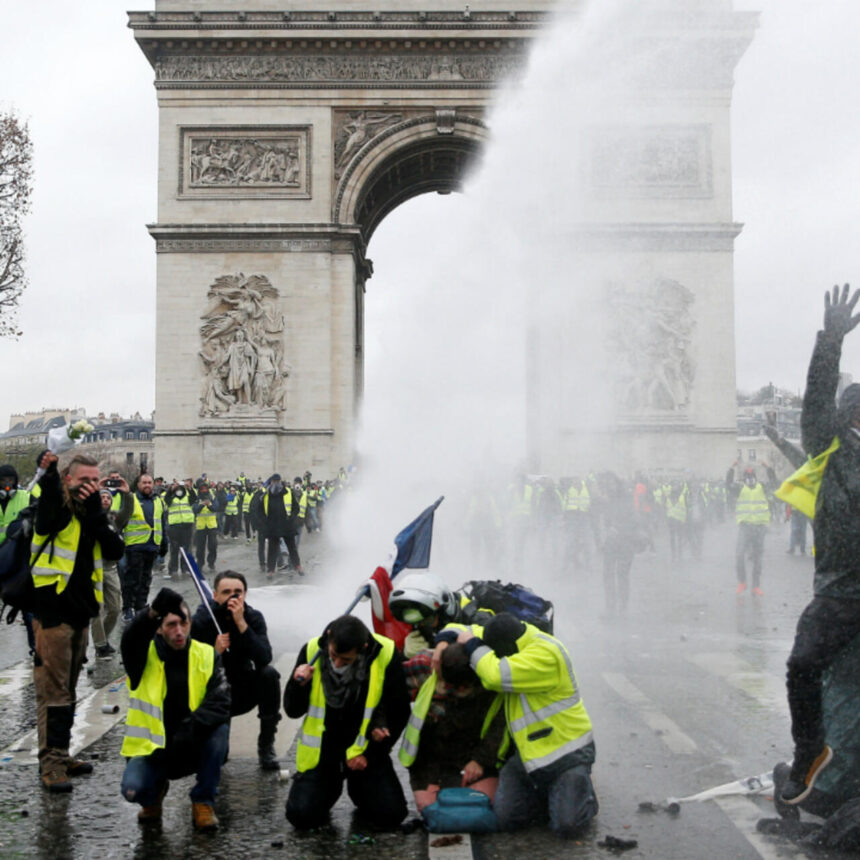
Paris Protesters Approach Macron’s Élysée Palace as Violent Unrest Spreads Across France
PARIS, France — Tensions escalated in Paris on Saturday as groups of protesters moved towards the Élysée Palace, the official residence of President Emmanuel Macron, amid nationwide demonstrations over the rising cost of living, social inequality and deteriorating public services.
The protesters reportedly came within approximately 200 metres of the presidential palace before encountering a heavy police presence and tear gas, according to reports by French media outlets.

Demonstrations were restricted in the area around the palace, with security forces deployed to prevent crowds from advancing towards the presidential residence.

The incident formed part of a wider wave of protests that swept across France on October 17, with clashes, fires, looting and damage to public and private property reported in several cities.
According to reports by Le Monde, groups of demonstrators moved through central Paris towards the Élysée district despite police deployments and restrictions on demonstrations in the area.

The crowds later moved away from the palace after police used tear gas to disperse protesters.
Protests Spread Beyond Paris
The unrest was not limited to the French capital, as demonstrations and violent confrontations were reported in cities including Lyon, Marseille, Bordeaux and Limoges.
In Limoges, the historic city hall was heavily damaged by fire, while other public buildings and businesses were targeted during the disturbances.
Police also confronted demonstrators in several locations, deploying crowd-control measures as authorities struggled to contain groups moving through different parts of the cities.
Although many demonstrations began peacefully, clashes involving smaller groups overshadowed parts of the nationwide mobilisation.
Reports from French media indicated that hundreds of thousands of people participated in demonstrations across the country, although estimates of the overall turnout differed between government authorities and organisers.
Rising Living Costs Fuel Public Anger
The demonstrations brought together students, trade union members, former Yellow Vest activists and other citizens expressing dissatisfaction with economic conditions and public services.
The movement initially gained momentum through student protests over poor school facilities, overcrowded classrooms and teacher shortages before expanding to include broader grievances about the cost of living and social inequality.
The renewed mobilisation has drawn comparisons with the Yellow Vest movement that began in 2018, when demonstrators protested against fuel prices, economic pressures and policies they considered unfair to ordinary citizens.
The latest unrest has once again placed pressure on the French authorities to address public concerns while maintaining order and protecting businesses, public institutions and residents.
President Macron’s administration faces the challenge of responding to economic grievances while dealing with the violence and property destruction that accompanied parts of the demonstrations.
The events around the Élysée Palace have also raised questions about security arrangements in the area, given the proximity of demonstrators to one of France’s most important political institutions.
However, available reports indicate that protesters approached the palace but did not breach the presidential residence.
The situation highlights the growing tensions surrounding economic hardship, public services and the government’s response to widespread dissatisfaction across France.
NewsMediang.com