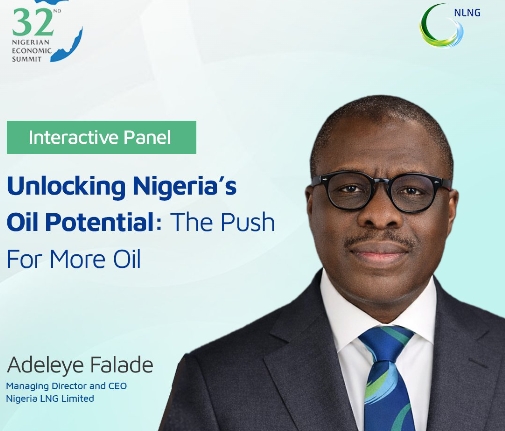
NLNG CEO Adeleye Falade to Discuss Strategies for Unlocking Nigeria’s Oil Potential at NES 2026

NewsMediang.com

The Managing Director and Chief Executive Officer of Nigeria LNG Limited (NLNG), Adeleye Falade, is expected to speak on strategies for unlocking Nigeria’s oil potential at the 32nd Nigerian Economic Summit (NES), scheduled to hold in Abuja on Tuesday, October 27, 2026.
Falade will participate in an interactive panel session titled “Unlocking Nigeria’s Oil Potential: The Push for More Oil,” where he is expected to share insights on policy issues affecting Nigeria’s energy future and explore practical approaches to strengthening the country’s oil and gas sector.

The session, scheduled for 2:45 p.m. to 4:00 p.m. at the Transcorp Hilton Hotel, Abuja, will focus on issues surrounding Nigeria’s capacity to expand oil production, improve the investment climate and develop policies that support sustainable growth in the energy industry.
His participation comes amid continued efforts to strengthen Nigeria’s oil and gas industry, attract investment and maximise the economic benefits of the country’s hydrocarbon resources.
Why Unlocking Nigeria’s Oil Potential Matters
Nigeria’s oil and gas sector remains a major source of government revenue, foreign exchange earnings and industrial activity. However, translating the country’s substantial petroleum resources into sustained economic growth requires more than increasing production targets.
The push for more oil raises important questions about investment, infrastructure, security, regulatory certainty and the ability of industry operators to bring projects into production efficiently.
One of the key issues is how Nigeria can create a policy environment that encourages long-term investment in exploration, field development and production. Investors generally require predictable regulations, transparent processes and confidence that projects can deliver competitive returns over their operating lives.
Addressing crude oil theft, pipeline vandalism and other disruptions to production will also remain important to efforts to increase output. Improvements in security, operational efficiency and infrastructure could help Nigeria reduce avoidable losses and make better use of existing production capacity.
Beyond these immediate challenges, sustainable growth will depend on developing new oil fields, maintaining existing assets and ensuring that investment decisions are supported by commercially viable projects.
Policy Stability and Investment Confidence
Falade’s panel topic places policy development at the centre of the discussion about expanding Nigeria’s oil production.
Clear and consistent policies can help reduce uncertainty for operators, encourage capital investment and support collaboration between government institutions and private-sector participants.
Effective implementation of the Petroleum Industry Act, transparent licensing arrangements and efficient regulatory processes are among the areas that can influence investor confidence and the pace of project development.
The discussion is also expected to provide an opportunity to consider how policymakers can balance the need to increase production with environmental responsibilities, energy security and the country’s long-term economic priorities.
For Nigeria, the objective should not simply be to produce more crude oil, but to ensure that additional output translates into stronger public revenue, job creation, industrial development and improved economic opportunities.
The Role of Natural Gas in Nigeria’s Energy Future
Although the panel focuses on unlocking oil potential, Nigeria’s wider energy strategy also depends on the development of its natural gas resources.
As the head of NLNG, Falade brings a perspective from an industry that processes Nigerian natural gas into liquefied natural gas for domestic and international energy markets.
Natural gas can contribute to export earnings, industrial growth and energy supply, while supporting sectors such as fertiliser production, power generation and petrochemicals.
Expanding the country’s energy potential therefore requires policies that recognise the relationship between oil production, gas development, processing infrastructure and access to domestic and international markets.
For NLNG and other industry stakeholders, a supportive policy environment, reliable infrastructure and sustained investment are important to maximising the value of Nigeria’s gas resources.
Shaping Nigeria’s Energy Policy
The 32nd Nigerian Economic Summit provides a platform for government officials, business leaders, investors and other stakeholders to examine policies and strategies for strengthening the Nigerian economy.
Falade’s participation in the interactive session is expected to contribute to conversations on how Nigeria can overcome barriers to oil production, improve its attractiveness to investors and translate its natural resources into broader economic benefits.
The central challenge is to establish a framework in which higher production, responsible resource management and economic diversification can reinforce one another.
As Nigeria seeks to strengthen its position in the global energy market, discussions around policy consistency, investment, infrastructure and operational efficiency will remain critical to determining how effectively the country can unlock its oil and gas potential.
NewsMediang.com will continue to follow developments from the 32nd Nigerian Economic Summit and the policy discussions shaping Nigeria’s energy sector.