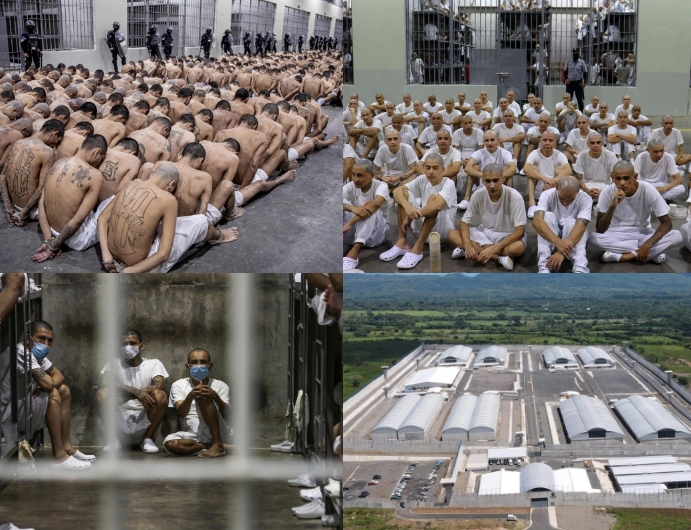
World’s Toughest Prison: No Family Visits, Limited Freedom: Inside El Salvador’s Notorious CECOT Prison with 40,000 Inmates
NewsMediang.com

El Salvador’s notorious Terrorism Confinement Centre, popularly known as CECOT, has attracted international attention for its extraordinary security measures, strict prison conditions and controversial approach to dealing with gang-related crime.

Ironically described as the “most generous prison in the world” in some online discussions, CECOT is far from what its name might suggest. The facility is widely regarded as one of the toughest prison complexes in the world.
Located in Tecoluca, El Salvador, CECOT was inaugurated in January 2023 under President Nayib Bukele as part of his administration’s aggressive campaign against criminal gangs.

With an official capacity of 40,000 inmates, the facility was designed primarily to accommodate suspected and convicted gang members arrested during the government’s nationwide crackdown.
The prison has become a major symbol of Bukele’s security strategy, which supporters credit with reducing gang violence and improving public safety across the Central American country.
However, its operations have also generated international criticism over alleged human rights violations, limited access to legal representation and the treatment of detainees.
Inside the controversial prison
CECOT operates under exceptionally strict security arrangements. Prisoners are held in large communal cells fitted with multi-level metal bunk beds, with limited opportunities to leave their accommodation areas.
Reports from journalists who have visited the facility indicate that inmates spend most of their day inside their cells, with very limited time for exercise.
A January 2026 report by Brazilian newspaper Folha de S.Paulo, following a visit to the prison, described conditions in which inmates reportedly spend approximately 23 hours and 30 minutes daily inside their cells.
The report also stated that artificial lights remain on around the clock, prisoners sleep on metal bunks without conventional mattresses or bedding, and family visits are not permitted.
The prison’s strict arrangements have made it a subject of international debate about the balance between public security and the fundamental rights of people in detention.
A 40,000-capacity facility
CECOT was initially announced as a facility capable of accommodating 20,000 prisoners, but the government subsequently doubled its stated capacity to 40,000.
According to figures contained in a November 2025 monitoring report by El Salvador’s Servicio Social Pasionista, the prison held approximately 14,561 inmates, representing about 36.4 per cent of its official capacity.
The relatively low occupancy figure contrasts sharply with overcrowding in other Salvadoran correctional facilities.
The same report estimated that other adult prisons in the country were operating at approximately 387.5 per cent of their installed capacity.
This contrast has raised questions about prison management, detention policies and the conditions under which thousands of people are held across the country’s correctional system.
Human rights concerns
Despite the government’s defence of its security policy, international human rights organisations have raised serious concerns about conditions in CECOT and other Salvadoran prisons.
Human Rights Watch has documented allegations of beatings, ill-treatment, prolonged detention without contact with family members or lawyers, and inadequate access to healthcare.
In a November 2025 report examining the detention of Venezuelan nationals transferred to El Salvador, Human Rights Watch and Cristosal documented allegations of systematic abuse, including physical violence and sexual abuse.
The organisations also reported that former detainees described severe restrictions on communication, recreation and access to legal assistance.
The Salvadoran government has defended its anti-gang campaign as necessary to restore security and protect citizens from criminal violence.
Bukele’s controversial security strategy
President Nayib Bukele introduced a state of emergency in March 2022 following a surge in gang-related killings.
The emergency measures expanded the powers of security agencies and allowed mass arrests of people suspected of gang involvement.
While the government has repeatedly highlighted the reduction in killings and improved security, rights organisations have questioned the extensive use of emergency powers, mass detention and restrictions on due process.
CECOT has consequently become an international symbol of the debate surrounding Bukele’s approach to crime control.
For supporters, the facility represents a major component of El Salvador’s fight against violent gangs. For critics, it raises fundamental questions about accountability, judicial oversight and the protection of human rights.
The debate over CECOT therefore goes beyond the physical structure of the prison, touching on a broader question confronting governments worldwide: how can public safety be strengthened without undermining the rights and dignity of people in custody?
NewsMediang.com