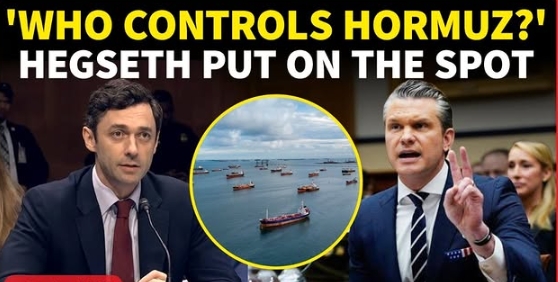
‘You Said We Won—So Who Controls the Strait of Hormuz?’ US Senators Challenge Pete Hegseth Over Iran War Endgame
US Defence Secretary Pete Hegseth has faced intense questioning from American lawmakers over the Trump administration’s claims of victory in the war against Iran, with senators demanding to know why the strategically important Strait of Hormuz remains disrupted despite repeated declarations of military success.

The tense exchange occurred during a Senate hearing on May 12, 2026, where Hegseth and Chairman of the Joint Chiefs of Staff, General Dan Caine, appeared before the Senate Appropriations Subcommittee to defend the administration’s proposed defence budget and address concerns about the ongoing conflict.

At the centre of the confrontation was a fundamental question: if the United States has achieved its military objectives against Iran, why has it not restored normal commercial shipping through the Strait of Hormuz?
Hegseth maintained that the United States effectively controls the strategic waterway, arguing that its naval operations and blockade have prevented Iran from moving goods through its ports.

“They can’t move anything out of Iranian ports,” Hegseth told lawmakers, insisting that Washington determines what enters the waterway.
“Ultimately, we control the strait, because nothing’s going in that we don’t allow to go in,” he added.
However, Democratic lawmakers challenged his explanation, pointing to continuing disruptions to international shipping and Iran’s demonstrated ability to threaten commercial vessels.
Senator Chris Coons questioned why commercial shipping had not returned to normal if Washington genuinely controlled the waterway.
“My question remains: How do we reopen the Strait of Hormuz to commercial shipping?” Coons asked.
Hegseth acknowledged that Iran retained certain capabilities, including fast boats, but insisted that American military operations had significantly weakened the country’s defence industrial base.
Senator Chris Murphy also pressed the defence secretary on the administration’s strategy for restoring shipping through the strait.
Asked how the waterway would be reopened, Hegseth said military options remained available, including operations against land-based targets, naval activities and the continued blockade.
Senator Jeanne Shaheen separately challenged the administration’s assessment of Iran’s military capabilities, questioning claims that the country’s defence industrial base had been overwhelmingly destroyed.
She argued that Iran’s continued production of drones and its ability to sustain the conflict contradicted the administration’s victory narrative.
“We have not won this war despite the rhetoric,” Shaheen said.
The Strait of Hormuz: A major strategic concern
The Strait of Hormuz is one of the world’s most important maritime trade routes, connecting the Persian Gulf to the Gulf of Oman and the wider international shipping network.
A substantial share of global oil and liquefied natural gas shipments passes through the narrow waterway, making disruptions there a major concern for energy markets and international trade.
The US-Israeli strikes against Iran, which began on February 28, 2026, triggered Iranian retaliation and the subsequent disruption of shipping through the strait.
Although a ceasefire took effect on April 8 following Pakistani mediation, negotiations have struggled to produce a lasting agreement.
The continuing uncertainty has raised concerns about energy supplies, shipping costs and the wider economic consequences of the conflict.
What is America’s endgame?
Beyond the argument over control of the Strait of Hormuz, the Senate hearing exposed broader disagreements about what Washington ultimately wants to achieve in Iran.
The administration has repeatedly highlighted the destruction of Iranian military infrastructure, including missile systems, naval assets and defence production facilities.
However, lawmakers have questioned whether those military gains have translated into a sustainable strategic outcome, particularly while Iran retains the ability to disrupt a critical international shipping corridor.
The hearing also raised questions about the cost of the conflict, the effectiveness of the ceasefire and the prospects for a diplomatic settlement.
For Hegseth, the challenge was to explain how the administration’s claims of military success could be reconciled with the continuing disruption of one of the world’s most important maritime routes.
The central question remains whether military pressure and a naval blockade can secure lasting freedom of navigation or whether a broader diplomatic agreement will be necessary.
For the international community, the distinction between controlling access to a waterway and restoring safe, uninterrupted commercial shipping remains critical.
NewsMediang.com reports that the Senate confrontation has brought renewed attention to the strategic and economic consequences of the Iran conflict, particularly the unresolved question of who effectively controls the Strait of Hormuz.