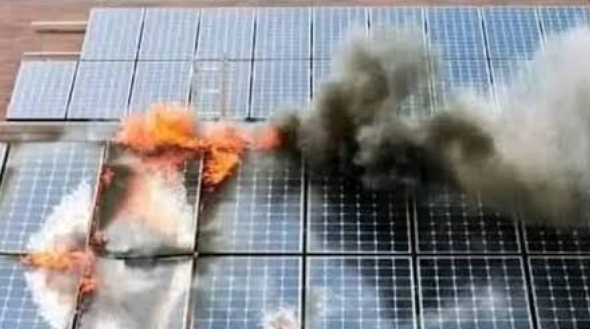
Fake Solar Panels Could Trigger Deadly Fires, Financial Losses, Experts Warn Nigerians
Energy experts have raised the alarm over the growing circulation of counterfeit solar products in Nigeria, warning that fake batteries, inverters, solar panels and other components are exposing consumers to devastating fire outbreaks, equipment failure and huge financial losses.

The experts, who spoke in separate interviews on Wednesday, urged Nigerians to purchase solar equipment only from authorised dealers and reputable suppliers to avoid falling victim to counterfeit products.

Managing Director of Wurvicat International, Atinuke Owolabi, identified batteries, inverters, solar panels, charge controllers, cables and connectors as the solar products most frequently counterfeited in the Nigerian market.
According to her, fake batteries and inverters pose the greatest danger because they can overheat, fail prematurely and ignite fires, putting lives and property at risk.

She advised consumers to thoroughly inspect products before purchase by checking manufacturers’ names, serial numbers, QR codes, certification labels, warranty documents and the overall quality of the equipment.
Owolabi also urged buyers to pay attention to product finishing and avoid items with poor workmanship, incomplete information or suspicious packaging.
“If the price appears too good to be true, it probably is,” she warned, noting that genuine solar products are rarely sold at unrealistically low prices because of manufacturing costs.
She explained that qualified professionals could carry out electrical and performance tests to confirm the authenticity and quality of solar equipment before installation.
The energy expert, however, cautioned consumers against relying solely on serial numbers, QR codes or warranty documents, saying counterfeiters have become increasingly sophisticated.
She advised buyers to verify product details directly through manufacturers’ official platforms and insist on original invoices before making payments.
Owolabi further stressed the importance of engaging qualified engineers for installation, warning that even genuine solar equipment could perform poorly or become unsafe if improperly designed, installed or maintained.
She called on the Standards Organisation of Nigeria (SON) to tighten import inspections, strengthen quality enforcement, intensify market surveillance and introduce tamper-proof certification stickers, while imposing tougher sanctions on importers and dealers caught selling fake solar products.
“An informed consumer is far less likely to become a victim,” she added.
Also speaking, Solar Systems Installation Manager at Pure Volt Power, Segun Ajayi, advised consumers to buy only from authorised dealers and established solar companies.
He urged buyers to verify product certifications, warranty coverage, after-sales support and whether sellers are officially recognised distributors.
Ajayi added that stricter regulation, stronger product verification systems and sustained public awareness campaigns would significantly reduce the circulation of counterfeit solar products across Nigeria.