
Exporting Crude, Importing Fuel Created Poverty — Africa Must Not Repeat Mistake With Lithium, Cobalt, Rare Earths – Wunti Warns


NewsMediaNG

The Chief Executive Officer of the World Energy Council Nigeria, Bala Wunti, has warned African countries against repeating the continent’s costly experience of exporting crude oil while importing refined petroleum products, urging governments to process critical minerals locally and capture more value from the emerging global minerals economy.
Wunti said Africa must move beyond being a supplier of raw materials and become a competitive hub for processing, manufacturing and industrialisation as demand for lithium, cobalt, graphite and rare earth elements accelerates globally.
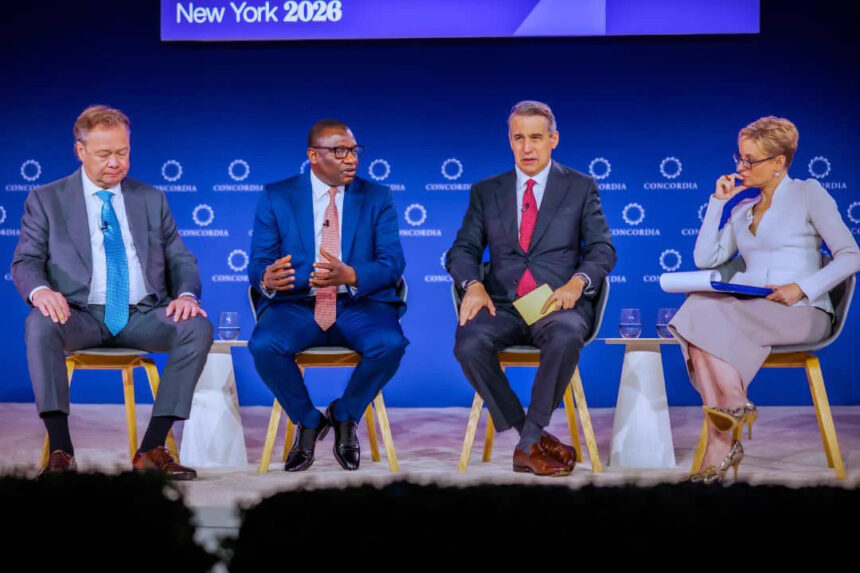
He spoke at the 2026 Concordia Annual Summit in New York during a panel discussion titled “Rare Currency: Critical Minerals in a Shifting Global Economy.”
The summit, held from September 20 to 23 at the Sheraton New York Times Square alongside the United Nations General Assembly, brought together heads of state, senior government officials and business leaders from more than 100 countries.
Wunti shared the panel with Alix Steel, Principal at DrivePath Advisors and former Bloomberg Television anchor; Steven Fox, Founder and Executive Chairman of Veracity Worldwide; and Scott Monteith, President and Chief Executive Officer of Avalon Advanced Materials.
The discussion examined the United States’ dependence on imported critical minerals, China’s dominance of global mineral-processing capacity and the strategic importance of minerals to defence, electricity generation, grid infrastructure, technology and industrial competitiveness.
Wunti stressed that the global supply gap required urgent action, particularly as countries seek to secure minerals critical to the energy transition and advanced manufacturing.
«“The urgency, need and speed of action are essential,” Wunti said.»
He noted that although the United States was seeking to expand domestic production, building new mineral-processing and production capacity could take decades, making partnerships with strategic allies increasingly important.
“Closing the supply gap has become a compelling national priority for the United States. However, domestic production takes decades, allies are indispensable, and a considerable distance remains between policy ambition and commercial reality,” he said.
From barrels to kilograms
Wunti said the changing structure of the global economy meant that energy security could no longer be viewed solely through the prism of crude oil and natural gas.
According to him, mineral security would increasingly determine the resilience of global energy and industrial systems.
“For the past 50 years, we priced energy in barrels. For the next 50 years, we will price it in kilograms, including kilograms of lithium, cobalt, graphite and rare earth elements,” he said.
“Whether those kilograms are controlled by allies or adversaries will help define the next global industrial order.”
The Nigerian energy expert warned African governments against allowing the continent’s critical minerals to follow the same export pattern that characterised its oil industry.
“Exporting crude oil and importing refined petroleum products created poverty, not prosperity. That model must not be repeated with lithium, cobalt and rare earth elements,” he said.
While acknowledging that temporary exports of mineral concentrates could sometimes be commercially necessary, Wunti said African countries should use such arrangements as a pathway towards developing domestic processing capacity, attracting investment and creating jobs.
“Africa must not remain merely a source of raw materials. It must become a processing partner,” he said.
He added that countries that establish viable mineral projects and secure positions in emerging supply chains early could benefit significantly from the growing critical-minerals market.
“The real prize is value addition through processing, factories, employment and industrialisation on the continent, rather than exporting those opportunities to Asia,” Wunti said.
Nigeria’s challenge is bankability
Addressing Nigeria’s efforts to develop its 44 identified critical minerals, Wunti said the major challenge was not simply the existence of mineral resources but the conversion of geological potential into bankable investment opportunities.
“Having minerals in the ground is only the beginning. We had geological indications, but not proven reserves supported by JORC-compliant data. We also had good policies, but not clearly defined projects. The world invests in projects, not potential,” he said.
He identified six key conditions for attracting serious investment into the sector: reliable geological data, clearly defined projects, enabling infrastructure, predictable regulation, credible developers and viable routes to market.
Wunti described the Nigerian Solid Minerals Company as a flagship platform for helping transform Nigeria’s mineral resources into commercially viable projects.
“The company is moving Nigeria from simply saying, ‘We have minerals,’ to presenting investable projects with clear commercial propositions,” he said.
He also argued that the challenge surrounding rare earth elements was not necessarily their physical availability but the difficulty and cost of bringing them into commercial markets.
“Rare earth elements are not necessarily rare in the ground. They are rare in the market. Bringing them to market requires capital and technology,” Wunti said.
‘The lesson is price, not pitch’
Wunti urged Nigeria and other African countries to move beyond promotional presentations about mineral deposits and demonstrate actual commercial opportunities to investors.
“We must present investors with actual transactions, not merely presentations. Give me a credible price, and I will give you private capital,” he said.
He welcomed recent measures by the United States, including Executive Order 14241, development-finance initiatives, export controls and bilateral mineral agreements aimed at strengthening critical-mineral supply chains.
He cited the reported $110-per-kilogram price floor for neodymium and praseodymium products under the MP Materials agreement as an example of government intervention that could provide greater commercial certainty for investors.
However, he stressed that international initiatives would need to be matched by credible domestic policies and commercial discipline in African countries.
“Ultimately, private capital must do the heavy lifting, but governments must make projects investable,” Wunti said.
According to him, governments should focus on risks that investors cannot independently resolve, including inadequate geological information, unpredictable regulations, weak infrastructure, inefficient permitting processes and uncertain investment frameworks.
At the same time, he cautioned that governments could improve the bankability of projects but could not make fundamentally unviable ventures profitable.
“Investors still require competitive economics and credible buyers,” he said.
Wunti identified JORC-compliant geological data, commercially viable pricing, stable and competitive fiscal regimes and credible buyers as critical requirements for attracting long-term capital.
“The lesson is price, not pitch,” he said.
Africa needs resilience, not isolation
Wunti further argued that credible pricing mechanisms could help close the gap between government policy and commercial reality.
“When the right price and investment conditions are available, processing can come to Africa. That is how we move from potential to bankability, from barrels to kilograms, and from extraction to processing,” he said.
He urged African governments to strengthen supply-chain resilience through domestic processing capacity and diversified international partnerships, while cautioning against attempting to achieve complete economic isolation.
“Pursue self-sufficiency, but do not pursue isolation. Complete independence is an illusion. Resilience is the goal,” Wunti said.
He explained that supply-chain security did not necessarily require countries to manufacture every component domestically.
“Security does not mean producing everything within your borders. It means ensuring that a competitor cannot cut off your supplies within 90 days,” he said.
Wunti said a partnership model combining American technology and capital with Africa’s mineral resources, processing capacity and human talent could help unlock greater economic value from the continent’s critical-minerals sector.
His central message was that Africa’s mineral wealth should not become another cycle of extraction without industrial development, with local processing, manufacturing, jobs and investment forming the foundation of the continent’s strategy for the emerging critical-minerals economy.