Airtel Africa Grows Q1 Revenue by 31% to $1.85bn, Profit Rises 27% as Customer Base Hits 189 Million

Airtel Africa Plc has reported a strong start to its 2026/27 financial year, posting robust growth across its mobile and fintech businesses as revenue climbed 31 per cent to $1.853 billion for the quarter ended June 30, 2026.

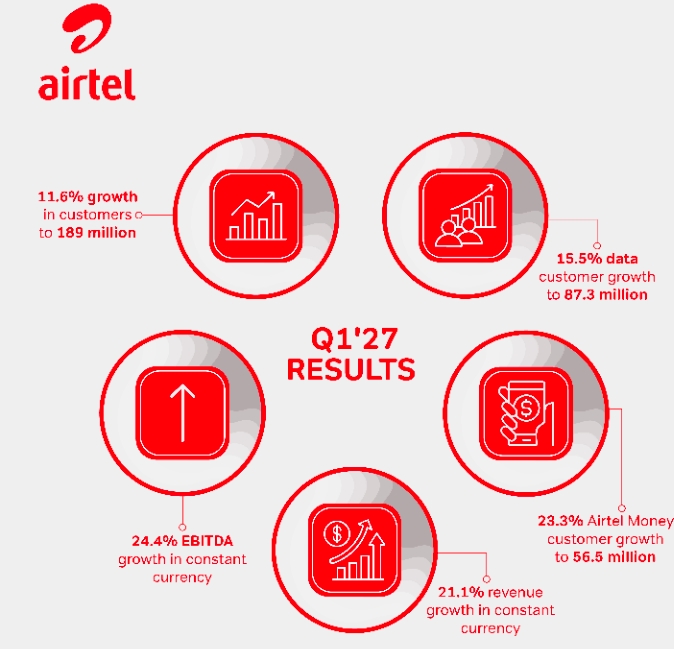
The telecommunications giant said its total customer base increased by 11.6 per cent to 189 million, while data customers grew 15.5 per cent to 87.3 million, driven by rising smartphone adoption and increasing demand for digital services.

According to the company’s first-quarter trading update, average monthly data usage per customer rose from 7.8GB to 10.6GB, contributing to a 56.3 per cent increase in data traffic across its network. Smartphone penetration also improved to 51 per cent, supporting stronger digital adoption across its markets.
Airtel Money continued its rapid expansion, with annualised total processed value (TPV) surging 51.5 per cent to more than $245 billion. The platform’s customer base rose 23.3 per cent to 56.5 million, reflecting increased adoption of digital financial services and broader usage across its ecosystem.
Financially, the company recorded revenue growth of 31 per cent in reported currency and 21.1 per cent in constant currency. Mobile services revenue increased 19.1 per cent, while mobile money revenue rose 25.8 per cent in constant currency.
Within mobile services, voice revenue grew 11.2 per cent, while data revenue jumped 27.2 per cent. Regionally, constant currency revenues expanded by 17.8 per cent in East Africa, 18 per cent in Francophone Africa and 29.8 per cent in Nigeria, reflecting the impact of tariff adjustments implemented during the fourth quarter of 2025.
EBITDA rose 36.6 per cent to $928 million, while the EBITDA margin improved to 50.1 per cent, up from 48 per cent a year earlier, despite higher energy costs linked to geopolitical developments.
Profit after tax increased 27 per cent to $198 million, compared with $156 million recorded in the corresponding period last year. The company said earnings were supported by stronger operating performance but partly offset by $6 million in derivative and foreign exchange losses, compared with gains of $22 million in the prior year. Profit was also impacted by an exceptional finance cost of $37 million arising from an in-principle settlement of a commercial dispute involving one of its subsidiaries.
Basic earnings per share rose to 4.4 cents from 3.4 cents, while earnings before exceptional items increased to 5.4 cents, representing a 57 per cent rise.
The company significantly increased capital expenditure during the quarter, investing $389 million, compared with $121 million in the same period last year. Airtel added more than 920 network sites, its highest first-quarter rollout, and expanded its fibre network to 82,100 kilometres to strengthen coverage, capacity and service quality.
Leverage also improved, with the ratio declining from 2.2x to 1.7x, while lease-adjusted leverage reduced from 0.9x to 0.5x, driven largely by improved EBITDA performance.
During the quarter, Airtel Africa’s Board approved a share buyback programme covering up to 1 per cent of its issued share capital. By June 30, 2026, the company had repurchased approximately 10.2 million shares for $46.6 million.
Commenting on the results, Sunil Taldar, Chief Executive Officer of Airtel Africa, said the company delivered another strong performance as customer growth accelerated across all business segments.
He said continued investment in digital platforms, artificial intelligence and network infrastructure was improving customer experience while supporting sustainable growth. Taldar also confirmed that London remains the preferred listing venue for Airtel Money in 2026, saying the move would provide access to a wider international investor base and unlock long-term value for one of Africa’s leading fintech businesses.
Despite expected pressure from rising energy costs, he expressed confidence that Airtel’s ongoing cost-efficiency programme and accelerated investment strategy would sustain growth and strengthen its leadership in Africa’s digital transformation.