

BBC Files Appeal Against Trump’s $10bn Defamation Lawsuit, Challenges Florida Court’s Jurisdiction

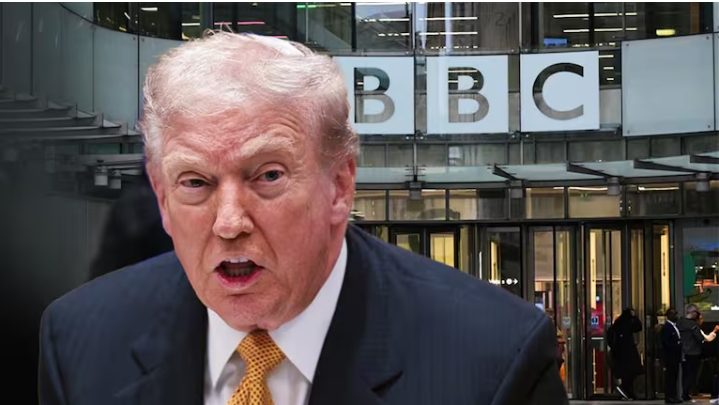
The British Broadcasting Corporation (BBC) has filed an urgent appeal against a US court ruling allowing President Donald Trump’s $10 billion defamation lawsuit against the broadcaster to proceed, arguing that the Florida court lacks jurisdiction to hear the case.

The broadcaster has approached the United States Court of Appeals for the 11th Circuit, seeking to overturn an earlier decision by a federal judge in Florida who rejected its application to dismiss the lawsuit.
The appeal, filed on November 17, 2026, challenges the court’s authority to hear the case, insisting that the documentary at the centre of the dispute was produced and broadcast in the United Kingdom and was never aired in the United States.

Trump instituted the lawsuit over the BBC’s editing of a January 6, 2021, speech he delivered shortly before the attack on the US Capitol.
The documentary, titled Trump: A Second Chance?, aired as part of the BBC’s Panorama programme ahead of the 2024 US presidential election.
The broadcaster faced criticism after two separate portions of Trump’s speech were edited together, creating the impression that he had directly encouraged supporters to engage in violent action.
The BBC subsequently apologised, acknowledging that the editing gave a misleading impression of Trump’s remarks. However, it has consistently denied that the documentary amounted to defamation.
Why the BBC is challenging the court’s jurisdiction
In its latest appeal, the BBC argues that the Florida court cannot exercise jurisdiction over the broadcaster because the documentary was not broadcast in the United States.
The corporation also maintains that it implemented measures to prevent access to the programme and other streaming content from the US.
According to its lawyers, allowing the lawsuit to proceed could create a wider legal problem for international businesses operating online, potentially exposing them to lawsuits in jurisdictions where their content was not officially distributed.
A BBC spokesperson said the organisation was surprised and disappointed by the earlier ruling.
The spokesperson maintained that the documentary was broadcast in the UK only and that the broadcaster was seeking an urgent review by a higher court.
Trump’s $10bn lawsuit
Trump is seeking $10 billion in damages, comprising $5 billion for alleged defamation and another $5 billion under Florida’s unfair business practices law.
However, in a ruling earlier this month, US District Judge Jeffrey Kuntz dismissed Trump’s unfair business practices claim while allowing the defamation claim to proceed.
The judge found that Trump had sufficiently alleged that the BBC acted with actual malice, a key legal requirement in defamation cases involving public figures in the United States.
The decision did not establish that the BBC was legally responsible for defamation; it allowed the claim to advance towards trial.
Trump’s legal team has accused the broadcaster of deliberately and deceptively editing his speech to damage his reputation and interfere with the 2024 presidential election.
What happens next?
The BBC’s appeal seeks to have the case dismissed on jurisdictional grounds before it proceeds to trial.
The underlying lawsuit is currently scheduled for trial on May 3, 2027, in Fort Lauderdale, Florida.
Trump is also expected to give testimony under oath as part of the legal proceedings.
The appeal represents another significant development in the growing legal dispute between the US president and one of the world’s most prominent international broadcasters.
For the BBC, the central question is whether a US court can exercise jurisdiction over a foreign broadcaster over a documentary that it says was never officially distributed in the country.
NewsMediang.com will continue to monitor developments in the case.