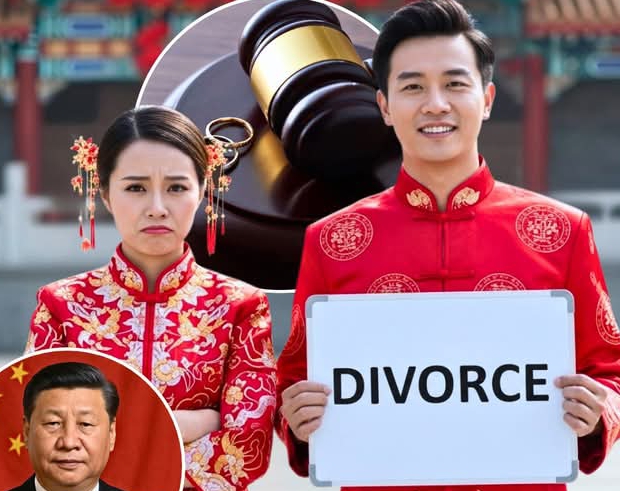
China’s Divorce Property Rules Spark Debate Over Women’s Rights

China’s revised judicial guidelines on marital property disputes have reignited debate over women’s financial security after divorce, particularly for spouses who sacrifice careers to raise children and manage the home.

China’s approach to dividing marital assets after divorce has come under renewed scrutiny following the introduction of new judicial guidelines that clarify how courts should handle disputes over property transferred between spouses, family-funded homes and other marital assets.

The rules, issued by China’s Supreme People’s Court on January 15, 2025, and effective from February 1, 2025, have drawn attention to the financial risks spouses may face when a marriage ends, especially where one partner has been the primary breadwinner while the other has taken responsibility for childcare and domestic duties.
At the centre of the debate is whether existing legal protections adequately recognise the contributions of spouses who may have no formal income but have spent years supporting their families.
Property ownership and divorce disputes
Under the new judicial interpretation, Chinese courts are directed to consider several factors when resolving certain property disputes, including the source of funds used to acquire an asset, the length of the marriage, the presence of children, each spouse’s contribution to the household and the circumstances surrounding the transfer of property.
The guidelines also address situations in which one spouse transfers a property acquired before marriage into the other spouse’s name or into both names, as well as cases involving homes purchased with financial assistance from parents.
Depending on the circumstances, a court may award a disputed property to one spouse while ordering reasonable compensation for the other.
The rules do not, however, establish a blanket provision that all property registered in one spouse’s name automatically belongs exclusively to that spouse. Nor do they require wives in every divorce case to produce receipts or bank transfers before they can claim a share of marital assets.
Nevertheless, the way particular properties are acquired, registered and transferred can have significant consequences when couples disagree over ownership.
Concerns over stay-at-home wives
The changes have renewed discussion about the position of spouses who leave paid employment or reduce their professional commitments to raise children, care for elderly relatives or support a partner’s career.
Unlike a spouse who earns a regular salary, a homemaker may have little documentary evidence of a direct financial contribution to the purchase of a house or other major assets.
Yet childcare, household management and other domestic responsibilities can enable the working spouse to devote more time to earning money and building wealth.
This has raised questions about how courts should assess contributions that cannot easily be measured through bank statements, employment records or purchase receipts.
Critics of property arrangements that place too much emphasis on financial ownership argue that the absence of a salary should not be interpreted as an absence of contribution to a marriage.
They warn that spouses who devote years to family responsibilities could face financial insecurity after divorce if their domestic contributions are not adequately recognised.
What the guidelines say about domestic contributions
China’s legal framework already provides for economic compensation in certain divorce cases where one spouse has taken on greater responsibilities, including raising children, caring for elderly family members or assisting the other spouse with work.
Article 21 of the Supreme People’s Court’s 2025 judicial interpretation addresses how courts may determine such compensation.
Relevant considerations include the time and effort invested in those responsibilities, their impact on both spouses, the paying spouse’s financial capacity and local income levels.
This provision is significant because it recognises that unpaid family responsibilities can form the basis of a claim for compensation.
However, the existence of a compensation mechanism does not necessarily mean that every homemaker will receive an equal share of every disputed asset. Outcomes depend on the applicable legal provisions and the facts of each case.
Supporters and critics differ
The debate reflects competing concerns over individual property rights and fairness within marriage.
Those who favour clearer rules on property ownership argue that courts need predictable standards for resolving disputes, protecting legitimate ownership interests and preventing lengthy litigation.
Others contend that legal certainty must not come at the expense of spouses whose contributions are primarily domestic rather than financial.
For these critics, the challenge is ensuring that the law recognises marriage as an economic partnership in which both paid employment and unpaid family care can contribute to a household’s prosperity.
The issue is particularly relevant where couples have built a shared life over many years but hold major assets in only one spouse’s name.
A wider debate over marriage and financial independence
The controversy also highlights broader questions about gender roles, economic independence and financial planning within marriage.
As more households face changing employment patterns and rising family expenses, the division of domestic responsibilities can have long-term consequences for each partner’s earning capacity and financial security.
For spouses who step away from paid work, returning to employment after years of caregiving may also present challenges, making the terms of a divorce settlement especially important.
The debate has prompted questions about whether couples should pay greater attention to property ownership, financial arrangements and the legal consequences of major asset transfers during marriage.
Ultimately, China’s revised judicial guidelines have brought renewed attention to a difficult issue: how to balance property rights with the contributions spouses make to a shared household.
While the rules do not automatically strip wives of rights to their husbands’ property, disputes over ownership and compensation underscore the importance of recognising both financial and domestic contributions when a marriage ends.
Source: Supreme People’s Court of China, Interpretation on the Application of the Marriage and Family Book of the Civil Code (II), issued January 15, 2025, effective February 1, 2025.