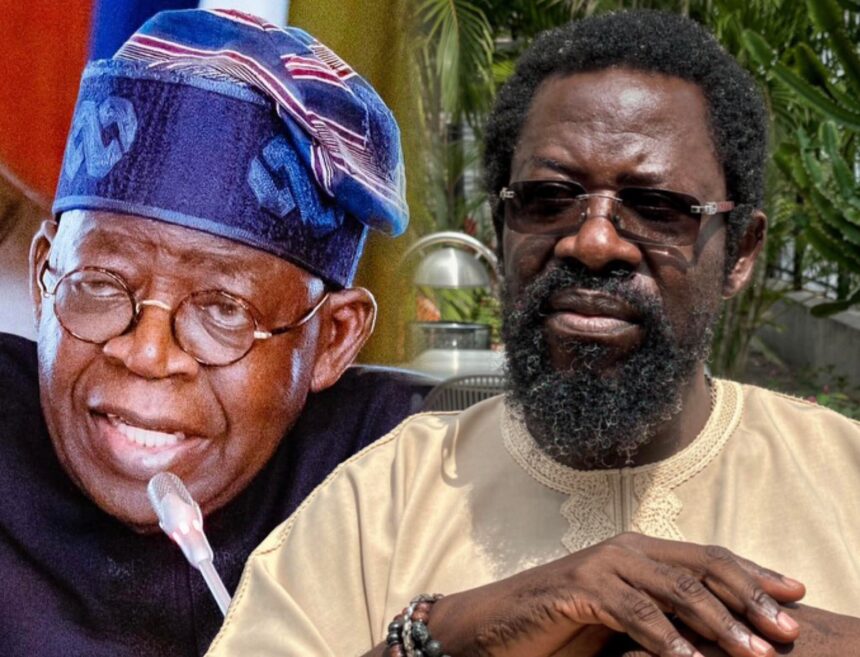
Human rights lawyer and political commentator Dele Farotimi has sparked widespread reactions after strongly criticizing the Federal Government’s approach to taxation following recent remarks by Nigerian President Bola Ahmed Tinubu on tax payment and public service delivery.
Farotimi’s reaction came after President Tinubu reportedly stated that Nigerians cannot expect world-class hospitals and quality public services without paying sufficient taxes, a comment that quickly generated heated debates across social media platforms.

The President’s remarks triggered strong responses from many Nigerians who argued that citizens are already burdened by multiple taxes, rising inflation, worsening insecurity and economic hardship, yet continue to struggle with inadequate public infrastructure and poor service delivery.

Reacting to the statement, Farotimi faulted what he described as a recurring pattern of government demanding more sacrifices from citizens without corresponding accountability or visible development.
According to him, taxation without transparency and responsible governance amounts to exploitation.

“Tax without accountability is ransom,” Farotimi stated.
The comment rapidly gained traction online, resonating with many Nigerians who say they feel increasingly disconnected from a system that continues to place more demands on citizens while failing to improve living conditions.
Several social media users argued that despite paying various taxes, levies and charges, many parts of the country still suffer from poor road networks, unstable electricity supply, inadequate healthcare services and growing security concerns.
The development also reignited conversations surrounding the state of public healthcare facilities across Nigeria.
Many government hospitals have repeatedly been criticized for overcrowding, inadequate medical equipment and shortages of essential supplies. At the same time, critics frequently point to the trend of public office holders seeking medical treatment abroad, often at significant public expense.
For many Nigerians, the contrast has become increasingly difficult to ignore.
Some questioned how citizens could be expected to contribute more through taxation when many believe there is little evidence of efficient management of existing public resources.
Others maintained that effective taxation should naturally translate into visible development, improved security, quality healthcare, reliable electricity and functioning infrastructure.
Farotimi’s remarks also came amid mounting frustration over Nigeria’s economic realities. Since the removal of fuel subsidy and the continued rise in living costs, millions of Nigerians have faced increasing financial pressure.
Food prices have surged sharply, transportation costs have risen across several parts of the country, businesses continue to battle economic challenges and concerns over unemployment remain persistent.
Many citizens say the present economic conditions have widened the disconnect between leaders and ordinary Nigerians struggling to cope with daily realities.
As reactions continue to pour in, Farotimi’s statement has evolved beyond a political criticism, becoming a broader expression of public concerns over governance, transparency and accountability.
The debate has once again brought attention to the growing trust gap between the government and citizens, amid calls for greater accountability and visible impact in public administration.