Germany Deploys Up to 1,000 Troops to NATO’s Eastern Flank as Russia Tensions Escalate
By NewsMediaNG

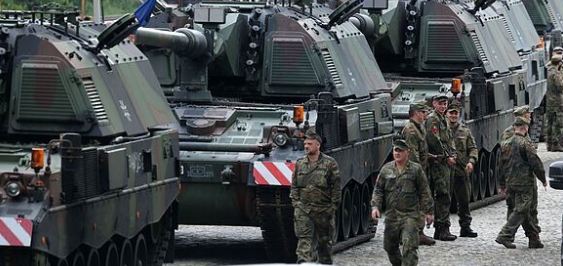
Germany is set to deploy up to 1,000 additional military personnel to Lithuania, strengthening NATO’s eastern flank amid growing tensions between the Western military alliance and Russia.

The move comes as security concerns continue to rise across Europe following a series of incidents involving Russian drones and other military activities near NATO territory, fuelling fresh fears of a wider confrontation between Russia and the alliance.
German Defence Minister Boris Pistorius said the additional personnel would help reinforce Germany’s growing military presence in Lithuania, where Berlin is establishing a permanent brigade as part of NATO’s efforts to strengthen its eastern defences.

Germany is already committed to deploying a major armoured brigade in Lithuania, with plans for the force to eventually comprise about 4,800 soldiers and 200 civilian personnel.
The brigade is expected to reach full operational capability by 2027 and represents one of Germany’s most significant military commitments to NATO’s eastern flank since the end of the Cold War.
The latest troop reinforcement comes against the backdrop of heightened concerns over Russia’s military posture and repeated incidents involving drones close to NATO member states.
A recent drone incident near the Ukraine-Poland border has further intensified concerns among European governments, with German officials warning that such actions could represent a dangerous escalation.
NATO has increasingly strengthened its eastern flank since Russia’s full-scale invasion of Ukraine, deploying additional troops, air-defence systems and military equipment across member states bordering or located close to Russia.
Lithuania, which shares borders with Russia’s Kaliningrad region and Belarus, has become a particularly important part of NATO’s defence strategy.
The German military presence there is consequently being viewed as a major component of the alliance’s deterrence strategy.
NATO Secretary-General Mark Rutte, during a recent visit to Berlin, praised Germany’s contribution to strengthening NATO’s collective defence, describing the country’s military commitment as an important element of European security.
Despite the growing military deployments, NATO and Germany have maintained that the objective is deterrence and defence, rather than preparation for an offensive war against Russia.
However, the rapid militarisation of NATO’s eastern flank has intensified public debate across Europe over the possibility that an incident involving Russian forces and NATO troops could trigger a much broader confrontation.
For now, there is no confirmation that World War III has begun, and Germany’s troop deployment does not by itself indicate that NATO is preparing to launch a war against Russia.
Instead, Berlin and its NATO allies say the increased military presence is intended to prevent aggression by demonstrating that an attack on any NATO member would trigger a collective response.
But with the war in Ukraine continuing and military activity increasingly occurring close to NATO territory, Europe is facing one of its most serious security challenges in decades.
The deployment of additional German troops to Lithuania therefore sends a clear message: NATO is significantly strengthening its eastern defences as tensions with Moscow remain dangerously high.