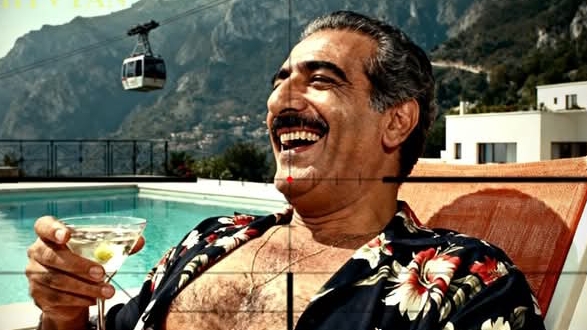
How Mossad Snipers Shot A General from the Tourist Cable Car
Junier, Lebanon, August 22nd, 2001. Every morning at exactly 0817 hours, Hassan Karim drank his coffee on a mountain terrace no sniper could reach. His compound sat above the city wrapped in rock, steel, and loyal guards. Israeli planners called him unshootable. But 420 m away, a red tourist cable car drifted silently over the Mediterranean, filled with laughing visitors and swinging backpacks.
It was never searched, never stopped, and passed his terrace for exactly 45 seconds. Before Kareem finished the front page of his newspaper, a weapon disguised as tourism rewrote the rules of assassination. Operation Sky Window. Hassan Karim was not a frontline fighter. He was something far more dangerous. A planner.
Born in southern Lebanon in 1968, Kareem grew up watching Israeli jets trace vapour lines across the sky above his village. The sound of distant explosions became his childhood soundtrack. By the age of 14, during the 1982 invasion, he witnessed F-16s striking a convoy near his school. The precision of it fascinated him more than it frightened him.
He began collecting technical manuals, studying flight patterns, and teaching himself the mathematics of interception. By age 19, Kareem had joined Hezbollah’s emerging military wing with a singular obsession, making Israeli pilots vulnerable. Through the 1990s, Kareem became the architect of Lebanon’s evolving air defence doctrine.
His speciality was synthesis. He combined Iranian surface-to-air training, Syrian logistics networks, and intimate knowledge of Lebanese terrain into layered threat systems. Israeli pilots who had operated with near impunity in the 1980s found themselves facing coordinated radar networks, mobile launch platforms, and pre-positioned ambush zones.
By the late 1990s, Kareem systems did not need to destroy aircraft. They forced jets higher, reduced strike accuracy, and transformed the air war from surgical to approximate. Associates described him as methodical, never impulsive. He documented everything in ledgers, treating warfare like engineering. By 2001, Kareem had proposed an ambitious upgrade, a distributed network combining upgraded SA7 missiles, radar-guided systems, and real-time communication relays.
If implemented, it would push Israeli aircraft above 15,000 ft permanently, degrading their effectiveness by an estimated 37% according to internal Israeli assessments. The network was scheduled for activation in September 2001. He lived accordingly. His residence above Junier was not symbolic. It was tactical.
The compound sat on a mountain face overlooking the Mediterranean, elevated 340 m above sea level. No neighbouring buildings existed within 600 m. The approach roads were single-lane switchbacks monitored by cameras. Guards rotated in 12-hour shifts. The terrace where Kareem took his morning coffee faced northeast, offering panoramic views, but no conventional sniper angles.
The nearest elevated position that could achieve line of sight was 1 to400 m away, beyond the effective range for reliable targeting. Terrain analysis confirmed what Israeli intelligence already knew. This was a problem geometry could not solve. Intelligence services had tracked Kareem for 4 years.
Initial assessment classified him as valuable but inaccessible. By March 2001, Israeli military intelligence concluded Kareem represented a threshold threat. His air defence network, if activated, would fundamentally alter the operational environment over Lebanon. The previous doctrine allowed Israeli jets to operate with assumed superiority.
Kareem’s system would introduce uncertainty and uncertainty cost lives. The authorisation to eliminate Kareem came in April 2001. Israeli doctrine has long emphasised asymmetric access. The principle is straightforward. Hardened targets are rarely defeated head-on, but from angles that defenders do not classify as threats.
Planners call it vector blindness. Every military commander protects against known attack profiles. The art lies in identifying what they ignore. By early 2001, every traditional option had failed a preliminary assessment. An air strike risked political escalation and collateral damage in a densely populated area.
Car bombs required proximity that surveillance indicated was impossible to achieve. Ground assault teams would face entrenched defences on terrain favouring defenders. Fixed sniper positions did not exist within effective range. The target profile seemed purpose-built to resist conventional elimination. Then a junior analyst reviewing civilian infrastructure maps noticed the teleferic de Junier, a cable car system operational since 1965 designed to carry tourists from sea level to mountain peaks.
The route passed within 420 m of Kareem’s terrace. Constant speed, constant altitude, fixed trajectory. The analyst flagged it as theoretically viable. Senior planners dismissed it initially. A moving platform introduced instability. Civilian presence created legal and operational complications. Wind drift over open water was unpredictable.
The firing window would be under 1 minute. But surveillance teams were already positioned. Within 2 weeks, they confirmed Kareem’s morning ritual. Every day, weather permitting. He emerged onto his terrace between 08:15 and 0820 hours. He carried Turkish coffee in a white ceramic cup. He sat in the same wicker chair facing northeast.
He read Alakbar newspaper, always starting with the front page. The routine lasted approximately 18 minutes. He was alone without guards on the terrace itself. The tactical paradox became clear. Kareem’s security was designed against static threats. Guards watched roads and buildings. Surveillance detected ground approaches.
But the cable car was civilian infrastructure, constant background motion, irrelevant to security protocols. It was never searched. Its passengers were tourists, not threats. And it passed at an optimal range for precision rifle work. Israeli doctrine includes a classification system for operational feasibility. Grade one, routine execution with standard protocols.
Grade two, specialised but proven methods. Grade three, novel approach requiring custom solutions. Grade four, theoretical only unproven in field conditions. Operation Sky Window was initially classified as grade four. Then simulation teams began testing variables. They calculated wind patterns at 420 m over water.
They modelled cable car stability during the critical approach segment. They analysed passenger density patterns across different times and days. They identified weapon systems capable of subminent target acquisition from moving platforms. Within three weeks, the operation was reclassified as grade three. Within five weeks, it became grade two with conditions.
The conditions were severe but achievable. Compromise cable car operator. Conduct extensive reconnaissance. Select optimal weather window. Utilise shooters with documented moving platform experience. The obstacles were quantified. Cable car velocity 4.2 m/s during the approach segment. Lateral sway amplitude 0.6 to 1.8 m depending on wind.
Passenger interference probability 43% based on tourist density averages. Acoustic signature risk is moderate due to ambient cable machinery noise. Extraction complexity is high due to Lebanese security presence and limited maritime routes. Despite these challenges, planners identified one critical advantage. Once the cable car entered the approach corridor, timing became deterministic.
The geometry was fixed. If Kareem appeared on schedule and weather conditions fell within tolerance, the shot was mathematically predictable. The challenge was not marksmanship. It was engineering every variable to align simultaneously. Authorisation moved to operational planning in late May 2001 while Abdul Kunvarin unit 504 responsible for deep penetration operations in hostile territory took operational control.
The mission received an internal designation sky window, reflecting both the firing position and the narrow temporal opportunity. Planners estimated a 6-week preparation timeline followed by a 3-week execution window. Within 4 days, the operation entered its preparation phase. But first, one critical element needed to be resolved.
securing cooperation from inside the cable car infrastructure itself. Without an operator willing to adjust timing and ignore irregularities, the entire plan collapsed. During the second week of June, an intermediary made contact with a cable car maintenance supervisor. The approach was financial, not ideological.
The supervisor was a Marinite Christian with gambling debts and a daughter requiring medical treatment. The offer was $40,000, half in advance. His role was simple. On a specified morning, ensure the cable car maintains optimal speed during the 0800 departure, manually adjust for any timing deviations, and report passenger density 30 minutes before departure.
He was told nothing about the operation’s purpose. He agreed within 18 hours. Intercepted communications from July 12th reveal Kareem discussing his daughter’s upcoming wedding in September. Analysts noted nothing operationally relevant. He spoke about traditional music selections and debated whether the ceremony should be held in Beirut or his home village.
His voice on the recording carried the warmth of a father anticipating a milestone. When the operation concluded 3 weeks later, the wedding was postponed indefinitely. His daughter received condolence visitors for 40 days according to Shia tradition. By late June, the operation entered its next critical phase, reconnaissance.
Two operatives were assigned under non-official cover, traveling separately into Lebanon through Cyprus and Syria. Their legend was German ecoourrists, complete with verifiable hiking routes, hotel reservations, and camera equipment purchased in Munich. One operative, designated primary, was a veteran sniper with documented experience on the maritime platformsrmsrmsrmsrmsrmsrmsrmsrmsrms during priororororororor naval operations.
The second, designated secondary, served as spotter and logistics coordinator. The reconnaissance phase consumed 11 rides over four weeks. Each ride was logged under different identities using forged EU passports. Teams rotated appearance, hair dye, eyeglasses, different clothing styles. They traveled on different days and times to avoid pattern recognition.
During these rides, they documented wind speed using handheld animometers concealed as camera light meters. They measured sway amplitude by filming through windows and analyzing footage frame by frame. They recorded vibration cycles by placing accelerometers inside camera bags. They established timing markers by correlating GPS data with visual landmarks.
The ride segment where the cable car achieved optimal geometry relative to Kareem’s terrace was designated the sky window. It lasted 45 seconds. From the moment the cable car cleared a rocky outcrop until it passed behind a tree line. During this window, the range remained between 405 and 438 m. The terrace was fully visible.
Background consisted of stone wall reducing risk of pass through into occupied structures. The angle of fire was approximately 12° downward within comfortable firing parameters. Critical data emerged from the 11th reconnaissance ride. Wind pattern stabilized between 0800 and 0830 hours, averaging 4.
1 m/s from the northwest. This was within tolerance for the selected weapon system. Passenger density on weekday morning departures averaged 7 to 12 individuals, providing sufficient concealment. The cable cars vibration cycle exhibited a predictable rhythm. Maximum stability occurred during the middle third of each support tower tower span, specifically between seconds 22 and 34 of the sky window.
The weapon was selected for predictable ballistics rather than stopping power. A 300 Winchester Magnum chosen for its proven mid-range performance and reduced sensitivity to crosswinds compared to smaller calibers. The rifle was a Accuracy International chassis with a Schmidt and Bender optic selected because it could be disassembled into six components small enough to fit inside a standard 65 L hiking backpack without requiring permanent modification.
No suppressor was mounted. Analysis indicated that ambient cable machinery noise combined with open air dispersal would mask the acoustic signature sufficiently. Additionally, subsonic ammunition was ruled out due to reduced accuracy at 420 m. The team structure was minimal by design.
Two operatives inside Lebanon, one communications relay in Cyprus, and a three-person maritime extraction cell positioned 12 nautical miles offshore aboard a cigarette boat disguised as a recreational fishing vessel. Total operational footprint, eight personnel. Compartmentalization was absolute. The extraction team knew only coordinates and timing.
The communications relay knew only code phrases. The cable car operator knew nothing. During the fourth week of July, Primary conducted a specialized drill. In a training facility outside Tel Aviv, a cable car cabin was suspended on hydraulic rams. programmed to replicate the recorded sway and vibration patterns.
Primary fired 60 practice rounds over 5 days, establishing muscle memory for the specific firing solution. By the final day, he achieved 92% hit probability on a human silhouette target at 420 m under simulated conditions. The remaining 8% was attributed to variables beyond training control. unexpected passenger movement, equipment malfunction, or target evasion.
The psychological preparation was clinical. Operatives underwent what unit 504 calls legend immersion. For 2 weeks before insertion, they lived as their cover identities continuously. They spoke only German. They researched hiking trails they would theoretically have visited. They created social media posts backdated to establish online presence.
One operative later described it in debriefing. You stop translating in your head. You dream in the legend. When someone asks your name, you don’t recall the alias. It simply is your name. This is necessary. Hesitation at a checkpoint means death. By August 18th, all elements were positioned. The weapon had been transported in pieces across three separate border crossings, then reassembled in a safe house outside Junier.
Operatives had checked into separate hotels. The extraction vessel had cleared Lebanese customs as a recreational charter returning to Cyprus. Weather forecasts predicted optimal conditions for August 22nd. Clear skies, northwest winds under 5 m/s. Seastate Comm. The operation was approved for execution. The window was 72 hours August 20th through 22.
If conditions fell outside parameters, the operation would abort and recycle for the following week. Kareem’s wedding preparations would likely keep him on schedule. But if he deviated, the entire apparatus would dissolve and 6 months of preparation would evaporate. At 0600 hours on August 22nd, the cable car operator sent a coded text message.
Morning delivery confirmed seven packages. This meant Kareem was at the compound and passenger density was within optimal range. The operation transitioned from preparation to execution. The final assembly began at 0730 hours in a hotel room overlooking Jun’s commercial district. The rifle components were laid across a bedspread in sequence.
Receiver, barrel assembly, stock, optic, magazine, bipod. Primary worked methodically, connecting each piece with practiced precision. No tools were required. The design allowed handtight assembly that maintained zero calibration. Secondary monitored police radio frequencies through a scanner concealed in a portable radio.
The room smelled of coffee and gun oil. At 0742 hours, both operatives exited the hotel separately. Primary carried the hiking backpack containing the assembled rifle wrapped in a sleeping bag. to external observation. It appeared as standard tourist equipment, slightly bulky, but consistent with overnight hiking gear.
Secondary carried a camera bag with telephoto lenses, binoculars, and a laser rangefinder disguised as a vintage light meter. They walked separately to the cable car station, arriving 3 minutes apart. The lower station was modest, a concrete platform with a ticket booth and waiting area. Approximately 20 tourists milled about, primarily European couples and a Lebanese family with three children.
The cable car itself was a red cabin suspended from steel cables capable of holding 15 passengers. Signs in Arabic, French, and English advertise the journey as a scenic route to mountain restaurants and hiking trails. At 0758 hours, Primary purchased a ticket using cash and a German passport identifying him as Klouse Vber, occupation listed as civil engineer.
Secondary had purchased his ticket the previous evening. They did not acknowledge each other. Primary positioned himself near the cabin’s rear corner. Secondary near the front opposite side. This created diagonal sight lines maximizing coverage and concealment. The cable car departed at 0806 hours exactly on schedule.
12 passengers boarded. the two operatives, four French tourists, three Lebanese locals commuting to mountain businesses, and three elderly American women. The cabin lurched slightly as it detached from the platform, then smoothed into its climbing rhythm. The machinery produced a steady mechanical hum punctuated by rhythmic thumps as the cabin passed over support tower wheels.
Primary placed his backpack on the floor near the cell’s rear window, partially obscured by other passengers bags. He positioned himself standing facing the window, one hand on the overhead rail. To anyone observing, he appeared to be a tourist enjoying the view. The Mediterranean stretched below, morning light creating silver patterns on the water.
The cabin climbed steadily, ascending the mountain face at 4.2 m/s. At 0809 hours, secondary began photography, creating visual cover for extended window observation. He used a telephoto lens to scan the mountain face, establishing baseline reference points. Through the viewfinder, Kareem’s compound became visible.
a two-story structure with a distinctive terrace jutting from the second level. The terrace was empty. Kareem had not yet appeared. At 0811 hours, an unexpected complication emerged. The cable car slowed abruptly as it approached the midpoint station. A small platform where passengers could board or disembark.
Protocol called for the cabin to pause only if passengers were waiting. None were visible, but the cabin decelerated anyway, coming to a complete stop at the platform. 30 seconds elapsed. No one boarded. No one exited. Primary felt the first edge of adrenaline. A delayed schedule meant the geometry would be wrong. If the cable car was 60 seconds behind, Kareem might finish his coffee and return inside before the sky window opened, the operation would abort.
6 months of work would collapse into a canceled morning. Then the cabin lurched forward again. The operator had manually corrected the pause, resuming speed without passengers. It was the unspoken signal. The window was still viable. Timing could be recovered. Secondary made eye contact with primary for 1 second, a barely perceptible nod.
The operation was still active. The cabin continued its ascent. At 0814 hours, it cleared the rocky outcrop that marked the beginning of the approach corridor below and to the northeast. Kareem’s terrace came into full view. The geometry was perfect. 420 m range, 12° downward angle, clear line of sight with stonewall background, but the terrace remained empty.
Primary knelt beside his backpack, ostensibly adjusting straps. His hands moved inside, locating the rifle through the sleeping bag fabric. He released one strap, creating an opening. The French tourists near him were absorbed in photographing the coastline. The Lebanese commuters were scrolling through phones.
The American women were debating which restaurant to visit. No one was watching him. At 0816 hours, secondary spotted movement. Through his telephoto lens, he watched Kareem emerge from the interior doorway onto the terrace. The target wore a white linen shirt and dark trousers. He carried a white ceramic coffee cup in his right hand.
Under his left arm, a folded newspaper. Kareem walked to the wicker chair positioned near the terrace edge, sat down, and placed the coffee cup on a small side table. He unfolded the newspaper. His posture was relaxed, the routine of a man who had performed this ritual a thousand times. The cable car entered the sky window at 0817 hours and 12 seconds.
Primary transitioned to operational mode. He extracted the rifle from the backpack in one smooth motion. The movement concealed by his body and the standing passengers between him and the French tourists. The rifle was already loaded, safety off, optic calibrated. He braced the stock against the cabin frame near the window, using the structure to absorb vibration.
The bipod remained folded. This was a standing brace shot, unconventional, but necessary for the confined space. Through the optic, Kareem’s head and shoulders filled the view. The target was reading, head tilted slightly downward. Range 420 m. Wind estimated 4 m/s from northwest based on water surface patterns.
The crosshairs settled on Kareem’s upper chest center mass. Primary’s breathing slowed, entering the physiological state shooters call combat calm. Heart rate decreased. Visual focus narrowed. Time dilated. At 0817 hours and 27 seconds, the cable car reached the stability zone. The sway dampened to minimum amplitude.
Vibration smoothed into its predictable rhythm. Secondary, watching through binoculars, saw Kareem turn a page of the newspaper. The target’s chest was fully exposed, unobstructed. Primary applied 4 12 lb of pressure to the trigger. The rifle fired. The sound was sharp but not explosive, absorbed partially by wind and cable noise.
Several passengers flinched, but the French tourists were talking loudly, and the Americans had just laughed at something. The sound blended into the ambient chaos of a tourist cabin. Through the optic, Primary saw the impact. The round struck Kareem in the upper left chest, approximately 3 cm below the clavicle.
The target’s body jerked backward. The newspaper fell from his hands. The coffee cup tipped, spilling dark liquid across the table. Kareem’s right hand moved toward the wound, but the motion was weak, uncoordinated. His head tilted forward, then slumped to the side. He did not scream. There was no visible spray of blood, no dramatic collapse.
To anyone observing from distance, it might have appeared that Kareem had fallen asleep. Total elapsed time from trigger pull to visible effect. 1.3 seconds. The rifle was lowered immediately. Primary returned it to the backpack in a reverse motion, rewrapping it in the sleeping bag and cinching the straps.
The entire reassembly took 28 seconds. His hands did not shake. Secondary continued photographing the coastline, his role unchanged. The cable car continued its arc upward. None of the other passengers reacted to the shot. The French couple was arguing about dinner reservations. The Lebanese commuters were on their phones.
The American women were discussing arthritis medication. A child near the front dropped a toy and her mother retrieved it. The cabin swayed gently, rising toward the mountain station. At 08, 18 hours and 42 seconds, the cable car exited the sky window as it passed behind the treeine. Kareem’s terrace disappeared from view.
The operation’s execution phase was complete. What remained was extraction. At 0823 hours, the cable car reached the upper station. Passengers disembarked in loose order. Primary exited third, secondary 8th. They walked in different directions. Primary headed toward a marked hiking trail leading northeast. Secondary walked to a restaurant terrace and ordered breakfast.
They did not speak or acknowledge each other. Primary’s extraction route covered 3 km of mountain trails before reaching a predetermined road where a motorcycle was staged. The motorcycle was a Honda 125 chosen for its ubiquity and mechanical reliability. It was positioned near a scenic overlook chain locked to a post key hidden beneath a nearby rock.
The motorcycle appeared to be just another vehicle left by a day hiker. Primary reached it at 0851 hours. He unlocked the chain, started the engine, and descended the mountain via secondary roads, avoiding Junier proper. Secondary remained at the restaurant for 22 minutes, establishing timeline separation.
He ate flatbread with Labna, drank Turkish coffee, and paid in cash. He exited at 0845 hours and walked to a car rental office where a vehicle had been reserved 3 days prior under his cover identity. The car was a white Renault, deliberately ordinary. He drove south toward Beirut, maintaining speed limits, blending into morning traffic.
At the compound, Kareem remained slumped in the wicker chair. From the interior of the house, no one had heard anything unusual. Guards were positioned at the entrance gate and road checkpoint, not on the terrace itself. Kareem’s morning coffee routine was private time, rarely interrupted. It was not until 0847 hours that a housekeeper brought fresh fruit to the terrace and discovered him.
Her scream brought guards immediately. They found Kareem unresponsive, a small wound in his chest, minimal external bleeding. The guard’s first assumption was cardiac arrest. One called for a doctor. Another radioed the security commander. Medical assessment began at 0852 hours. The doctor, arriving within 6 minutes, identified the wound as ballistic trauma.
Only then did guards begin searching for a firing position. By 0 9:15 hours, Primary had reached a coastal village 8 km south of Juni. He abandoned the motorcycle in a public parking area, keys in the ignition. The hiking backpack was disassembled. The rifle components were placed inside a waterproof dive bag weighted with chain.
Primary walked to a small marina where a Zodiac inflatable was staged, disguised as fishing equipment. He launched at 0921 hours and motored 300 m offshore. The dive bag was dropped in 17 m of water over rocky bottom. The weapon would never be recovered. Secondary rendevued with primary at a predetermined beach location at 0953 hours.
both transferred to the waiting cigarette boat, which had approached to within two nautical miles of shore. The boat accelerated immediately, reaching 42 knots, heading northwest toward international waters. Lebanese coastal radar tracked the vessel, but classified it as routine recreational traffic.
By 1020 hours, the boat had crossed into Criate search and rescue jurisdiction. By 1100 hours, it docked at Larnica Marina. The operatives transferred to a safe house and underwent standard debrief protocol. At the compound, confusion persisted. Guards searched every building within visual range.
They found no casings, no blast marks, no evidence of a firing position. The trajectory analysis conducted later pointed toward empty air over the Mediterranean. The only structure in that vector was the cable car line, but this seemed absurd. The cable car had been operational all morning. Dozens of tourists had ridden it.
No one reported anything suspicious. Hezbollah’s security apparatus arrived at 10:35 hours. They secured the compound and began systematic investigation. They interviewed the cable car operator who reported nothing unusual. They reviewed surveillance footage from the lower station, seeing only tourists. They examined the terrace for forensic evidence.
The bullet had passed through Kareem’s chest and embedded in the stone wall behind him. It was extracted at 1100 hours. a 300 Winchester Magnum round, matchgrade, consistent with precision rifle work, but the firing position remained unexplained. By 1200 hours, Israeli signals intelligence intercepted the first Hezbollah communications confirming Kareem’s death.
The intercepts contained confusion and disbelief. One transmission stated, “No firing position identified. attack vector impossible to determine. Another recommend suspending all terrace activities pending investigation. The intercepts were archived and analyzed. Assessment operational success. Extraction complete. Attribution uncertain.
The cable car continued operating throughout the day. Tourists rode up and down the mountain unaware that they were passing through an active crime scene. At 1300 hours, Lebanese authorities closed the cable car temporarily for inspection. They found nothing. It reopened at 1500 hours.
By 1700 hours, news reports began circulating about Kareem’s death, attributed initially to possible sniper fire. Source unknown. By 72 hours after the shooting, Lebanese military intelligence had reconstructed the basic geometry. The trajectory analysis was conclusive. The shot originated from approximately 420 m northwest of the terrace at an altitude consistent with the cable car route during the 0815 to 0820 window.
Investigators interviewed every passenger from the 0806 departure. All were tourists with verifiable documentation. None reported hearing a gunshot. None recalled suspicious behavior. The French couple remembered a German hiker with a large backpack, but the description was generic. Tall, athletic build, dark hair. Thousands matched it.
The cable car operator was interviewed three times. His story remained consistent. Normal morning, standard passengers, no irregularities. Financial records were examined and revealed nothing suspicious. The $40,000 had been distributed through a complex series of transfers terminating in offshore accounts.
He was never charged. He continued working the cable car for two more years before moving to Cyprus. ostensibly for family reasons. Hezbollah issued a public statement on August 24th attributing Kareem’s death to Israeli aggression, but providing no operational details. Internally, the response was immediate and comprehensive.
Every senior commander with regular outdoor exposure was relocated to hardened facilities. Terrace activities ceased. Morning routines were randomized. Movement patterns were encrypted. The psychological impact was exactly what Israeli planners had intended. Hezbollah’s leadership became prisoners of their own security protocols, limiting their mobility and effectiveness.
Israeli officials maintained standard operational silence. No confirmation, no denial. Foreign media speculated extensively. The Guardian ran an analysis piece titled The Impossible Shot, detailing the technical challenges and concluding that if Israeli involvement was real, it represented a significant evolution in assassination tradecraft.
The article quoted a former British SAS officer, “Using civilian infrastructure as a firing platform crosses a threshold. It’s tactically brilliant and ethically complicated. Every lead ended in dead ends, suggesting sophistication well beyond typical militant operations. The lack of physical evidence, the absence of witnesses, and the impossible firing geometry, all pointed towards state level capability.
But in intelligence operations, transparency is rarely the point. The goal is strategic effect, not public attribution. What was achieved tactically was straightforward. Hassan Karim was eliminated. The air defense network he designed was delayed indefinitely. Syrian and Iranian advisers who had been coordinating with Kareem suspended operations pending security review.
The network’s planned September activation date passed without implementation. Israeli aircraft continued operating over Lebanon with minimal constraint. Strategically, the intelligence gained extended beyond Kareem’s death. The operation proved that individuals previously considered untouchable due to geographic isolation were in fact vulnerable.
Every mountainside compound, every elevated safe house, every strategically positioned residence suddenly required reconsideration. The concept of spatial security had been fundamentally challenged. What it cost diplomatically was minimal. Lebanon protested through official channels.
The Arab League issued a condemnation, but without definitive proof of Israeli involvement. The international response remained muted. Relations with Lebanon were already adversarial. The operation added no new tensions. Operationally, the cost was more nuanced. The operation revealed several tradecraftraft elements that Hezbollah’s security apparatus could study and adapt to.
The targeting of predictable routines became obvious. The vulnerability of elevated positions within range of mobile platforms became doctrine. Future operations would need to account for enhanced awareness. But in the calculus of intelligence work, these costs were acceptable. For the cable car operator, consequences were delayed but severe.
In 2003, he was found dead in his Cypress apartment. Official cause, suicide. Associates reported he had become increasingly paranoid, convinced that Hezbollah or rival intelligence services would eventually connect him to the operation. Whether his death was truly suicide or staged elimination remains unclear.
The investigation was cursory. Conclusions ambiguous. For Hassan Kareem’s family, the consequences were immediate and permanent. His daughter’s wedding was postponed, then cancelled when her fiance’s family withdrew their consent, citing security concerns about association with a targeted individual. She never married.
His widow relocated to Damascus, living in relative isolation. His son joined Hezbollah’s military wing, motivated by revenge. He was killed in 2006 during the Lebanon War. The family’s trajectory exemplifies the cascading human costs that extend far beyond the primary target. Israeli intelligence assessment concluded that operational benefits outweighed costs by a significant margin.
Internal analysis estimated that Kareem’s elimination delayed Hezbollah’s air defense capability by 18 to 24 months. Providing a critical window during a period when Israeli air operations over Lebanon were strategically essential. Whether this assessment proved correct became clear in subsequent years.
Israeli aircraft continued operations with minimal losses through 2006, suggesting that the delayed network never achieved its intended effectiveness. The operation entered classified training curricula within multiple intelligence agencies. Western services studied sky window as a case study and creative problem solving under constraint.
The lesson was not the specific method. Cable cars are rarely relevant but the broader principle. Infrastructure dismissed as civilian background can become operational opportunity. Threat assessment models were revised globally. Fairies, gondilas, observation decks, even drone tours became subjects of security evaluation.
The moral question persists. Was Hassan Karim a legitimate military target coordinating lethal capabilities against Israeli aircraft? Or was he a defensive planner protecting Lebanese airspace from foreign intrusion? Perspective A argues he was an active combatant in an ongoing conflict, that his air defense network would have directly enabled attacks against Israeli pilots, and that eliminating him was a proportional response, preventing greater violence.
Specific fact, intercepted communications showed Kareem coordinating with Iranian military advisers on missile deployment schedules, demonstrating active offensive preparation. Perspective B argues he was a technical specialist operating within Lebanon’s sovereign territory, that his defensive systems were legitimate national infrastructure, and that using a civilian cable car as a weapons platform normalized the militarization of public spaces that should remain protected.
Specific fact, no evidence exists that Kareem personally ordered or participated in attacks against Israeli targets. His role was strategic planning, not tactical execution. The answer reveals more about your worldview than about Kareem. If you prioritize security and preemptive action against emerging threats, the operation appears justified.
If you prioritize sovereignty and the preservation of civilian spaces from militarization, it appears as dangerous precedent. Both positions contain internal logic. Both are incomplete. What remains undeniable is the operation’s technical achievement. Mossad, assuming Israeli involvement, solved a problem that conventional doctrine deemed unsolvable.
They weaponized motion, turned tourism into a firing platform, and executed a kill shot from an impossible position. The marksmanship was extraordinary. The planning was meticulous. The extraction was flawless. But the deeper question transcends tactical execution. When intelligence agencies turn everyday infrastructure into weapons platforms, what spaces remain neutral? If a cable car can become a sniper nest, can a ferry become a surveillance post? Can an elevator become an interrogation chamber? Can any public system be trusted to
remain merely functional rather than weaponized? This is not hypothetical philosophy. It affects you. Every time you board public transportation, enter a public building, or move through monitored space, you exist within a landscape where intelligence agencies have already determined that civilian infrastructure can serve military purposes.
The invisible line separating war from daily life has been eroded systematically. Operation by operation, precedent by precedent. Operation Sky Window succeeded because Hassan Karim believed his terrace was safe. He believed geography protected him. He believed routine was invisible. He was wrong on all counts. The question is whether you would have believed differently and whether that belief would have saved you.
What’s your take? Does eliminating a military planner through civilian infrastructure represent justified adaptation to asymmetric warfare? Or does it represent the normalization of a paradigm where no space is ever truly civilian again?