In Ogun, Jubilation Is Not Enthusiasm — It Is Fatigue By Feyisetan Ogunfuyi

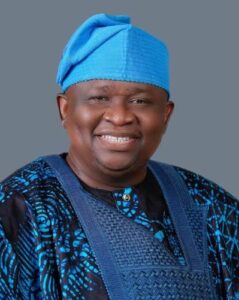
By all appearances, the public endorsement of (Yayi) by Governor was designed to steady the political landscape—an assurance of continuity, stability, and sustained progress.

But beyond the applause and carefully choreographed optics of party politics, a different mood is taking hold across Ogun State—especially within its most economically active corridors. It is not enthusiasm. It is not even conviction. It is fatigue.
And from that fatigue has emerged a quiet but unmistakable refrain: anything but the present.

That sentiment, more than anything else, explains the unusual warmth that greeted Adeola at the APC stakeholders’ meeting. By objective standards, he remains a relatively unfamiliar figure in Ogun’s governorship calculus. Yet, his reception was not built on an established local track record, but on something far less flattering to the incumbent—a growing erosion of public confidence in governance priorities.
This is not to suggest that the Abiodun administration has done nothing. There are projects to point to, initiatives to list, and sectors where activity has occurred. But governance is not measured by the mere presence of projects—it is measured by their coherence, impact, and alignment with the state’s economic realities.
And it is precisely here that the disconnect lies.
Across Ogun—particularly in the border communities adjoining Lagos—what is evident is not an absence of development, but a pattern of misdirected development. Projects appear isolated, poorly sequenced, and in some cases, disconnected from economic logic. Gains recorded in completed initiatives are steadily undermined by neglect in areas that matter most.
Nowhere is this contradiction more visible than in Ado-Odo/Ota and Ifo Local Government Areas. These are not peripheral zones; they are Ogun’s economic gateways—its interface with Lagos, Nigeria’s commercial nerve centre.
Logic would dictate sustained, deliberate investment in such corridors. Instead, what residents encounter is a stark discontinuity: functional infrastructure on the Lagos side collapsing almost immediately upon entry into Ogun. From Agbado to Ota, Ojodu Abiodun to Iju, Akute, Ijoko, and Lafenwa, the story is consistent—development does not transition; it stops.
The Agbado axis offers a particularly telling example. Lagos has extended its Red Line rail infrastructure to improve mobility and unlock economic opportunities. Yet, on the Ogun side, the complementary infrastructure needed to maximise that advantage remains largely absent.
Nearly two years on, what should have been a shared economic gain has become a one-sided intervention. This is more than an oversight—it is a failure of coordination, and more fundamentally, a failure of vision.
Infrastructure, especially roads, does not function in isolation—it is a system. Its value lies in connectivity. A road that leads nowhere, a transport project that is not integrated, or a rural intervention that cannot connect to urban markets—these are not achievements; they are missed opportunities disguised as progress.
This explains why even the administration’s flagship projects—such as the airport and agro-cargo hub—struggle to command widespread public confidence.
Under Governor Abiodun, project selection appears uneven at best, and ill-conceived at worst. When the state’s most strategic economic arteries are neglected, the value of projects located in less consequential areas becomes diminished.
Simply put: isolated transformation is no transformation.
The condition of key routes reinforces this reality. The Sango-Ota–Ijoko corridor, Ota-Idiroko Expressway, Ijebu-Ode–Epe road, and the Sango-Ota–Ogba Ayo–Oke-Aro–Akute road are not peripheral—they are lifelines. Their prolonged neglect raises difficult questions about prioritisation.
Why have the very corridors that sustain Ogun’s internally generated revenue been left to deteriorate, while attention is diverted elsewhere?
For many residents, the answer is uncomfortable. There is a growing perception that governance decisions have been shaped less by economic necessity and more by political considerations—including a reluctance to continue projects associated with predecessors.
Whether or not this is intentional, the outcome is clear: discontinuity, delay, and declining public trust.
Nowhere are the consequences more pronounced than in Ota itself. As one of the state’s most industrialised zones, it should represent Ogun’s strongest economic statement. Instead, it has become a study in contradiction—an industrial hub constrained by failing infrastructure.
Businesses face rising logistics costs. Workers endure punishing commute times. Investors encounter inefficiencies that should not exist in such a critical corridor. The zone that generates value for the state is paradoxically denied the infrastructure required to sustain that value.
The dysfunction extends into rural Ogun, particularly Yewa North. Even where roads exist—such as the Imasayi–Igan Okoto–Ayetoro Road—the issue is misalignment. Without proper linkage to major transport corridors, these projects underperform economically. Farm produce struggles to reach key markets like Lagos, and expected gains fail to materialise.
What remains are projects that exist physically but fall short functionally.
This is the core indictment: not that nothing has been done, but that too much of what has been done lacks integration within a coherent development strategy.
It is within this context that Adeola’s emergence is being interpreted. The enthusiasm surrounding him is less about proven capacity and more about a collective desire for departure—from a governance style many now perceive as inattentive to critical needs.
The optimism, in essence, is not about who he is—but about who he is not.
That is a difficult verdict for any administration.
As Ogun approaches 2027, the political conversation is shifting fundamentally. Continuity is no longer assumed to be a virtue; correction is increasingly seen as a necessity.
Voters are asking simpler, more grounded questions:
Are projects aligned with economic priorities?
Have critical corridors received attention?
Are past investments being completed—or quietly abandoned?
In answering these questions, roads have become the most credible witnesses. And across Ogun—from Ado-Odo/Ota and Ifo to the rural stretches of Yewa North—they tell a consistent story: one that challenges the narrative of progress and exposes the limits of selective development.
The implication is clear. Achievements, no matter how well-intentioned, cannot stand in isolation. When poorly integrated or overshadowed by neglect in strategic areas, they lose their value in the eyes of the people.
That is why the applause that greeted Adeola was not merely political—it was emotional. It carried a message, however understated: that the present has fallen short, and that even uncertainty now feels like an improvement.
For an incumbent administration, that may be the hardest judgment of all.