“It’s My Land, I Can Build What I Want” — Neighbour Floods Woman’s Compound With Roof Water, Challenges Her to Court
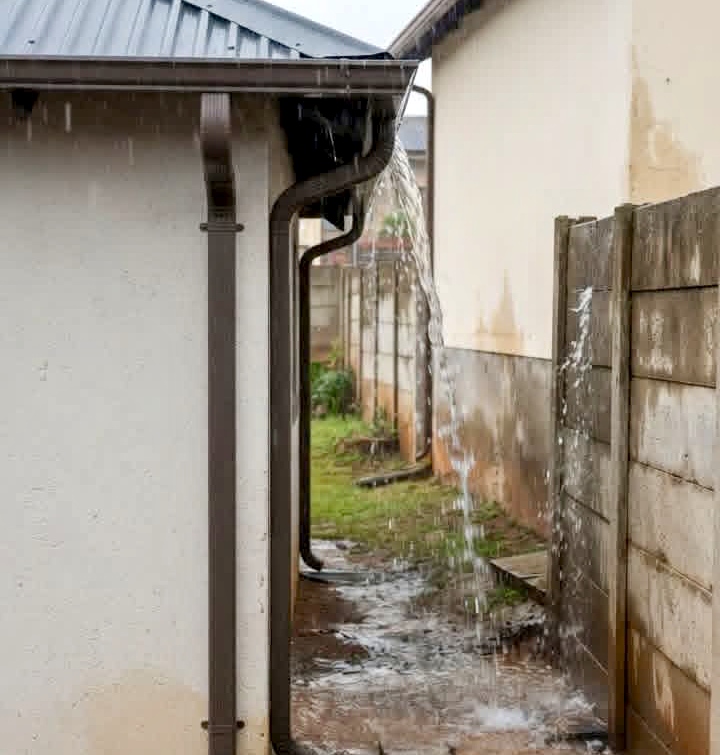
A property dispute has escalated between two neighbours after a man allegedly constructed his house so close to the boundary that rainwater from his roof now pours directly into the adjoining compound.
The aggrieved neighbour said the situation has resulted in persistent flooding and damage to part of her property, prompting her to confront the man and demand that he provide a proper drainage system.

According to her account, the neighbour began constructing the house about a year ago.

Although she noticed that the building was being erected very close to their boundary, she said she deliberately avoided confrontation because she did not want to create problems.
However, after the building was completed, she said the consequences became difficult to ignore.

Whenever it rains, water from the neighbour’s roof reportedly flows directly into her compound, flooding the area around her house and damaging part of her wall.
She said she approached the neighbour and asked him to find a way of redirecting the rainwater away from her property.
Rather than address the drainage problem, however, the neighbour allegedly responded:
“This is my house and my land. I can build whatever I want on my property. If rain falls on my roof, where do you want me to put the water?”
The woman said she reminded him that he could not deliberately direct water into another person’s compound, particularly where such discharge was causing damage.
According to her, the neighbour dismissed her concerns and challenged her to take the matter to court if she believed she had a case.
The dispute has now raised a broader property-law question: Does owning a piece of land give a property owner the unrestricted right to construct and drain water in whatever manner he chooses, even where it causes damage to a neighbouring property?
Does Land Ownership Permit It?
Generally, ownership of land does not mean that a property owner can use the property in a manner that unlawfully interferes with another person’s rights or causes avoidable damage to neighbouring property.
Where a building’s roof, gutters or drainage system is designed or constructed in such a way that rainwater is discharged onto a neighbour’s property and causes substantial flooding or damage, the affected neighbour may have legal grounds to seek redress.
Depending on the circumstances and evidence available, issues such as private nuisance, negligence, trespass, unlawful discharge of water and breaches of applicable building-control or drainage requirements may arise.
The fact that the neighbour owns the land does not automatically give him a licence to cause damage to another person’s property.
What Can The Affected Neighbour Do?
The first step is to properly document the problem.
The affected homeowner should take photographs and videos showing the direction of the water during rainfall, as well as the damage caused to the wall, compound and other parts of the property.
She should also retain repair estimates, receipts and any other evidence establishing the financial impact of the flooding.
A formal written complaint can then be made to the neighbour, requesting that an appropriate gutter, downpipe, drainage channel or other lawful solution be installed to prevent rainwater from being discharged into the adjoining compound.
Where the neighbour refuses to cooperate, the affected homeowner may also approach the relevant local planning or building-control authority for an inspection, particularly if there are concerns that the construction or drainage arrangement does not comply with approved requirements.
If the dispute remains unresolved, she may consult a property or civil litigation lawyer to determine whether court action is appropriate.
Depending on the facts, possible remedies could include an order requiring the neighbour to stop the offending discharge, an injunction against continuing interference and compensation for proven damage.
One Important Distinction
A property owner is not necessarily responsible for ensuring that absolutely no rainwater leaves his land.
The critical question is how the water is being discharged and whether the discharge amounts to an unreasonable or unlawful interference that is causing damage to the adjoining property.
Similarly, the fact that the woman noticed the construction and initially remained silent does not automatically mean that she has surrendered her legal rights. The significance of her earlier silence would depend on the particular circumstances.
Ultimately, the neighbour’s declaration that “this is my house and my land” does not, on its own, settle the dispute.
Land ownership comes with rights, but those rights are not necessarily unlimited where their exercise causes unlawful harm to another property owner.
For the woman, the immediate priority is to preserve evidence of the flooding and damage, seek an appropriate drainage solution and obtain professional legal advice before deciding whether to commence proceedings.