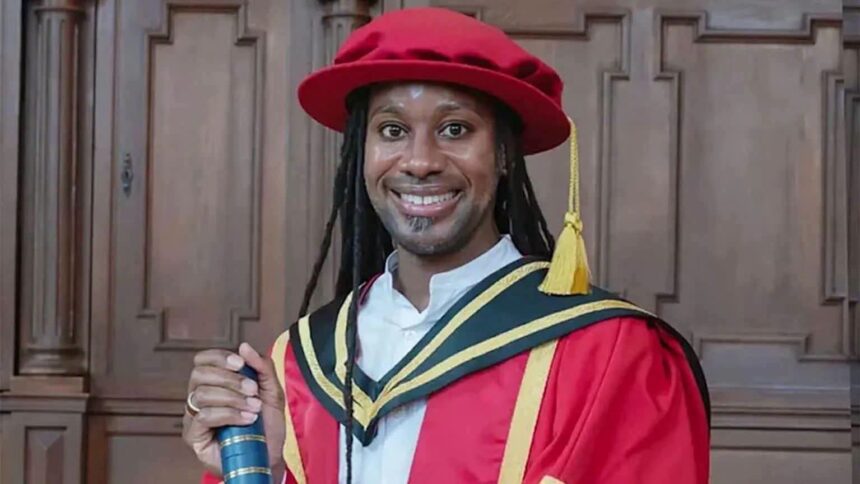
Jason Arday Dies at 41: Who Was He Before the Controversy?
Jason Arday, the sociologist whose remarkable rise through academia made him one of Britain’s most prominent Black scholars, has died at the age of 41.
Arday was found unresponsive at an address in Battersea, south London, on Friday afternoon. Police said his death was unexpected but is not currently being treated as suspicious. His cause of death has not been made public, with a report expected to be prepared for the coroner.

His death comes just days after he resigned from the University of Cambridge and Jesus College amid an academic controversy surrounding questions about his academic work and qualifications.

But before the controversy, Arday had built a career around an extraordinary personal and academic journey.
Born in London to Ghanaian parents, Arday reportedly did not speak until he was 11 and did not learn to read and write until he was 18.

Despite those early challenges, he went on to pursue higher education, earn a doctorate and establish himself as a sociologist whose work focused on race, inequality, social mobility and education.
In 2023, aged 37, he was appointed Professor of Sociology of Education at the University of Cambridge, becoming the university’s youngest Black professor.
His appointment was widely regarded as a significant milestone in British academia and reflected a career that had taken him from an unconventional educational beginning to one of the world’s most prestigious universities.
The controversy
Arday’s final months at Cambridge were marked by questions surrounding his academic record.
Allegations had been raised concerning plagiarism in his doctoral thesis and other publications. Arday denied deliberately engaging in wrongdoing.
His PhD had previously been investigated by Liverpool John Moores University. The institution did not uphold the plagiarism allegations, although it identified some matters it described as “honest and reasonable error.”
Cambridge later received new information and opened another investigation into questions surrounding his academic qualifications and honorary appointments, alongside separate complaints concerning alleged academic misconduct.
On August 5, Arday resigned from Cambridge and Jesus College.
Nine days later, he was dead.
The timing is striking, but it does not establish a connection between the controversy and his death.
There is currently no public evidence showing what caused his death, and his cause of death has not been announced.
Two separate questions
Arday’s death does not erase the legitimate questions that had been raised about his academic record. Those issues should be examined on the evidence, and any institutional failures in recruitment, vetting or oversight should be properly addressed.
At the same time, an unresolved academic controversy should not automatically be presented as an explanation for his death.
Those are separate matters.
The circumstances of his death remain a matter for the coroner and the relevant authorities.
What cannot be disputed, however, is the extraordinary nature of Arday’s journey.
A child who reportedly did not speak until the age of 11 and did not learn to read or write until 18 eventually became a professor at one of the world’s most prestigious universities.
His academic career may continue to attract scrutiny, and questions surrounding his work and Cambridge’s handling of the matter may remain subjects of debate.
But behind those headlines was a 41-year-old man whose life had been defined, at least in part, by an extraordinary rise through the education system.
Until the facts surrounding his death are established, speculation should give way to caution.
Whatever view is ultimately taken of the controversy surrounding Jason Arday, his death is a reminder that public figures remain human beings even when their professional lives become the subject of intense public scrutiny.