Senate Tightens Rules for Leadership Positions, Blocking New Entrants Including Outgoing Governors

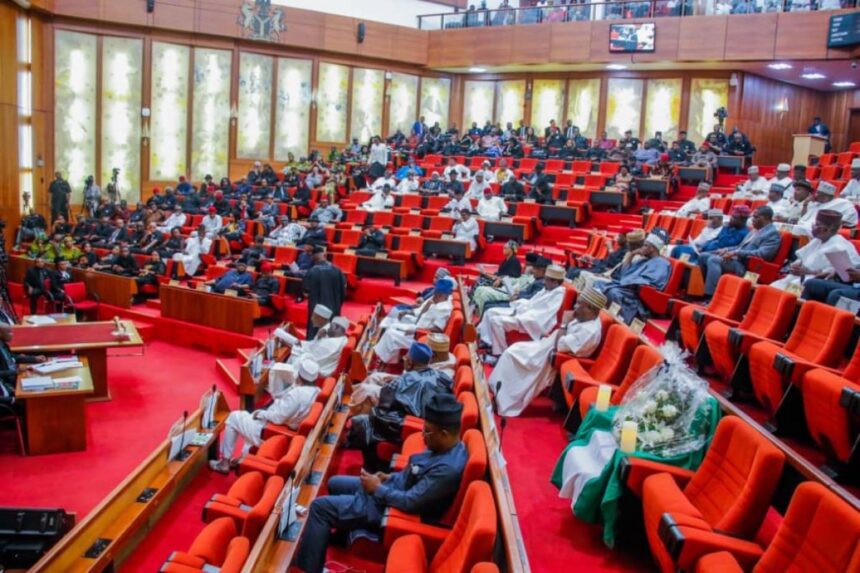
Barely a year before the inauguration of the 11th National Assembly, the Senate on Tuesday amended its Standing Rules in a move widely viewed as a pre-emptive strike to restrict access to its most powerful offices, effectively sidelining incoming lawmakers such as outgoing governors and political heavyweights.

After a nearly three-hour closed-door session, the upper chamber revised Orders 4 and 5 of its Standing Rules, introducing stricter eligibility criteria that prioritize ranking senators with substantial legislative experience for presiding and principal positions.
The amendments come as several outgoing governors and former senators position themselves to contest senatorial seats in the 2027 general elections with the aim of vying for top leadership roles, including Senate President and Deputy Senate President.

Under the revised Order 4, the Senate reinforced a clear hierarchy for the emergence of presiding officers. Nomination “shall be in accordance with the ranking of senators and shall be strictly adhered to,” the new rule states.
The stipulated order of ranking is: (i) Former President of the Senate, (ii) Former Deputy President of the Senate, (iii) Former Principal Officers of the Senate, (iv) Senators who had served at least one term of four years, (v) Senators who had been members of the House of Representatives, and (vi) first-time senators only in the absence of the above categories.
In addition, the amended Order 5 bars first-time and non-consecutive senators from contesting principal offices. It stipulates that “Any senator shall not be eligible to contest for any principal office of the Senate unless he has served as a senator for at least two consecutive terms immediately preceding nomination.”
The changes have far-reaching implications: senators-elect who were not members of both the 9th and 10th Assemblies will be ineligible to contest key leadership positions in the 11th Senate. Presiding offices include the Senate President and Deputy Senate President, while principal offices cover the Senate Leader, Deputy Senate Leader, Chief Whip, Deputy Whip, Minority Leader, Deputy Minority Leader, Minority Whip, and Deputy Minority Whip.
The rule changes coincide with an intensifying scramble for Senate seats ahead of the 2027 polls, driven largely by governors completing their two-term constitutional limits. At least 10 state governors are expected to leave office by May 29, 2027, with several already angling for senatorial tickets.
Those set to complete their tenures include Governors AbdulRahman AbdulRazaq (Kwara), Abdullahi Sule (Nasarawa), Ahmadu Fintiri (Adamawa), Babagana Zulum (Borno), Inuwa Yahaya (Gombe), Mai Mala Buni (Yobe), Babajide Sanwo-Olu (Lagos), Dapo Abiodun (Ogun), Seyi Makinde (Oyo, PDP), and Bala Mohammed (Bauchi, APM). Bayelsa’s Douye Diri and Imo’s Hope Uzodimma, whose tenures end in early 2028 due to off-cycle elections, have also been linked to early Senate calculations.
In Imo State, political tensions have escalated over the Imo West senatorial seat. The All Progressives Congress (APC) has positioned Governor Hope Uzodimma as the consensus candidate, with party leaders from the Orlu Zone purchasing his nomination form last Saturday. State APC Chairman Chief Austin Onyedebelu urged the governor to accept the ticket before the May 5, 2026 deadline and warned other aspirants to step aside.
Former Governor Rochas Okorocha has also purchased nomination forms in a bid to return to the Senate, setting the stage for a potential intra-party contest.
The Senate’s decision is seen as an effort to safeguard institutional experience and prevent politically powerful first-timers from immediately assuming control of the chamber. It sends a clear signal that legislative track record within the Senate, rather than external political influence, will determine leadership in the 11th National Assembly.
The amendments were passed amid reports that President Bola Tinubu recently rejected automatic return tickets for National Assembly members, further empowering state governors in candidate selection processes.