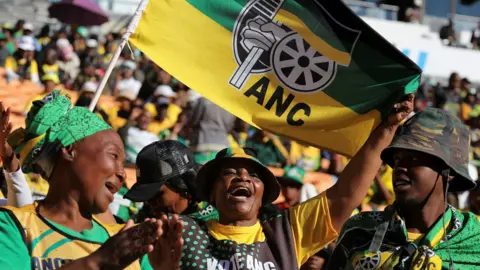

South Africa’s ANC Suffers Worst-Ever Election Defeat as Support Falls to 30.76%

NewsMediang.com

South Africa’s ruling African National Congress (ANC) has recorded its worst-ever electoral performance, securing just 30.76 per cent of the votes in the country’s 2026 municipal elections.
The result, announced by the Electoral Commission of South Africa (IEC) on Sunday, November 8, 2026, marks another significant setback for the party that led the struggle against apartheid and has dominated South African politics since the country’s transition to democracy in 1994.
Despite finishing as the largest political party nationally, the ANC experienced a sharp decline in support, falling from 45.59 per cent in the 2021 municipal elections to 30.76 per cent in the latest polls.
The Democratic Alliance (DA) emerged second with 24.64 per cent, while former President Jacob Zuma’s uMkhonto weSizwe (MK) Party secured 9.76 per cent.
The Economic Freedom Fighters (EFF) received 6.22 per cent, while ActionSA came fifth with 5.67 per cent.
The outcome reflects growing political fragmentation in South Africa, with voters distributing their support among several political parties.
ANC Faces Coalition Challenges
The election results have increased the likelihood of coalition negotiations across several municipalities, as no single party secured an outright majority in many local government councils.
According to the results, the ANC secured outright control of 53 municipalities and emerged as the leading party in 128 municipalities.
The DA secured outright control in 12 municipalities, while the Inkatha Freedom Party (IFP) won five. The MK Party secured control of three municipalities.
The fragmented results mean political parties will have to negotiate alliances to form administrations in several councils.
Service Delivery and Public Dissatisfaction
The election comes amid widespread concerns over unemployment, corruption, infrastructure challenges and inadequate municipal services.
Issues including water shortages, electricity outages, poorly maintained roads and inefficient waste collection featured prominently in the election campaign.
ANC Secretary-General Fikile Mbalula previously described the party’s performance as catastrophic, acknowledging that communities had experienced failures in essential service delivery.
The party’s declining electoral fortunes also follow its loss of an outright parliamentary majority in the 2024 national elections, ending three decades of uninterrupted dominance.
What the Results Mean for South Africa
The latest outcome signals a changing political landscape in South Africa, where the ANC can no longer rely on the level of electoral dominance it enjoyed in previous decades.
Coalition negotiations are expected to play a major role in determining the leadership of several municipalities, particularly major urban centres.
The results also present a significant test for the ANC as it seeks to rebuild public confidence ahead of future national political contests.
For South African voters, the immediate challenge will be whether the emerging coalition administrations can deliver improvements in infrastructure, public services and local governance.
NewsMediang.com reports that the 2026 municipal election results represent a major development in South Africa’s democratic and political history.