The Long Road to Literary Glory: Inside Nigeria’s Most Prestigious Literary Prize sponsored by NLNG

A Feature Story by Newsmediang.com

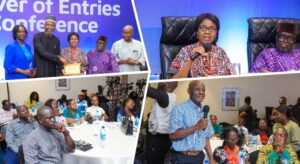

There were no dramatic readings or performances, only a symbolic but weighty transfer: manuscripts moving from organisers to judges, from possibility to scrutiny. Yet within those pages lies the future of contemporary Nigerian poetry.
In a room filled with anticipation rather than applause, 224 literary works quietly changed hands—marking the start of a journey that will end with just one winner.
At the centre of it all is the Nigeria Prize for Literature, one of Africa’s most prestigious literary honours, valued at $100,000. This year, 2026 the spotlight returns to poetry—a genre that demands less volume, but far more precision.
“This is the beginning of a process that requires attention, patience, and sound judgement,” said Dr. Sophia Horsfall, General Manager, External Relations and Sustainable Development at NLNG, as she addressed stakeholders at the handover ceremony in April 2026. “One that will run its course and ultimately determine the outcome of this year’s Prize.”
A Genre That Leaves No Room to Hide
Poetry is often romanticised as free-flowing and expressive. But for those who judge it—and those who write it—it is arguably the most exacting form of literature.
“Poetry… requires a particular kind of attention,” Horsfall noted. “One that values precision, depth, and the ability to express complex ideas in a few words and with clarity. In many cases, a single line defines the entire piece.”
That idea was echoed, even more starkly, by Professor Akachi Adimora-Ezeigbo, Chairman of the Advisory Board, who will oversee the adjudication process.
“There is very little room to hide,” she said. “One cannot rely on length or excessive explanation. Every line must be precise; every word must justify its presence.”
It is this unforgiving nature that makes the poetry cycle both daunting and revered. For many writers, it is the ultimate test of craft.
224 Voices, One Outcome
This year’s competition attracted 224 entries—a number that signals not just participation, but persistence. Behind each submission is a writer willing to subject their work to one of the most rigorous literary evaluations on the continent.
From this pool, a longlist of eleven will emerge, then a shortlist of three, before a final winner is announced in October.
But the real work begins now.
“This moment marks an important transition,” Adimora-Ezeigbo explained. “It is the point at which responsibility for the submitted works formally passes into the hands of the Advisory Board and the panel of judges.”
What follows is months of reading, debate, and careful consideration—often invisible to the public, but central to the Prize’s credibility.
“We read thoroughly and independently,” she said. “Where necessary, we interrogate the works… and assess them against a standard that has been carefully built, refined, and sustained over time.”
Beyond the Prize Money
While the $100,000 award inevitably draws attention, both organisers and judges insist that the real value of the Prize lies elsewhere.
“While the Prize money understandably attracts initial attention, what follows is far more significant,” Adimora-Ezeigbo said. “The sustained relevance of the work, the conversations it stimulates, and the influence it exerts over time are the true measures of the Prize’s impact.”
Past winners have often gone on to shape literary discourse, with their works studied, debated, and referenced long after the award night.
One such benchmark is Nomad by Romeo Oriogun, which won the poetry category in 2022. The collection, described as “layered” and “introspective,” continues to serve as a standard against which new works are measured.
A Cultural Moment, Not Just a Competition
For NLNG, the Prize is not just a corporate initiative—it is a cultural investment.
“We have provided the platform, but the credibility of the Prize rests on the integrity of its process and the quality of the works it attracts,” Horsfall said.
Over the years, the Prize has done more than recognise literary talent. It has helped shape reading culture, encouraged discipline among writers, and created a space for Nigerian stories to evolve with confidence.
Perhaps more importantly, it has become a national conversation.
“Annually, the Nigeria Prize for Literature ignites a spirited conversation that extends far beyond the literary community,” Horsfall added. “It sparks anticipation, debate, critical reflection, and cultural engagement.”
That conversation is amplified by the media, whose role extends beyond reporting to shaping public engagement with literature.
The Weight of Judgement
As the manuscripts begin their journey through the adjudication process, the responsibility now rests heavily on the judges.
“The credibility of this Prize rests on your ability to make difficult decisions with fairness,” said Anne-Marie Palmer-Ikuku, NLNG’s Manager, Corporate Communication and Public Affairs, in her closing remarks.
Her message underscored a simple but powerful truth: that the strength of the Prize lies not just in the entries it receives, but in the integrity of the decisions it produces.
“In the months ahead,” she said, “what happens next will require critical attention, unbiased judgement… In the end, it will produce an outcome that reflects the standard this Prize has come to represent.”
The Quiet Wait
For now, the room has emptied. The speeches are over. The entries are no longer just submissions—they are contenders.
While some will be set aside. A few will rise. One will endure.
And somewhere within those 224 collections of verse, a voice is waiting—not just to win, but to define this moment in Nigerian literature.