Trump Gets What He Wanted in Greenland As Denmark Approves Major Security Agreement


Denmark’s parliament has unanimously approved a major security agreement with the United States and Greenland, marking a significant diplomatic breakthrough for US President Donald Trump following months of tensions over his ambition to bring the strategically important Arctic island under American control.

The agreement, approved on Thursday, November 19, 2026, received the backing of all 109 lawmakers who participated in the vote at Denmark’s parliament, known as the Folketing, with no votes against.
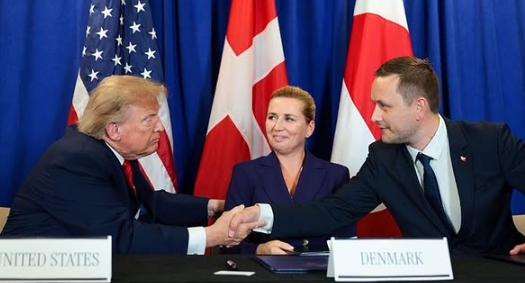
The development clears a major legislative hurdle for the trilateral security arrangement signed by Trump, Danish Prime Minister Mette Frederiksen and Greenlandic Prime Minister Jens-Frederik Nielsen in New York on September 22.
Greenland’s parliament had earlier approved the agreement in November, recording 16 votes in favour, none against and seven abstentions.
The deal is expected to significantly expand America’s military presence in Greenland, while establishing a framework for closer security cooperation among the United States, Denmark and the self-governing territory.
What Trump Secured From the Greenland Deal
Under the agreement, the United States will be allowed to expand its military operations and infrastructure in Greenland, including modernising its existing Pituffik Space Base in the northwestern part of the island.
The arrangement also provides for the establishment of additional US defence areas at Narsarsuaq in southern Greenland and Mestersvig in the east.
Further military facilities and defence installations could be established under the agreement, subject to its provisions.
The deal also supports the proposed US Golden Dome missile defence system and strengthens cooperation on Arctic and North Atlantic security.
Importantly, the agreement builds on the existing 1951 defence arrangement between Washington and Copenhagen, which already provides a legal framework for American military activities in Greenland.
The expanded security partnership is intended to strengthen NATO’s defence capabilities in the Arctic, a region that has become increasingly important amid growing geopolitical competition involving the United States, Russia and China.
Greenland Will Not Become American Territory
Despite the development being viewed as a diplomatic victory for Trump, the agreement does not transfer ownership of Greenland to the United States.
Greenland remains a self-governing territory within the Kingdom of Denmark, with its own parliament and government responsible for most domestic affairs.
The agreement reaffirms Danish sovereignty and recognises the right of Greenlanders to determine their political future.
It will also remain in force even if Greenland eventually achieves independence from Denmark, subject to the agreement’s provisions.
This distinction is significant because Trump had repeatedly expressed interest in bringing Greenland under American control, arguing that the island is vital to US national security.
His comments, including his refusal to rule out the use of force, had generated serious diplomatic tensions between Washington and Copenhagen and raised concerns among other NATO members.
Denmark and Greenland had consistently maintained that the island was not for sale and that its future should be determined by its people.
Why Greenland Matters to the United States
Greenland occupies a strategically important position between North America and Europe, making it central to military surveillance, missile defence and security operations across the Arctic and North Atlantic.
Its geographical location provides an important advantage for monitoring military activities and potential threats approaching North America and Europe.
The island also possesses significant mineral resources, including deposits considered important to modern technology and strategic industries.
As competition for influence in the Arctic intensifies, Washington has increasingly viewed Greenland as an important part of its long-term security and geopolitical strategy.
The new agreement is also designed to limit the potential influence of countries outside NATO and the European Union in certain strategic sectors of Greenland, particularly critical infrastructure and sensitive investments.
What Happens Next?
With both Denmark and Greenland having approved the agreement, the remaining step is formal diplomatic notification to the United States confirming that their respective parliamentary procedures have been completed.
The agreement will enter into force after the necessary notification is communicated to Washington.
It does not require ratification by the United States Senate.
The US Ambassador to Denmark, Kenneth Howery, welcomed the Danish parliament’s approval, describing it as a major achievement that would modernise the security partnership and strengthen the defence of the United States, Denmark, Greenland and NATO.
However, questions remain about how the expanded American military presence will work in practice and how Denmark and Greenland will balance their interests with Washington’s growing strategic ambitions in the Arctic.
For Trump, the parliamentary approval represents an important diplomatic achievement in his effort to strengthen American influence over one of the world’s most strategically significant territories.
While the United States has not acquired Greenland, the agreement gives Washington a broader framework for expanding its military footprint on the island.
NewsMediang.com reports that the development marks a significant shift in Arctic security cooperation, even as questions surrounding Greenland’s sovereignty, independence and long-term relationship with the United States remain central to the debate.