Trump Promises $5,000 (₦6M) Payout to Every Adult American If Republicans Win Elections in November
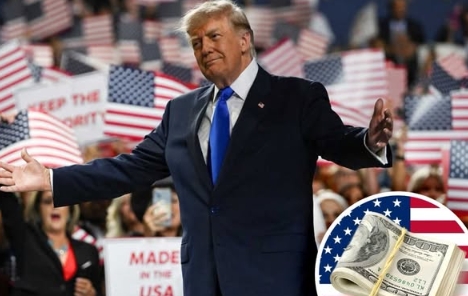
US President Donald Trump has promised that every adult American could receive a $5,000 government payout if Republicans win control of both chambers of Congress in the November midterm elections.

Trump made the pledge as Republicans intensify their campaign ahead of the crucial elections, where control of the House of Representatives and Senate will be at stake.

The proposed payment, which could benefit nearly 270 million American adults, would potentially cost the US government about $1.3 trillion if implemented universally.
However, Trump has yet to provide detailed information on how the proposed payout would be funded, who exactly would qualify, when payments would be made or what mechanism would be used to distribute the money.

The president’s proposal has already triggered questions over its financial viability, legality and potential impact on the country’s already substantial federal debt.
Trump Links Payout to GOP Victory
Trump’s announcement effectively ties the proposed financial benefit to Republican success at the ballot box.
He said the payment would become possible if Republicans secure victories in both the House and Senate during the November midterm elections.
The proposal comes as Trump seeks to maintain Republican control of Congress and rally his political base around his administration’s economic agenda.
Trump has previously promoted the use of revenue generated from tariffs as a source of funds for initiatives benefiting Americans.
But critics argue that the amount of tariff revenue available would not be sufficient to finance a universal $5,000 payment on the scale being proposed.
Potential $1.3tn Cost
With an estimated 270 million adults potentially eligible, a $5,000 payment to each recipient would amount to approximately $1.35 trillion.
Even if the number of eligible recipients were significantly lower, the programme would still represent one of the largest direct federal cash distributions in US history.
Economists and fiscal policy analysts are therefore expected to scrutinise the proposal over its implications for government spending, inflation, borrowing and the national debt.
Questions have also emerged over whether higher-income Americans would be eligible.
While Trump presented the idea broadly as a payment to adult Americans, discussions surrounding the proposal have suggested that eligibility could ultimately be restricted, particularly for wealthier households.
Democrats Reject Proposal
Democrats have dismissed Trump’s announcement as an “empty promise,” arguing that the president has failed to explain how the government would finance such a massive programme.
Critics also questioned whether Trump has the legal authority to establish the payment without congressional legislation.
A programme involving hundreds of billions or more than $1 trillion in federal expenditure would ordinarily require congressional approval and a clearly defined funding mechanism.
The controversy has therefore shifted attention from the appeal of a $5,000 payment to the practical question of who would pay for it and how.
Midterm Elections Take Centre Stage
Trump’s promise comes at a politically sensitive period as Republicans campaign to retain their influence in Congress.
The November midterms will determine the balance of power on Capitol Hill and could significantly affect Trump’s ability to advance his legislative agenda during the remainder of his presidency.
By linking the proposed payout to a Republican victory, Trump has added an economic incentive to his broader campaign message and placed the issue of household finances at the centre of the midterm debate.
For millions of Americans, however, the key question remains whether the promised $5,000 dividend can move from a campaign pledge to an actual government programme.
Until details of its financing, eligibility and legal framework are made public, the proposal remains a politically powerful promise with a potentially enormous price tag.