Turkey vs Israel: Military Power Comparison 2026 — Who Has the Stronger Army?

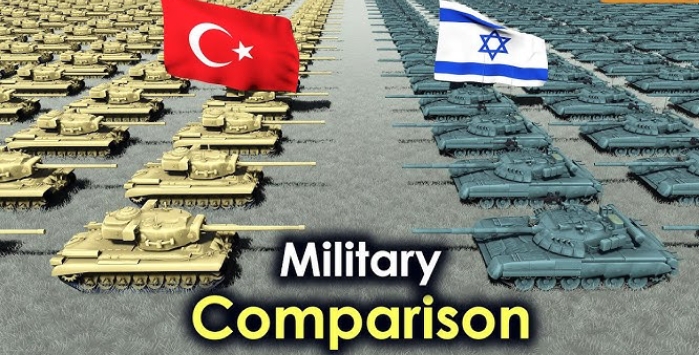
Turkey and Israel are both among the most capable military powers in the Middle East and surrounding region, but they derive their strength from very different advantages.

According to Global Firepower’s 2026 comparison, Turkey ranks 9th globally, ahead of Israel at 15th, based on a broad assessment of manpower, equipment, finances, logistics and other conventional military factors.

🇹🇷 Turkey vs 🇮🇱 Israel — Key Figures
Category Turkey Israel Advantage
Global Firepower rank 9th 15th 🇹🇷 Turkey
Active personnel 481,000 169,500 🇹🇷 Turkey
Reserve personnel 380,000 465,000 🇮🇱 Israel
Defense budget $51.4bn $34.6bn 🇹🇷 Turkey
Total aircraft 1,101 597 🇹🇷 Turkey
Fighter aircraft 201 239 🇮🇱 Israel
Tanks 2,284 1,300 🇹🇷 Turkey
Armoured vehicles 98,193 62,380 🇹🇷 Turkey
Self-propelled artillery 1,045 323 🇹🇷 Turkey
Naval vessels 192 82 🇹🇷 Turkey
Submarines 14 6 🇹🇷 Turkey
Frigates 17 0 🇹🇷 Turkey
Attack helicopters 111 48 🇹🇷 Turkey
Figures are 2026 Global Firepower estimates and should not be interpreted as exact operational inventories.
🇹🇷 Turkey: The Larger Conventional Military
Turkey has the clear advantage in manpower, land forces and naval strength.
Its 481,000 active personnel are almost three times Israel’s reported 169,500. Turkey also has a larger reserve force of 380,000, although Israel has more reservists at 465,000.
Turkey also possesses a much larger conventional land force, including more than 2,200 tanks, almost 100,000 armoured vehicles and more than 1,000 self-propelled artillery systems in Global Firepower’s 2026 inventory.
At sea, Turkey has a major numerical advantage, with 192 naval vessels, 14 submarines and 17 frigates, compared with Israel’s 82 vessels, six submarines and seven corvettes.
Turkey’s defence-industrial base also gives it significant advantages in drones, armoured vehicles, naval platforms and indigenous weapons production.
🇮🇱 Israel: Smaller Force, Advanced Technology
Israel cannot match Turkey in overall manpower or conventional military volume, but raw numbers do not tell the entire story.
Israel has 239 fighter aircraft, compared with Turkey’s 201, according to Global Firepower. Israel also has a larger aerial tanker fleet, with 13 compared with Turkey’s seven.
The Israeli military’s major strengths include advanced airpower, intelligence, electronic warfare, precision weapons, missile defence and highly trained reserve forces.
Israel’s military is also structured around rapid mobilisation. Its 465,000 reservists give it a substantial pool of personnel that can be activated during a major conflict.
Another important factor is Israel’s sophisticated missile-defence architecture and its strategic relationship with the United States, which provides access to advanced weapons, intelligence and military technology.
Air Force: Israel Has the Edge in Quality
This is arguably the most difficult category to judge.
Turkey has more aircraft overall — 1,101 versus 597 — but Israel has more fighter aircraft, 239 versus 201.
Israel’s fleet includes the F-35I Adir, one of the world’s most advanced operational fighter aircraft. Turkey currently relies heavily on its large F-16 fleet while continuing to develop and procure newer indigenous systems.
Therefore, if the question is quantity, Turkey has the advantage.
If the question is high-end combat capability, stealth, intelligence integration and precision strike, Israel has a strong advantage.
Navy: Clear Turkish Advantage
Turkey has a significantly larger navy.
Global Firepower lists Turkey with 14 submarines and 17 frigates, while Israel has six submarines and no frigates in the same dataset. Turkey also operates a helicopter carrier.
For a prolonged conventional naval conflict, Turkey’s larger fleet, geographic position and shipbuilding capacity would give it considerable advantages.
Army and Ground War: Turkey
On conventional ground warfare, Turkey is clearly stronger in numbers.
Turkey has more personnel, tanks, armoured vehicles and artillery. Its 2026 Global Firepower figures show Turkey with 2,284 tanks compared with Israel’s 1,300, and 1,045 self-propelled artillery systems compared with Israel’s 323.
However, Israel has extensive combat experience and highly developed intelligence, surveillance, precision-strike and combined-arms capabilities.
Defence Spending: Turkey Spends More in Absolute Terms
Global Firepower estimates Turkey’s 2026 defence budget at approximately $51.4 billion, compared with $34.6 billion for Israel.
But Israel devotes a much larger proportion of its economy to defence. One 2026 comparison puts Israeli military spending at about 7.3% of GDP versus roughly 1.7% for Turkey.
So Turkey spends more in absolute dollars, while Israel has a much heavier defence burden relative to the size of its economy.
Verdict: Who Is Stronger?
For overall conventional military power: 🇹🇷 Turkey.
Turkey has the advantage in:
👥 Active manpower
🪖 Ground forces
🛡️ Tanks and armoured vehicles
💥 Artillery
✈️ Total aircraft
🚢 Naval strength
🐋 Submarines
💰 Total defence spending
🏭 Defence-industrial scale
Israel, however, has major advantages in high-end military technology and combat capability, particularly in advanced fighter aircraft, intelligence, missile defence, precision strike and military technology.
The bottom line
Turkey is the stronger large-scale conventional military power, while Israel is arguably the more technologically sophisticated and combat-focused force.
A hypothetical Turkey-Israel conflict therefore cannot be decided simply by counting tanks or soldiers. Geography, air superiority, intelligence, missile defence, logistics, alliances, mobilisation and the duration and location of a conflict would dramatically affect the outcome.
Global Firepower’s 2026 assessment nevertheless gives Turkey the overall conventional advantage, ranking it 9th in the world versus Israel’s 15th.
Overall winner by conventional military scale: 🇹🇷 TURKEY
High-end technological/combat capability: 🇮🇱 ISRAEL