University of Ibadan Honours Customs Boss Adeniyi for Security, Revenue Contributions

NewsMediang.com

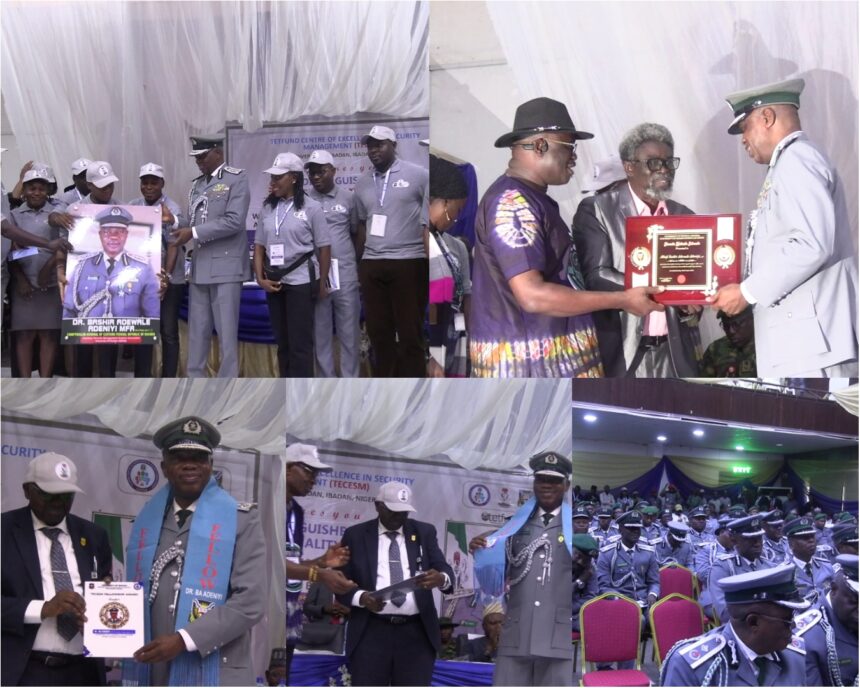
The Comptroller-General of the Nigeria Customs Service (NCS), Bashir Adewale Adeniyi, has been honoured as a Fellow of the TETFund Centre of Excellence in Security Management (TECESM), University of Ibadan, while calling for stronger intelligence-led border management to protect Nigeria’s revenue, security and national sovereignty.

Adeniyi received the recognition on Tuesday, October 20, 2026, during the third Distinguished Personality Lecture organised by TECESM at Trenchard Hall, University of Ibadan, where he delivered a lecture titled, “Why Customs Matters: Revenue, Security and Nationhood in a Borderless World.”
The Customs chief argued that the growth of global trade and digital commerce has not made national borders irrelevant. Instead, he said, the increasing movement of goods, money and people across countries has made effective customs administration more important.
He maintained that the Nigeria Customs Service occupies a strategic position at the intersection of revenue generation, national security and the preservation of Nigeria’s sovereignty.
MV Velika Arms Seizure Highlights Customs’ Security Role
Using three scenarios to illustrate the Service’s importance, Adeniyi cited the interception of 399 pump-action rifles and hundreds of firearm components aboard the vessel MV Velika at Tin Can Island Port, Lagos, in July 2026.
He said the discovery resulted from the Service’s risk-management system, rather than chance, adding that the seized items had been handed over to the National Centre for the Control of Small Arms and Light Weapons.
The Customs chief declined to disclose further details because suspects were already facing proceedings before the Federal High Court.
He also recalled the interception of 844 rifles and 112,500 rounds of ammunition at a bonded terminal in Onne, Rivers State, in June 2024, as well as the handover of 1,599 seized firearms to the national small-arms control centre in February 2025.
According to him, preventing illicit weapons from entering the country is particularly important as Nigeria approaches the 2027 general elections.
Adeniyi also identified counterfeit medicines, illicit drugs, wildlife trafficking, fuel smuggling and the illegal movement of essential commodities as threats requiring stronger border surveillance and inter-agency cooperation.
He stressed that Customs works alongside agencies such as the National Drug Law Enforcement Agency, the National Agency for Food and Drug Administration and Control, and the Economic and Financial Crimes Commission to tackle different forms of illicit trade.
Customs Generates Trillions for Government
On revenue, Adeniyi disclosed that the Service collected ₦3.2 trillion in 2023, ₦6.105 trillion in 2024 and ₦7.28 trillion in 2025, exceeding its ₦6.58 trillion target for the latter year.
He said the Service was targeting ₦11.07 trillion in revenue for 2026 and had collected approximately ₦4.03 trillion in the first half of the year.
While acknowledging the influence of exchange-rate adjustments on revenue growth, he attributed the improved performance also to stronger valuation procedures, digital platforms, risk management and enforcement.
He explained that customs revenue contributes to the Federation Account, which funds government responsibilities across federal, state and local levels.
According to him, revenue collected at seaports, airports and land borders ultimately supports public services, including education, healthcare and infrastructure.
“A nation that cannot fund itself cannot govern itself,” Adeniyi said, stressing that revenue generation should be pursued through compliance, technology and trade facilitation rather than harassment of legitimate businesses.
He also called for a review of import duty concessions valued at approximately ₦1.68 trillion in 2024, arguing that the government should assess whether such waivers were achieving their intended economic objectives.
Adeniyi Advocates Intelligence-Led Border Management
Addressing the relationship between border control and nationhood, the Customs boss said Nigeria’s border communities require an approach that combines effective law enforcement with respect for historical, cultural and economic ties.
Using the example of a market woman who has traded across the Idiroko border between Ogun State and the Republic of Benin for two decades, he explained that many border residents share languages, family relationships and commercial interests across national boundaries.
He said Customs must enforce the law without unnecessarily disrupting legitimate cross-border trade.
Adeniyi cited the ECOWAS Trade Liberalisation Scheme as one of the mechanisms through which eligible goods of community origin can move legally across participating countries.
He argued that making legitimate trade easier would encourage traders to use authorised channels instead of resorting to smuggling routes.
Reflecting on Nigeria’s land border closure between August 2019 and December 2020, he said the experience demonstrated the limitations of relying on blanket restrictions to eliminate smuggling.
According to him, the closure disrupted some illegal activities but did not dismantle the networks responsible for them.
“The lesson is that a nation is protected by intelligent control of its border, not by sealing it,” he said, advocating intelligence sharing, data-driven operations and joint patrols with neighbouring countries.
Customs Modernisation and Digital Trade
Adeniyi also challenged the idea that digital commerce had rendered customs institutions obsolete.
He noted that online shopping, international supply chains and electronic transactions continued to depend on national regulatory frameworks, even as governments sought to facilitate faster movement of goods.
He pointed to the Nigeria Customs Service’s B’Odogwu digital clearance platform and the Authorised Economic Operator programme as examples of reforms intended to improve efficiency and compliance.
He said the Service was pursuing faster cargo clearance while strengthening its ability to identify suspicious consignments and protect government revenue.
The Customs chief maintained that technology should help the Service distinguish compliant traders from high-risk transactions, allowing legitimate businesses to operate more efficiently while enforcement resources are directed towards potential violations.
Calls for University Collaboration
Adeniyi called on the University of Ibadan, TECESM and the Tertiary Education Trust Fund to deepen collaboration with the Nigeria Customs Service in research, training and policy development.
He proposed cooperation in areas including border-economy research, data analytics fellowships, an illicit-trade observatory, postgraduate studies on border management and independent evaluation of Customs reforms.
He said stronger links between academics and practitioners would improve policy decisions and help the Service respond to emerging challenges in international trade and security.
In his welcome address, TECESM Director, Professor Benjamin Aluko, said the lecture was part of the centre’s efforts to promote intellectual engagement and strengthen security management in Nigeria.
The outgoing Vice-Chancellor of the University of Ibadan, Professor Kayode Adebowale, also underscored the importance of Customs administration to national security, economic development and sovereignty.
He commended the Service’s revenue performance and digital reforms, while urging students and security professionals to develop expertise in data analysis, intelligence, trade monitoring and criminal networks.
The event featured the presentation of the 54-chapter book Perspectives on Security Management in Nigeria and the first edition of the Ibadan Security Review, published in May 2026.
The investiture of Adeniyi as a TECESM Fellow was one of the highlights of the programme.
Other attendees included TETFund Executive Secretary, Arc. Sonny Echono; incoming University of Ibadan Vice-Chancellor, Professor Peter Olapegba; former Vice-Chancellor, Professor Abel Idowu Olayinka; former Chief of Army Staff, Lieutenant-General Tukur Yusuf Buratai (retd.); and representatives of security agencies.