US.-ISRAEL VS IRAN: THE DEFENSIVE GAUNTLET: TECHNOLOGY, DETERRENCE AND THE URGENT NEED FOR STRATEGIC RESTRAINT

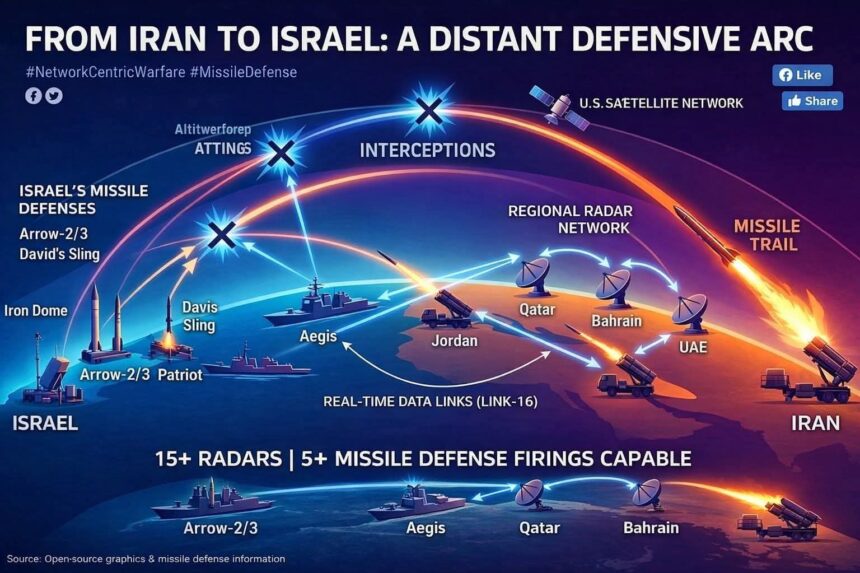
In today’s security environment, a missile launched from Iran toward Israel does not travel through empty sky, it enters one of the most sophisticated, battle-tested, and multilayered defense networks ever assembled.

What was once theoretical is now operational reality.

From the moment of launch, infrared early-warning systems, including U.S. space-based detection networks, identify heat signatures within seconds. Data is rapidly transmitted to ground-based radar systems across the region, forming a near-instantaneous coalition response architecture that spans air, sea, cyber, and space domains.
In the mid-course phase, advanced interception systems such as Arrow 3 are designed to neutralize threats beyond the atmosphere, minimizing debris risks and protecting civilian populations. U.S. naval assets equipped with Aegis systems reinforce this exo-atmospheric shield, underscoring the multinational dimension of deterrence.
As projectiles transit regional airspace, coalition forces, including U.S., European, and regional partners, provide layered interception capabilities, targeting both ballistic threats and accompanying cruise missiles or drones intended to overwhelm defenses. Air superiority platforms serve not only as combat aircraft, but as mobile intelligence and tracking nodes.
Should a threat penetrate these outer rings, it encounters terminal systems such as Arrow 2, David’s Sling, and emerging directed-energy platforms like Iron Beam, each layer calibrated to protect civilian centers and critical infrastructure.
Yet beyond the engineering lies a deeper strategic truth.
The defining challenge of 2026 is not merely technological sophistication — it is sustainability. The arithmetic of attrition, interceptor stockpiles, and saturation tactics reflects a dangerous shift toward volume-based escalation. When hundreds of projectiles are launched simultaneously, the risk is not only physical destruction, but systemic depletion and miscalculation.
This evolving landscape sends a powerful message:
Deterrence is real.
Coordination is unprecedented.
But escalation carries exponential consequences.
Every missile launched risks widening a conflict that could destabilize an entire region. Every interception underscores both capability and fragility. The more advanced the defensive shield becomes, the more urgent the responsibility to prevent its constant activation.
Security cannot rest solely on layers of steel, code, and laser energy. It must ultimately rest on diplomacy, communication, and strategic restraint.
The existence of a defensive gauntlet should serve not as an invitation to test it, but as a reminder of how close the region stands to a tipping point.
Strength must be balanced with wisdom.
Capability must be guided by responsibility.
And deterrence must create space for dialogue, not permanent confrontation.