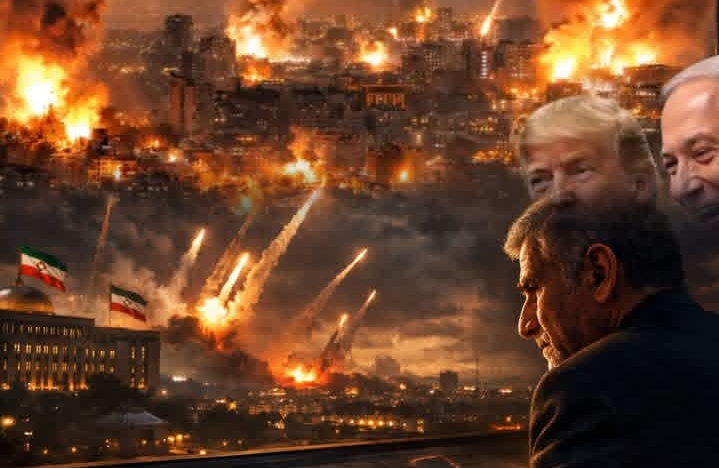
US–Israeli Airstrikes Hammer Tehran in Heaviest Night of War as Iran Fires Missiles at Israel

The Iranian capital, Tehran, witnessed its most intense bombardment yet late Monday night as joint airstrikes by the United States and Israel targeted key military sites across the city, marking Day 11 of the escalating conflict with Iran.

Residents across multiple districts reported waves of powerful explosions that shook buildings through the night, triggering widespread power outages and sending thick columns of smoke rising into the skyline.
The bombardment is believed to be the most aggressive round of attacks since the war erupted on February 28.

Targets Across the Capital
According to military sources, the strikes focused on strategic locations believed to be linked to Iran’s defence infrastructure, including facilities associated with the Islamic Revolutionary Guard Corps (IRGC).
Among the reported targets were:
IRGC command and administrative headquarters
Weapons research and development facilities
Strategic military installations surrounding Tehran
The operation reportedly involved a large formation of fighter jets and long-range bombers deployed in coordinated waves.
U.S. Defence Secretary Pete Hegseth described the operation as “the most intense day of strikes so far” since hostilities began.
Civilian Impact Reported
Iranian state media said the strikes also affected residential neighbourhoods located near military installations.
Local reports suggest dozens of civilians may have been killed in several districts.
Videos circulating on social media showed:
Buildings partially destroyed by blast waves
Large fires are burning through the night
Emergency responders rushing to the affected areas
Authorities have yet to release an official casualty figure, but humanitarian concerns are growing as the conflict deepens.
Iran Warns of Oil Disruption
Iranian officials say the country will continue resisting the attacks and warned that further bombardment could trigger retaliation targeting global energy routes.
Leaders in Tehran indicated Iran could attempt to block oil shipments through the Persian Gulf — one of the world’s most critical oil transit corridors.
Former U.S. President Donald Trump warned that any disruption to international oil supply routes would provoke significantly stronger retaliation from Washington.
Missiles Fired Toward Israel
In response to the strikes, Iran launched fresh missile barrages toward Israel overnight.
Israeli authorities said most of the incoming missiles were intercepted by national defence systems, preventing major damage.
However, air raid sirens reportedly sounded across several Israeli cities as the attacks unfolded.
Rising Death Toll
The war, which began on February 28, was launched with the stated objective of weakening Iran’s nuclear and missile capabilities.
Local sources estimate that more than 1,300 people may have been killed in Iran since the start of the conflict, although the numbers remain difficult to independently verify.
Analysts warn that without diplomatic intervention, the fighting could expand across the Middle East, raising the risk of a broader regional war.