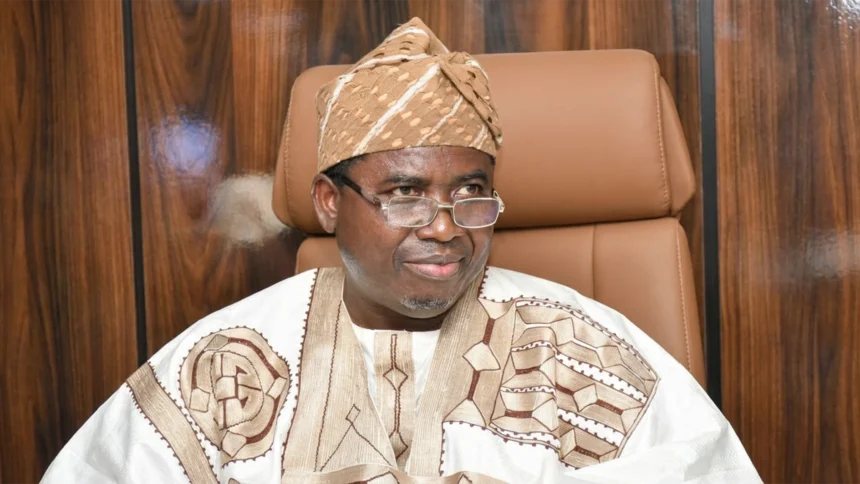
2027 Election: ‘I Have Handed Everything Over to God’ – INEC Chairman
The Chairman of the Independent National Electoral Commission (INEC), Prof. Joash Ojo Amupitan, has said he has handed everything over to God as he prepares to lead the commission in conducting Nigeria’s 2027 general election.
Amupitan disclosed this on Wednesday at the Artificial Intelligence and Democracy Forum 2026 in Abuja, where he spoke about the enormous responsibility of conducting credible elections in Africa’s most populous nation.

He said his faith in God remained a source of strength and reassurance amid the challenges associated with his position.

“I’m being reminded of the enormity of the task on me. I’m also encouraged by the word of God, which is, ‘Come unto me, all you that labour and are heavy laden, and I will give you rest.’ So that has been my anchor.
“And sometimes people say, ‘You are not bothered.’ I said, I’ve handed over everything to God,” the INEC chairman said.

The forum, organised by Yiaga Africa, was themed “Safeguarding the 2027 General Election in the Age of Artificial Intelligence.”
Speaking at the event, Amupitan assured Nigerians that artificial intelligence would not determine the outcome of the 2027 general election, insisting that the authority to choose the country’s leaders rests with voters.
“No, algorithms will not and must never decide the 2027 votes. Algorithms will not decide the vote because the choice of who leads Nigeria belongs exclusively to the Nigerian people,” he said.
According to him, although AI is increasingly influencing political communication, electoral logistics and the information available to voters, the technology must be deployed to strengthen democracy rather than undermine it.
“Our task, therefore, at this forum and within the Commission is to ensure that AI remains a servant of democracy, not its master,” Amupitan added.
He disclosed that the 2027 general election would involve more than 103 million registered voters across 176,846 polling units in the 36 states and the Federal Capital Territory.
He identified the scale of the exercise, difficult terrain, insecurity and poor network coverage in some communities as major logistical challenges confronting the commission.
Despite these challenges, Amupitan said INEC had completed 10 of the 14 major activities on its election timetable, while working within the timelines prescribed by the Electoral Act 2026.
He also disclosed that the commission had procured and begun receiving additional Bimodal Voter Accreditation System (BVAS) devices to strengthen its technological capacity ahead of the polls.
The INEC chairman said the commission had digitised its candidate nomination process through the INEC Candidate Nomination Portal, which had processed more than 15,000 nominations across 22 political parties.
He added that the commission had introduced online voter registration and was implementing a decentralised, multi-phase Permanent Voter Card collection exercise nationwide.
On the potential benefits of artificial intelligence, Amupitan explained that predictive modelling and geospatial analysis could help INEC improve the deployment of election materials and personnel.
He said AI-driven systems could analyse traffic patterns, weather forecasts, road conditions and security incidents to identify suitable routes for transporting electoral materials to polling units.
The technology could also provide early warnings about weather-related disruptions and help the commission identify logistical difficulties before election day.
On electoral integrity, Amupitan said biometric voter accreditation and electronic transmission of polling-unit results had helped address vulnerabilities associated with manual accreditation and arbitrary manipulation of results.
He noted that AI could further support the auditing of uploaded polling-unit result sheets by identifying mathematical inconsistencies, unusual entry patterns and discrepancies in image quality.
However, he emphasised that human collation remained the statutory standard for declaring election results, adding that AI would serve as a supporting tool for detecting anomalies.
Amupitan said INEC would continue collaborating with civil society organisations, technology firms, regulatory bodies and security agencies to maximise the benefits of artificial intelligence while addressing threats to the electoral process.
He maintained that the ultimate responsibility of all electoral stakeholders was to ensure that technological advancements strengthened democratic institutions without compromising Nigerians’ right to freely elect their leaders.