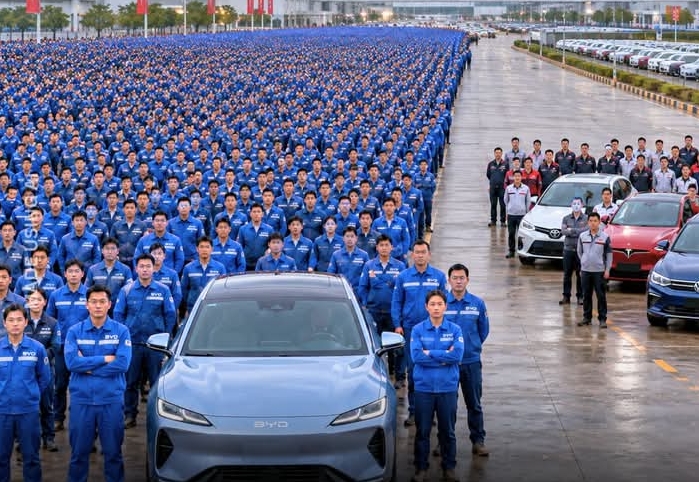
BYD Employs 1.02 Million People, More Than Toyota, Ford, GM and Tesla Combined
Chinese electric vehicle manufacturer BYD has grown its workforce to more than 1.02 million employees, surpassing the combined workforce of four major global automakers: Toyota, General Motors (GM), Ford and Tesla.

BYD Chairman Wang Chuanfu disclosed the figure on Wednesday, October 28, 2026, at the 33rd annual conference of the China Society of Automotive Engineers.

The announcement highlights the extraordinary expansion of the Chinese automaker, which reportedly added approximately 150,000 employees in the first 10 months of 2026.
According to the figures, Toyota, GM, Ford and Tesla collectively employ about 851,000 people, meaning BYD has approximately 170,000 more employees than the four companies combined.

About 960,000 BYD employees are based in China, while approximately 60,000 work overseas. The company also has up to 120,000 research and development engineers working on technologies including battery cells, electric motors, electronic controls and semiconductors.
Why BYD Has Such a Large Workforce
BYD’s enormous workforce reflects its vertically integrated business model, which involves manufacturing many of the components used in its vehicles rather than relying entirely on external suppliers.
The company produces key components, including batteries, semiconductor chips and electric motors. Its workforce also covers its electronics contract-manufacturing business, which assembles devices for other brands.
This broad business structure means BYD’s employee numbers extend beyond vehicle manufacturing alone.
However, the company’s large workforce does not necessarily translate into higher vehicle production per employee.
Available comparisons indicate that BYD produced approximately five vehicles per employee last year, compared with about 12 for Tesla and 29 for Toyota.
The difference partly reflects the wider range of businesses included in BYD’s employee count.
Workforce Expands Despite Declining Sales
The latest workforce expansion comes against the backdrop of declining vehicle sales.
BYD’s vehicle sales reportedly fell by 3.9 per cent in the first nine months of 2026, despite the company’s growing international presence.
Its overseas business, however, has recorded significant growth, with exports emerging as an increasingly important part of its global expansion strategy.
The development presents an interesting contrast: while BYD continues to expand its workforce and international operations, its domestic market faces intensifying competition.
For NewsMediang.com, the figures highlight the scale of China’s electric vehicle industry and the growing influence of BYD in the global automotive market.