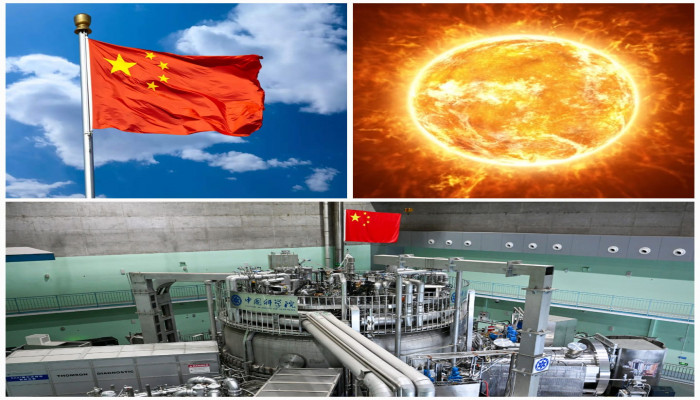

China has recorded another major milestone in its pursuit of nuclear fusion technology after scientists successfully advanced operations of its so-called “artificial sun” reactor, a project aimed at producing virtually limitless clean energy.

The Experimental Advanced Superconducting Tokamak (EAST), an experimental reactor, is designed to replicate the nuclear fusion process that powers the sun by generating enormous heat and pressure capable of fusing hydrogen atoms together to release energy.
Researchers say the breakthrough demonstrates China’s growing capability in fusion, a field widely viewed as the long-term solution to global ener,gaslimate challenges because it promises abundant energy with minimal carbon emissions and far less radioactive waste than conventional nuclear reactors.

According to Chinese scientists, the reactor achieved extremely high plasma temperatures while maintaining stable operation for extended periods — a key requirement in the global race to develop commercially viable fusion power.
Fusion differs from traditional nuclear fission used in existing power plants. Instead of splitting atoms, fusion combines light atomic nuclei, producing massive amounts of energy similar to the reactions occurring inside stars.
Experts believe that if successfully commercialised, fusion energy could revolutionise electricity generation by providing a near-unlimited supply of clean power without relying on fossil fuels.
China has invested heavily in advanced energy technologies in recent years and is increasingly positioning itself among the world leaders in fusion research alongside projects in the United States, United Kingdom, France and Japan.
The EAST reactor forms part of broader international efforts to develop practical fusion energy, including collaborations linked to the ITER project, the world’s largest experimental fusion programme currently under construction in France.
Despite the progress, scientists caution that significant engineering and economic hurdles remain before fusion power can become commercially available on a large scale. However, the latest achievement is being seen as another important step toward making clean, sustainable and virtually inexhaustible energy a reality.