EKEDC Apologises After Billing Solar-Powered Lekki Resident ₦112,606 for ‘Loss of Revenue’
Raphael Awoseyin says electricity distribution company threatened to disconnect his property over low power consumption, raises concerns about impact of solar adoption on DisCos

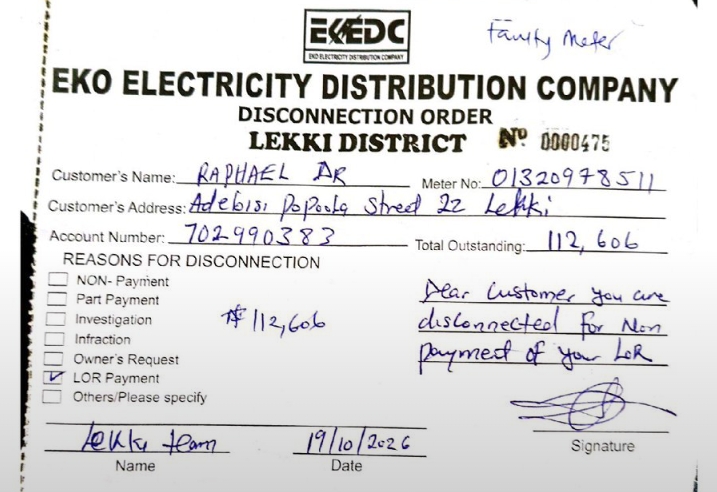
Eko Electricity Distribution Company (EKEDC) has reportedly apologised to a Lekki Phase 1 resident, Raphael Awoseyin, after the electricity distribution company allegedly demanded ₦112,606 from him for what it described as a “Loss of Revenue” (LOR) arising from his low electricity consumption.

Awoseyin, who installed an 18kW solar power system at his property, said the company’s personnel issued him a disconnection notice after questioning why his prepaid meter recorded little or no electricity consumption.
According to him, the incident occurred despite his explanation that he had substantially reduced his dependence on EKEDC’s supply by using solar energy for his daytime electricity needs.

In an account that has generated considerable public reaction, Awoseyin said the incident raises questions about how electricity distribution companies will respond as more Nigerian households invest in alternative power sources to cope with unreliable electricity supply and high tariffs.
How the Dispute Started
Narrating his experience, Awoseyin explained that installing the 18kW solar system had relegated EKEDC’s electricity supply to a backup option, which he mainly used when solar power was unavailable.
He said the change in his electricity consumption pattern was followed by more frequent visits from EKEDC personnel, who came to inspect his prepaid meter.
During one of the visits, he said, the electricity workers watched the meter to determine whether it was recording consumption.
When the meter did not register any movement, the personnel allegedly contacted him, suspecting that he had bypassed the meter.
Awoseyin said he explained that his property was being powered by solar energy and that he relied on EKEDC mainly when he needed electricity after dark.
To demonstrate that his meter was functioning, he said he switched his inverter to bypass mode for approximately two minutes, allowing his property to draw electricity directly from EKEDC.
According to him, the meter began recording consumption normally, but the personnel appeared dissatisfied with the explanation before leaving the premises.
EKEDC Demands ₦112,606
Awoseyin said the situation escalated on October 19, 2026, when three EKEDC personnel visited his property with a disconnection notice.
He explained that his last electricity token purchase was in July 2026 and that he still had sufficient units remaining on his prepaid meter.
When he questioned the proposed disconnection, he said the personnel cited “Loss of Revenue” as the reason and claimed that his low consumption suggested a faulty meter.
According to Awoseyin, the team demanded ₦112,606 as payment for the alleged revenue loss.
He maintained that his meter was not faulty and offered to have it tested to establish its condition.
However, he alleged that one of the personnel insisted that the company was losing revenue and needed to recover the money.
The incident prompted Awoseyin to accuse the company of penalising him for reducing his dependence on grid electricity through investment in solar power.
He said he was unwilling to pay the amount and initially indicated that he would lodge a formal complaint with the relevant regulatory authority if EKEDC disconnected his supply.
NERC Intervention, EKEDC Apologises
In an update following the public outcry, Awoseyin said his account of the incident, which he shared on two WhatsApp platforms, attracted widespread attention and prompted Nigerians to contact the Nigerian Electricity Regulatory Commission (NERC).
He said several people who did not know him personally forwarded the complaint to the regulator, which reportedly contacted EKEDC and demanded an explanation.
According to him, the distribution company was also inundated with complaints from members of the public seeking clarification over the incident.
Awoseyin said that within 24 hours of sharing his account, three EKEDC managers contacted him, apologised for what had happened and promised to replace his existing meter with a smart meter within a week.
He described the calls from the managers as polite and said the development gave him confidence that public pressure could help improve accountability in the electricity sector.
However, he maintained that he did not believe his existing meter was faulty.
EKEDC’s reported apology and promise to replace the meter represent a significant development in the dispute. The company’s independent account of the incident and the basis for the original ₦112,606 demand were not included in Awoseyin’s account.
Solar Adoption Raises Questions for DisCos
Beyond his personal experience, Awoseyin said the incident highlights a wider challenge facing electricity distribution companies as more Nigerians turn to solar energy to reduce their dependence on the national grid.
He argued that the combination of unreliable public electricity supply and high tariffs, particularly for Band A customers, was encouraging households and businesses to invest in alternative power systems.
According to him, the EKEDC personnel appeared to have assumed that a meter recording little or no consumption while electrical appliances were in use indicated either meter bypass or a technical fault.
He said the possibility that the customer was using an independent electricity source, such as solar power, did not appear to have been considered.
Awoseyin urged electricity distribution companies to sensitise their field personnel to the growing use of alternative energy systems and develop appropriate procedures for inspecting properties where grid consumption has declined significantly.
He suggested that DisCos could introduce periodic verification exercises to establish whether meters were functioning properly and whether customers were legitimately relying on alternative power sources.
As an example, he said an inspector could observe a brief switch from solar power to grid electricity to confirm that a functioning meter records consumption.
Such checks, he argued, would help distinguish genuine low consumption from meter faults or electricity theft.
Any such verification, however, would need to follow applicable regulatory requirements and respect customers’ rights.
Industrial Customers, Band A Consumers and the Future of DisCos
Awoseyin also raised concerns about the long-term sustainability of the electricity distribution business in Nigeria.
He argued that in many electricity markets, industrial consumers provide an important revenue base that helps support the wider power sector, including electricity supplied to households.
In Nigeria, however, he observed that many large industries have invested in their own power generation because of the limitations of public electricity supply.
This, he argued, leaves distribution companies increasingly dependent on residential consumers, including Band A customers who pay higher tariffs for electricity supply.
Awoseyin noted that these customers are often better positioned financially to invest in solar panels, inverters and battery storage systems capable of significantly reducing their dependence on the grid.
If the trend continues, he warned, distribution companies could face declining electricity sales and increasing pressure on their revenue.
He therefore called on DisCos to rethink their existing business models rather than depend exclusively on electricity allocated to them from the national grid.
According to him, the rapid adoption of solar energy presents a challenge that the electricity distribution industry must confront through innovation and new approaches to service delivery.
A Wider Electricity Sector Challenge
The controversy comes amid growing interest in alternative energy solutions by Nigerian households and businesses seeking more reliable electricity and greater control over their energy costs.
While solar power can reduce a customer’s purchases from the grid, low consumption alone does not establish that a meter is faulty or that electricity has been illegally diverted.
Similarly, a distribution company’s revenue concerns do not, by themselves, establish that an individual customer owes a specific amount. Any demand for payment should have a clear basis that can be explained and verified.
Awoseyin’s experience has consequently raised questions about how electricity distribution companies can protect their commercial interests while accommodating customers who invest in alternative sources of power.
For him, the central lesson is that Nigeria’s electricity market must adapt to changing consumer behaviour.
He thanked the Nigerians who shared his account and contacted the regulator, describing their intervention as evidence that public participation can help make the country better.
The incident also leaves an important question for the industry: as more customers generate their own electricity, what changes must distribution companies make to remain financially viable without unfairly penalising consumers for using less grid power?