Iran–U.S.: Three Carriers, Fifty Jets, and a Nuclear Deadline; Washington Loads the Gun While Talking Peace


The United States has surged more than 50 fighter jets into the Middle East within 24 hours, according to Axios, citing a U.S. official. This does not appear to be routine rotation. It looks like positioning.

Independent flight trackers observed waves of F-16s, F-22s, and F-35s moving toward the region, quietly expanding Washington’s airpower footprint near Iran.
And yet, indirect negotiations between Washington and Tehran are ongoing.
A U.S. official told The Jerusalem Post that recent talks in Geneva made “progress,” but acknowledged that key details remain unresolved. Iran reportedly told U.S. intermediaries it would return within two weeks with detailed proposals aimed at narrowing remaining gaps.
“There were good meetings,” the official said. “But the gaps are still wide. There’s still a lot of work to be done.”
Diplomacy remains alive — but fragile.
The Carrier Surge: USS Gerald R. Ford Enters the Theater
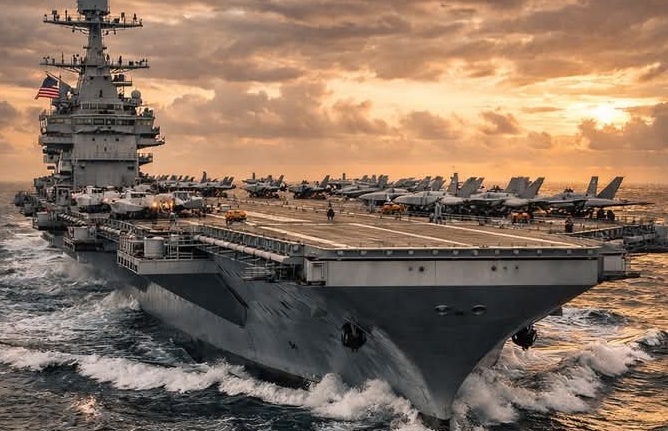
Washington has now ordered the deployment of the USS Gerald R. Ford, the largest aircraft carrier in the U.S. fleet, to the Middle East.
The carrier and its escorts had been operating in the Caribbean. Four U.S. officials confirmed they were informed of the redeployment late last week.
Meanwhile, the USS Abraham Lincoln and other naval and air assets were already positioned in the region earlier this year.
This is not symbolic deterrence.
It is layered strike capability — carrier aviation, cruise missiles, and fifth-generation aircraft operating within coordinated reach.
According to defense reporting, a potential U.S. strike sequence would likely follow a familiar pattern:
1. Initial salvos of Tomahawk cruise missiles targeting command nodes, radar systems, and air defense sites.
2. Follow-on waves of fighter aircraft to exploit degraded defenses.
The central question:
How resilient is Iran’s rebuilt air defense network?
Iran’s Air Defense Reset — China Steps In
Following the mid-2025 conflict with Israel, which reportedly degraded portions of Iran’s long-range air defense architecture, Tehran accelerated efforts to rebuild. This time, it turned decisively toward Beijing.
HQ-9B (FD-2000B)
Often described as Iran’s new flagship long-range surface-to-air system:
Estimated range: 250–300 km
Speed: reportedly above Mach 4
AESA radar with 360-degree coverage
Cold-launch system
Designed to intercept aircraft, cruise missiles, and ballistic missiles
Analysts suggest its radar and electronics architecture may outperform older Russian S-300 variants it is replacing.
Additional Systems
HQ-16: Medium-range interceptor reportedly capable against tactical ballistic threats.
HQ-22 (FK-3): Medium-to-long-range system with reported reach up to 170 km.
YLC-8B and JY-27A radars: Chinese long-range surveillance systems designed to improve detection of low-observable aircraft such as the F-35.
Iran continues to operate legacy systems like the HQ-2 (a Chinese derivative of the Soviet S-75), while maintaining indigenous platforms such as the Bavar-373.
The result is a heterogeneous, layered air defense environment — mixing Chinese, Russian, and domestic systems — specifically designed to complicate Western electronic warfare and targeting.
Strategic Undercurrents
Several dynamics elevate the stakes:
Defense Diversification
Tehran appears intent on reducing reliance on Moscow after Russia did not immediately replenish damaged systems in 2025.
Payment in Oil
Iran is widely believed to offset Chinese defense acquisitions through energy shipments.
Technology Integration
Recovered drone and missile components in recent conflicts reportedly revealed Chinese-origin microelectronics and AI-assisted targeting elements.
For Beijing, any future Iran-Israel or Iran-U.S. confrontation could serve as a real-world testing ground for anti-stealth radar performance.
The Maritime Factor: YJ-12
Another variable is the potential acquisition of the Chinese YJ-12 anti-ship missile — a high-speed, ramjet-powered system often labeled a “carrier-killer.”
If integrated into Iran’s arsenal, it would strengthen maritime area-denial capabilities in the Persian Gulf and surrounding waters. Tehran has previously reverse-engineered foreign systems, as it did with the C-802 missile, later fielded domestically as the Noor.
Such capabilities would complicate U.S. naval freedom of maneuver in confined maritime corridors.
The Paradox
While Tehran promises to return within two weeks with detailed nuclear proposals, Washington is assembling:
More than 50 additional fighter aircraft
Multiple carrier strike groups
Immediate cruise-missile strike capacity
Negotiations continue.
Force posture intensifies.
Diplomacy and deterrence are now operating on parallel tracks — and either can collapse first.
The coming two weeks are not just about nuclear proposals.
They are about whether deterrence holds — or ignition begins.