Editorial content Newsmediang

399 Rifles at Tin Can Port: Customs Seized the Guns — Now, Who Imported Them?

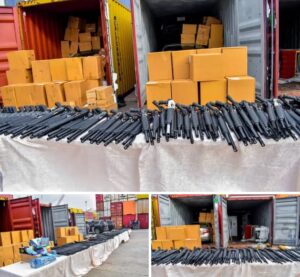
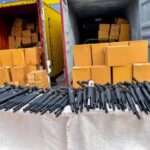
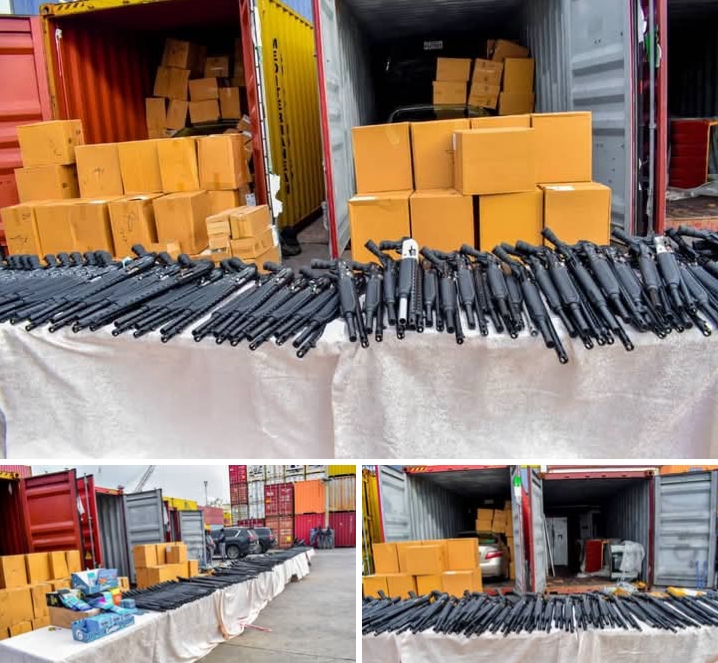
The discovery of 399 fully assembled Jojef rifles and a large quantity of firearm components at the Tin Can Island Port in Lagos is not merely another seizure by the Nigeria Customs Service. It is a major national security incident that demands a thorough investigation into who imported the weapons, who financed the shipment, who cleared it, and where it was ultimately destined.
The Nigeria Customs Service deserves commendation for intercepting the shipment and completing the examination of the seized container. But the seizure itself should not mark the end of the matter. It should be the beginning of a deeper investigation.

The critical question Nigerians are entitled to ask is simple: Who imported the rifles into Nigeria?
The public needs to know the identity of the importer or importing entity, the name of the consignee, the shipping agent, the clearing agent and the declared contents of the container. Investigators must establish where the shipment originated, who supplied the firearms, who paid for them and who was expected to receive them in Nigeria.
More importantly, authorities should determine how a shipment containing hundreds of rifles and numerous firearm components was able to enter the country’s importation and shipping chain in the first place.
Were the firearms properly declared? If not, what was declared on the import documents? Were false descriptions, forged documentation or front companies used to conceal the nature of the cargo?
There are also legitimate questions surrounding the entire logistics chain.
Who owns the container? Who booked the shipment? Who handled the documentation? Who was the consignee? Which clearing agent was responsible? What port and customs records exist? Were there previous shipments linked to the same importer or associated companies?
These questions must be answered through evidence, not speculation.
The Customs Comptroller-General, Adewale Adeniyi, has warned that criminal networks could attempt to exploit Nigeria’s borders, ports and airports ahead of the next election cycle. That warning makes the Tin Can seizure even more significant.
The discovery of 399 rifles in a single shipment raises the possibility that this was not an isolated act by an individual smuggler. Investigators should therefore examine whether the shipment is connected to a wider arms-trafficking network operating across Nigeria or beyond the country’s borders.
The investigation should extend beyond the immediate importer.
The Nigeria Customs Service, Nigeria Police Force, National Centre for the Control of Small Arms and Light Weapons, Department of State Services and other relevant security and financial intelligence agencies should work together to establish the complete chain of ownership and financing.
Financial investigations are particularly important. Authorities should follow the money behind the shipment, examine the companies involved, trace payments and identify individuals or organisations that may have financed the procurement or transportation of the weapons.
The seized rifles should also be subjected to proper forensic examination. Serial numbers, markings and other identifying features could provide valuable intelligence about their origin, previous ownership and possible links to other arms seizures or criminal investigations.
Nigeria must also resist the temptation to treat the case as concluded simply because the weapons have been seized.
Seizing the guns is only half the job. Finding the people behind the guns is the real test.
If an importer knowingly brought prohibited firearms into Nigeria, that person or entity must face the full force of the law. If criminal networks were involved, their financiers, facilitators, transporters and intended recipients must all be identified and prosecuted.
At the same time, if the investigation reveals failures or deliberate compromises within the importation, port, customs or clearance processes, those responsible must also be held accountable, regardless of their position.
The public deserves transparency.
The authorities should, at the appropriate stage of the investigation, provide Nigerians with credible information about the importer, the origin of the shipment, the intended destination and the outcome of the investigation—while protecting sensitive intelligence that could compromise ongoing operations.
With Nigeria approaching another major election cycle, the stakes are particularly high. Illegal firearms can fuel political violence, criminality, banditry and communal conflicts.
This is therefore bigger than a Customs seizure.
It is a test of Nigeria’s capacity to trace illegal weapons from the port to the people behind them.
NewsMediaNG calls on the relevant security and law-enforcement agencies to launch a comprehensive investigation into the 399 Jojef rifles seized at Tin Can Island Port, identify the importer and intended recipients, trace the financial and logistical networks behind the shipment, and ensure that every person found culpable is brought to justice.
The question Nigerians are asking is not only: “Where are the 399 rifles?”
The bigger question is: “Who brought them into Nigeria—and who were they meant for?”
Nigeria deserves an answer.