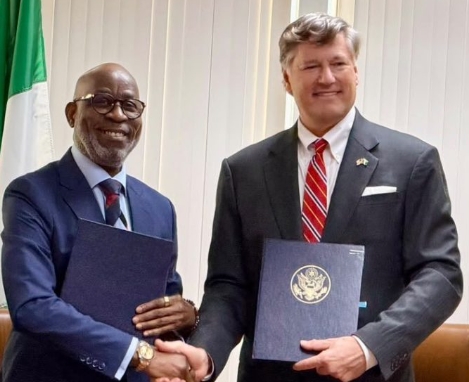
Nigeria, U.S. Sign Deal to Unlock $700bn Mineral Resources
Nigeria and the United States have signed a framework agreement aimed at attracting American investment into Nigeria’s solid minerals sector and unlocking the country’s estimated $700 billion mineral resource base.

The agreement was signed in New York by Nigeria’s Minister of Solid Minerals Development, Dele Alake, and U.S. Deputy Secretary of State Christopher Landau, on the sidelines of the 81st United Nations General Assembly.

The framework covers geological data and exploration, mineral development and processing, infrastructure development and technical capacity building, with the objective of identifying viable projects and facilitating partnerships between Nigerian and U.S. businesses.
Alake said the agreement represents a shift from Nigeria’s traditional role as an exporter of raw minerals, stressing that the government wants more processing and value addition to take place within the country.

“Nigeria cannot remain a source of raw materials while others capture most of the value,” Alake said.
He said the partnership is expected to support local processing, job creation, skills development and opportunities for Nigerian businesses.
Nigeria’s mineral wealth includes deposits of lithium, gold, tin, gemstones, iron ore and phosphate, among others. The government has been seeking to diversify the economy away from oil while attracting investment into the largely underdeveloped mining sector.
The agreement does not itself transfer ownership or grant the U.S. unrestricted access to Nigeria’s entire $700 billion mineral resource base. Rather, it establishes a framework for cooperation and investment, with specific projects and commercial partnerships expected to follow.
U.S. officials described Nigeria as an important regional partner, while the agreement comes amid Washington’s broader effort to diversify supplies of critical minerals used in technologies including electric-vehicle batteries and renewable-energy infrastructure.
NewsMediaNG reports that the deal could mark a significant development in Nigeria’s push to convert its largely untapped mineral deposits into domestic industrial activity, but its economic impact will depend on how quickly the framework translates into actual mining projects, processing facilities, investment and jobs.