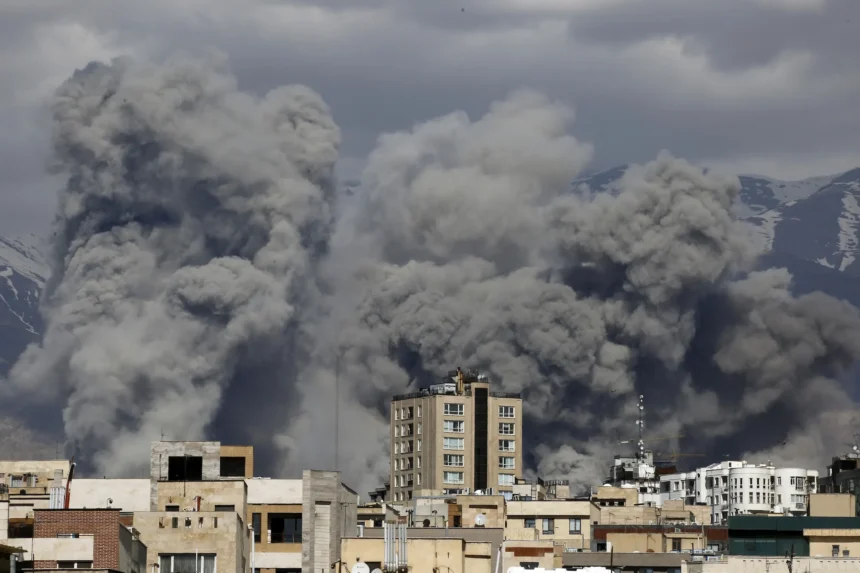

Iran has vowed a “crushing response” after the United States launched a new wave of military strikes on Iranian targets, marking a sharp escalation in tensions in the Middle East.

According to the U.S. Central Command (CENTCOM), American forces carried out coordinated strikes on more than 80 Iranian military targets, including air defence systems, command-and-control facilities, coastal radar installations, anti-ship missile sites and over 60 Islamic Revolutionary Guard Corps (IRGC) boats. Washington said the operation was in retaliation for Iranian attacks on commercial vessels transiting the Strait of Hormuz.

In response, Iran’s Khatam al-Anbiya Central Headquarters condemned the strikes as a “blatant act of aggression,” warning that its armed forces would deliver a “crushing response.” The military command also declared that it would not tolerate U.S. interference in the Strait of Hormuz, insisting that commercial shipping must adhere to the routes set by Iran.
More Than 150 IRGC Operators Killed in Overnight U.S. Strikes on Iran
The unconfirmed report says that more than 150 Islamic Revolutionary Guard Corps (IRGC) personnel were reportedly killed in overnight U.S. strikes targeting around 80 sites across Iran, according to claims circulating after the operation.
The casualties allegedly include senior IRGC officers, defense personnel, and military operators involved in Iran’s security and missile networks.
However, Iran was said to have launched massive attacks on Bahrain using missiles and drones. Most of these were intercepted and destroyed in mid-air, although there are reports of strikes in some areas. The IRGC claims that US bases were their targets, but reports indicate that civilian infrastructure was struck
The latest exchange has heightened fears of a wider regional conflict, with the Strait of Hormuz—through which a significant share of the world’s oil exports passes—remaining at the centre of the confrontation.
Global energy markets are closely monitoring developments as concerns grow over possible disruptions to international shipping.