US Major News Networks Suspend White House Coverage as Trump Bans CNN, MS NOW, Politico
Major US TV networks halt presidential pool coverage as media organisations challenge Trump administration in federal court


NewsMedianG
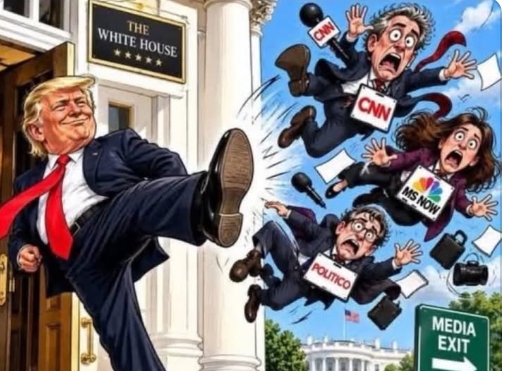
A fresh confrontation between US President Donald Trump and the American media has escalated into a courtroom battle after the White House barred CNN, MS NOW and Politico from its premises, prompting the three news organisations to challenge the decision in federal court.

The dispute intensified on Monday when major television networks — including ABC, CBS, Fox News and NBC — suspended their shared television pool coverage of Trump’s presidential events.
The development has triggered a wider debate over press access, presidential authority and the constitutional protections afforded to journalists covering the US government.
CNN, MS NOW and Politico filed their lawsuit in the US District Court in Washington, alleging that the White House violated their First Amendment rights to freedom of the press and Fifth Amendment due-process protections.
The organisations are seeking an expedited hearing and an order restoring their access to the White House.
Trump: ‘Fake News’ Behind the Ban
Trump announced the ban on Friday through his Truth Social account, accusing CNN, MS NOW and Politico of repeatedly publishing what he described as “fake news.”
He subsequently defended the decision, arguing that the White House was not attacking the free press but was instead taking action against what he characterised as false reporting.
Trump has also suggested that other media organisations could face similar restrictions.
The White House has maintained that access to the presidential complex is a privilege rather than an unconditional right.
Vice President JD Vance similarly defended the administration, arguing that Trump was not banning media organisations from existence but was refusing what he described as “special access” to outlets whose reporting the administration considers problematic.
Media Outlets: Government Cannot Punish Critical Reporting
CNN, MS NOW and Politico have rejected the administration’s justification.
In their legal challenge, the organisations argue that their credentials were revoked because the White House objected to their journalism.
They contend that allowing the government to determine which news organisations receive access based on the content of their reporting would undermine independent journalism and constitutional press protections.
The organisations have asked the court to intervene immediately while the broader legal case proceeds.
Fox News, ABC, CBS and NBC Join Coverage Suspension
The legal battle was followed by an unusual development inside the White House television press pool.
The pool — comprising CNN, Fox News, ABC News, CBS News and NBC News — normally rotates responsibility for providing camera coverage of presidential events.
The designated network records the event and distributes the footage to other news organisations, reducing the cost and logistical burden of having multiple television crews competing for limited space.
CNN was scheduled to provide pool coverage of Trump’s departure from the White House and his visit to New York for the United Nations General Assembly.
But after CNN was removed from its scheduled role, the remaining networks decided not to replace it.
Fox News Washington Bureau Chief Bryan Boughton, who chairs the rotating pool, informed journalists that the television pool would suspend coverage of presidential events and that no replacement pool would be established.
Pool coverage of Congress and selected other government activities was not affected.
Networks: Public Deserves Independent Information
In a joint statement, the five television networks said the American public has a significant interest in receiving accurate and independent information about government activities.
The networks argued that news organisations should not be restricted because the administration disagrees with their reporting.
The coordinated decision effectively left the White House without the usual shared television coverage system for presidential events.
The White House subsequently promoted its own video coverage of Trump’s activities, further intensifying the dispute over who controls the images and information coming from presidential events.
Court Battle Takes Centre Stage
The lawsuit has now placed the dispute before the US judiciary.
The case was assigned to US District Judge Timothy Kelly, a Trump appointee who previously handled a legal battle involving CNN correspondent Jim Acosta’s White House press credentials during Trump’s first administration.
In that earlier case, Kelly granted CNN a temporary restraining order, after which Acosta’s access was restored.
Trump has since criticised Kelly’s involvement in the latest case, signalling that the administration is prepared to continue the legal fight if the initial ruling goes against it.
A hearing on the media organisations’ request for emergency relief is expected this week.
A Bigger Fight Over Press Freedom
The dispute is larger than the three news organisations involved.
At its core is a constitutional question over whether a presidential administration can restrict a media organisation’s access to the White House because it objects to the organisation’s reporting.
The Trump administration says it is responding to what it considers inaccurate and harmful journalism.
The affected news organisations, press advocates and other media groups argue that government access should not be used as a tool to punish unfavourable reporting.
The White House Correspondents’ Association has called for the affected reporters’ access to be restored, stressing the importance of an independent press being able to scrutinise government officials regardless of whether those officials approve of the coverage.
The legal proceedings are therefore likely to have implications beyond CNN, MS NOW and Politico, particularly for how future administrations manage press access and relations with news organisations.
Trump-Media Feud Enters Another Chapter
Trump has had a long-running and often confrontational relationship with major US news organisations, frequently accusing sections of the media of unfair or inaccurate coverage.
The latest confrontation, however, has moved the dispute beyond political rhetoric.
With three major news organisations now in court, major television networks suspending their shared presidential coverage and the White House providing its own media feed, the battle has become an institutional dispute over access, journalism and constitutional protections.
The courts will now have to examine the legal arguments surrounding the administration’s decision.
Until then, the central question remains: where should the line be drawn between a government’s control of access to its facilities and the media’s responsibility — and constitutional right — to independently scrutinise those in power?
NewsMediaNG will continue to monitor the legal battle and its implications for press freedom and government accountability.