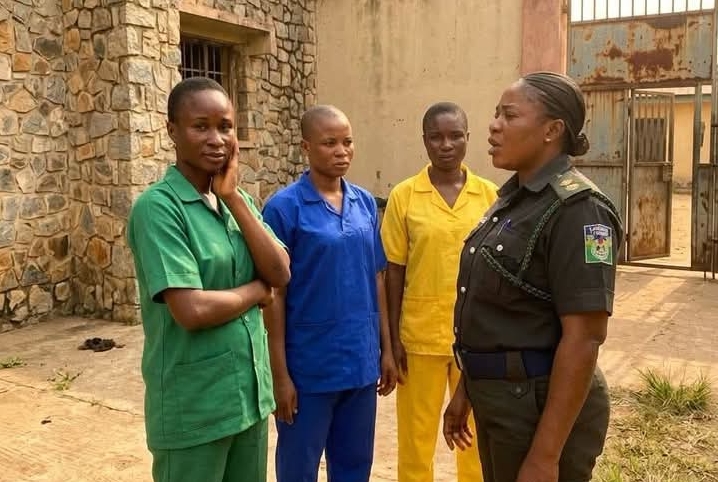
Why Nigerian Prisoners Wear Green, Blue and Other Colours
By NewsMediaNG
Have you ever noticed that inmates in Nigerian correctional facilities sometimes wear different colours of uniforms, particularly green and blue, and wondered what the colours mean?

The difference is not simply a matter of fashion or personal preference.

In correctional facilities, uniforms can serve practical purposes, including helping authorities distinguish between different categories of inmates. In Nigeria, green and blue have commonly been associated with different custody statuses.
What does the green uniform mean?
Green is generally associated with awaiting-trial or remand inmates—people held in custody while their cases are still before the courts.

An awaiting-trial inmate may have been arrested and charged with an offence but has not yet been convicted by a court.
This distinction is important because being detained in a correctional facility does not automatically mean that a person has been found guilty.
A person wearing a green uniform could therefore be someone whose trial is ongoing, someone who has not yet been convicted, or someone otherwise held on remand pursuant to a court order.
What about the blue uniform?
Blue is generally associated with convicted inmates.
In other words, the commonly cited distinction is that convicted inmates wear blue, while awaiting-trial inmates wear green.
The colour coding allows correctional authorities to identify inmate categories more easily and can assist with administration, movement and security within correctional facilities.
However, uniform practices can vary between facilities and jurisdictions, so the colours should not be treated as an infallible legal classification in every circumstance.
Why is the distinction important?
The distinction between an awaiting-trial inmate and a convicted prisoner is more than just a difference in uniform colour.
Under the principle of the presumption of innocence, a person accused of a crime is considered innocent until proven guilty according to law.
This means that someone who has been arrested, charged and remanded in custody should not automatically be described as a criminal or convicted prisoner.
Some people spend considerable periods in custody while waiting for their cases to be heard or concluded.
Consequently, seeing someone in a correctional facility does not, by itself, establish that the person has been convicted of an offence.
Why do correctional facilities use different colours?
Colour-coded uniforms can make it easier for correctional officers to identify different groups of inmates at a glance.
They can also contribute to security and effective management within correctional facilities, particularly where large numbers of inmates are being held.
Uniforms additionally help distinguish inmates from correctional officers and other personnel working within the facility.
What about yellow uniforms?
Different countries and correctional systems use different uniform colours.
In some jurisdictions outside Nigeria, yellow or other colours may be used for particular inmate categories, security classifications or institutional purposes.
Therefore, the meaning attached to a particular colour depends on the correctional system in which it is being used.
The bigger lesson
The next time you see inmates wearing different colours in a correctional facility, it is important not to assume that the difference is merely about appearance.
There may be an administrative and legal distinction behind the colours.
Most importantly, custody and conviction are not the same thing.
An inmate awaiting trial remains an accused person whose case is yet to be determined by a competent court. A convicted inmate, on the other hand, is a person who has been found guilty through the judicial process.
So, while green and blue may commonly be used to distinguish awaiting-trial and convicted inmates in Nigeria, the colour of an inmate’s uniform should not replace the legal facts of the individual’s case.
Law is emotionless.
— Emmanuella Chinenye Ogwale
NewsMediaNG